3. Bond markets: beware of shark-infested waters

Currently reading

3. The emergence of the Middle Powers: The new map of risk and opportunity

Macro and Policy

2 min read

3. The emergence of the Middle Powers: The new map of risk and opportunity

Key takeaways

  • The era of easy global cooperation is fading; geopolitical risk is structurally higher than during much of the post-Cold War period.
  • The influence of the United States and China as the "superpowers" has polarised the world and traditional powers are in danger of losing their relevance.
  • These middle powers could be increasingly central to how geopolitical risks are managed – or mismanaged.

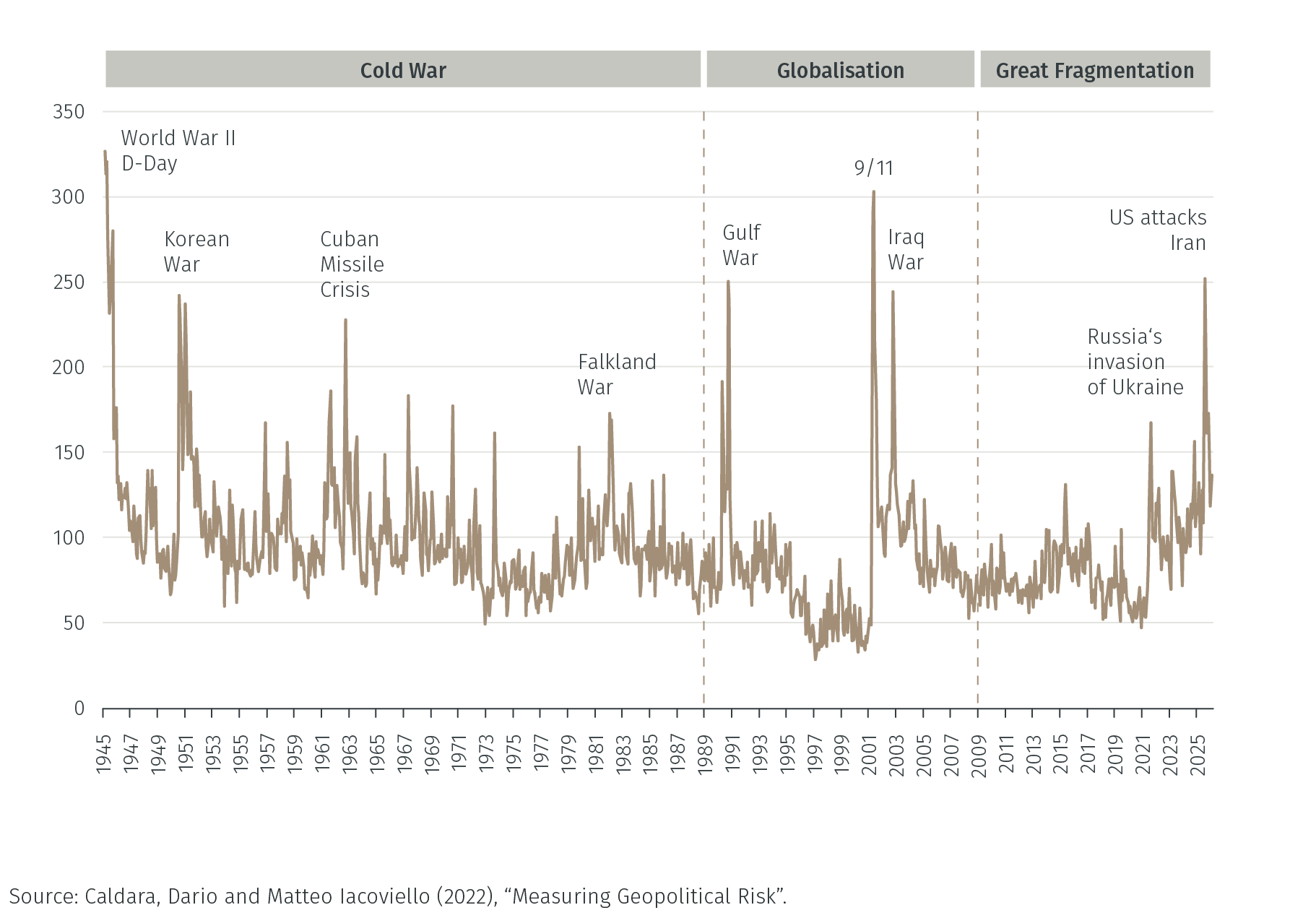
Over the past 80 years, the geopolitical timeline can be divided into three phases that reshaped global trade, security and economic prosperity. We now seem to be entering a fourth phase in the post‑war geopolitical order, in which geopolitical risk has risen above Cold War levels. Military spending is higher, populism has spread and the role of multilateral institutions has weakened.

The US and China remain as the world's two superpowers, but their alliances globally are at risk given their domestic policy agendas. Traditional powers such as Germany, France, and the UK have seen their economic influence diminish (Figure 8) and from a world order perspective have become heavily reliant on institutions like NATO – institutions that are themselves becoming increasingly contested.

This combination of inward-looking superpowers and weaker multilateralism has opened space for a new group of middle power states.

Figure 7. Geopolitical Risk Index

02_EFG_Outlook_2027_EN_Charts_Website__Figure7_Source.png

The rise of the middle powers – “if not at the table, on the menu”
The World Economic Forum defines middle powers as influential states that sit below high powers but which are helping to shape a new multilateralism to address global challenges. In a world in which superpowers are contested and traditional powers constrained, these middle powers are becoming central to the management – or mismanagement – of geopolitical risks.

The emerging middle powers share the following three characteristics:

  • Multi‑alignment: They maintain ties with several powers rather than binding themselves exclusively to one. Increasingly, the UK and several European nations fall into this camp.
  • Coalition‑building: They form flexible coalitions and support international institutions to shape global norms.
  • Industrial and regional strength: They possess meaningful industrial capacity and strong regional agency.

Countries such as Australia, Canada, South Korea, Norway, Brazil, Indonesia, India, Turkey and Saudi Arabia fit this description.

At Davos in January 2026, Canada’s Prime Minister Mark Carney captured the mood: “The middle powers must act together, because if we are not at the table, we are on the menu.” His warning reflects growing economic coercion by superpowers and the growing risk that "traditional powers" could be forced into binary choices between China and the US. In this environment, middle powers are potential counterweights to coercive rivalry rather than passive observers.

Trade as a weapon – and the middle‑power response
Over the last two decades, superpowers have increasingly used economic leverage to achieve political goals. Trade, technology and finance have been weaponised through sanctions, tariffs, export controls and access restrictions.

China has used threats to cut off rare earth exports and influence via the Belt and Road Initiative to extend its geopolitical reach.

The US has pressured governments and firms to avoid Chinese 5G technology and has used tariff threats and sanctions to secure more favourable trade and security arrangements.

Middle powers and traditional powers have strong incentives to cooperate with each other to counter these pressures, deepen trade links and reduce dependence on any single superpower. In recent years, they have created new trade frameworks to bypass stalled multilateral organisations. Trade between developing nations (South–South) has more than doubled, rising from just over 15% of global goods trade in 2005 to 28% in 2025, reflecting deeper regional integration and lower dependence on traditional partners.

Examples include:

  •  Economic cooperation between Australia and India.
  • Trade agreements between Southeast Asian economies and Gulf states.
  • Latin American countries strengthening commercial ties with Asia and Oceania through the Trans‑Pacific Partnership.

Game theory suggests that a fractured global economy, where each country acts alone, leads to a non‑cooperative equilibrium that leaves everyone poorer and more vulnerable. Middle powers such as Canada and Australia are instead seeking to de‑risk supply chains through diversification and strategic partnerships, turning reliability into diplomatic leverage.

Their multi‑alignment, industrial capacity and regional agency position them uniquely to mitigate geopolitical risks. If they can coordinate effectively, renew forms of multilateralism and resist economic coercion, they may help stabilise a fragmented system and support a more coordinated global order.

For investors, the rise of middle powers is not just a political theme but a structural lens for assessing risk and opportunity in 2027. Understanding how these countries navigate superpower rivalry, regional conflicts and technological competition will be critical to judging their market opportunities and risks.

Regional test cases for middle power dynamics

Latin America: middle powers under superpower pressure
Latin America illustrates how superpower competition interacts with middle power dynamics. Aside from Colombia and Ecuador, where the US remains the main trading partner, China is now the principal export destination for most of South America. Yet since the return of President Trump to the White House, many countries have shifted their political alignment back towards the US.

The Trump administration has intensified efforts to assert US influence in the Americas, using economic coercion to discourage governments from deepening ties with China. This has put Latin American middle powers under pressure to choose between Washington and Beijing, challenging their ability to remain multi aligned.

At the same time, since 2023 South America has seen a political swing towards right-wing governments in countries such as Argentina, Bolivia, Ecuador, Paraguay, Chile, Peru and Colombia. This shift raises a key question: can Latin American middle powers maintain their regional agency and diversified partnerships, or will they be drawn into more binary alignments that increase vulnerability to external pressure?

For investors, Latin America is a test case of whether middle powers can balance economic opportunities from China with security and political ties to the US, while preserving domestic stability and credible institutions.

Europe: cohesion at risk, middle powers more important
Europe’s internal cohesion is also being tested. After the recent snap election in Spain, three of the largest eurozone economies will go to the polls in 2027: Germany and France will hold presidential elections in January and April respectively, while Italy will hold general elections before September.

Right‑wing parties have risen in the polls by tapping into public anger over job prospects and immigration. The victory of Alternative for Germany (AfD) in local elections and rising support for Marine Le Pen in France are both signs of this trend. Fragmentation among centrist parties and the rise of more extreme forces could weaken cohesion among key EU members. Parties leading in the polls are campaigning on tighter immigration rules, reduced EU powers and lower financial contributions.

A less cohesive EU would not only undermine Europe’s ability to act as a unified traditional power, but also increase the importance of middle powers – both within Europe and globally – in sustaining effective multilateral cooperation.

For investors, this means paying close attention to European countries that combine strong institutions with pragmatic regional engagement, and to how EU politics affect the broader balance between superpowers and middle powers.

China: tech supremacy and pressure on middle powers
China will hold the National Congress of the Chinese Communist Party (CCP) later in 2027, an event that takes place every five years. Analysts expect a significant leadership reshuffle, with more than two thirds of the Central Committee and the Politburo Standing Committee being replaced. China will seek to project political continuity, social stability and clarity on economic policy.

“ ...can Latin American middle powers maintain their regional agency and diversified partnerships... ”

Externally, China is expected to shift some pressure away from Taiwan itself and focus more on coercion towards countries that support Taiwan, such as Japan, the Philippines and Australia. At the same time, China sees an opportunity to consolidate its technological power. Its drive for tech supremacy will centre on boosting production capacity. With domestic demand less able to absorb this output, China will continue to expand exports and build alliances in other markets.

These relationships will further entangle middle powers in the global competition for technological leadership. Countries that trade heavily with China in advanced technologies will need to balance economic gains against security concerns and potential pressure from the US.

For investors, this underscores the importance of understanding how middle powers position themselves in emerging tech blocs and how they manage the risks of being caught between competing regulatory and security regimes.

Our view for 2027

As Alfred, Lord Tennyson wrote, “The old order changeth, yielding place to new.” The words resonate strongly today. Geopolitical change is constant, but there are moments when the pace accelerates, established relationships are tested and new alliances reshape the global landscape. We are living through such a period, with profound implications for markets, economies and investment strategies.

For an investor, the rise of middle powers is a practical portfolio lens, not just a political story. Countries that can maintain multi‑alignment, invest in technology and defence, and manage their regional relationships thoughtfully are more likely to offer stable environments for capital over the next decade. This argues for favouring economies that trade with both Washington and Beijing, have credible institutions and are investing in their own security and technological capabilities – while remaining realistic about the risks of policy swings and external pressure.

It also means treating geopolitical risk as a permanent design feature of portfolios, rather than something to trade around individual headlines. In a world shaped increasingly by middle powers, resilience will depend on understanding not only the superpowers, but also the countries that are “at the table” – and determined not to be “on the menu.”

For you as an investor, the message from Theme 3 is to be deliberate about where you take country and sector risk, favouring resilient middle‑power economies that balance US and China ties, invest in security and technology, and build structural geopolitical resilience into your portfolio. The points below translate this into concrete portfolio actions for the year ahead.

Action for investors:

  • Favour specific economies but test their resilience. Countries that keep trading and that maintain diplomatic ties with both Washington and Beijing are better placed to absorb shocks.
  • Position for higher defence and security spending. Rising military budgets and heightened geopolitical risk should support defence, cybersecurity and related industries, but keep exposure diversified.
  • Watch for China’s 2027 Party Congress. This will signal the direction of industrial policy, export strategy and technology priorities, and should be treated as a reference point for China allocation.

Richiesto

Richiesto

Richiesto

Richiesto

Richiesto

Richiesto

Richiesto

Please note you can manage your subscriptions by visiting the Preferences link in the emails you receive from us.

Richiesto