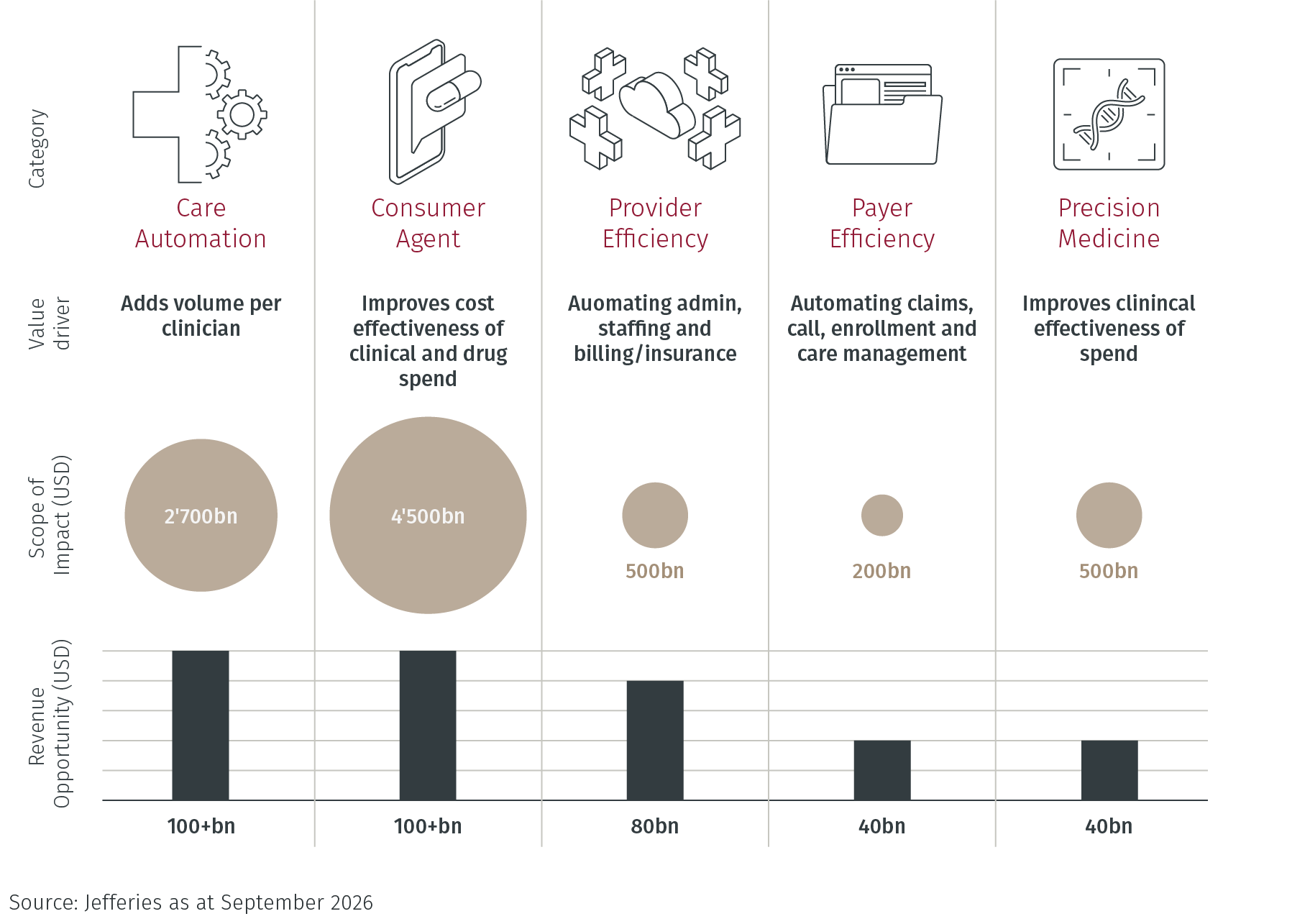
By 2027, the primary impact of AI will be felt in two high-stakes areas: it will sharply shorten research and development cycles in biotechnology and be used to automate healthcare administration at scale, for which $300 billion to $600 billion in potential annual revenue is at stake for automation leaders.
While AI drug discovery remains at an early stage, administrative AI is already delivering measurable margin improvements, with some organisations reporting a 40% reduction in administrative costs. This transition is being catalysed by changes in the regulatory environment, including the Food and Drug Administration’s (FDA) new frameworks for generative medical devices and the Centers for Medicare and Medicaid Services (CMS) shift towards outcome-based reimbursement.
To explain this further, a generative medical device can be used to analyse medical images, interpret medical information, generate summaries or recommendations for doctors, and help to develop software that assists with diagnosis or treatment plans. The FDA has been developing and refining its approaches to AI-enabled medical devices, so those being developed will have to meet regulatory standards.
Meanwhile, the CMS, which oversees the major US public healthcare programmes, is moving from paying for a service, such as consultation, scan or procedure, towards linking payment to the quality of care and improvement in the patient’s health. So, AI health technology will need to deliver measurable improvements.
The dominant disruptor
The integration of AI into US biotechnology and healthcare administration has reached a critical inflection point, shifting from speculative innovation to a primary driver of operating profit. By 2027, AI is projected to be the dominant force disrupting US healthcare, moving beyond simple chatbots that assist with individual tasks to agentic AI systems (software that can plan and carry out multi-step tasks with limited human input) that coordinate clinical care and link computational drug discovery with physical drug validation.
The core view is that as AI models become more widely accessible, the competitive advantage will depend increasingly on the depth and scale of companies’ own proprietary data, their ability to integrate AI into core workflows, and their capacity to translate these capabilities into commercial value.