Officials cited a reported jailbreak that could unlock Mythos’s hacking capabilities. Access was restored on 1 July, following closer coordination with Anthropic on frontier capabilities and on evidence of safeguard effectiveness.
This episode represented a marked shift in government attitudes towards AI as AI was now seen as not just ordinary software but something closer to a potential weapon requiring much tighter oversight and regulation. The US is walking a fine line, wanting rapid AI development while keeping control of capabilities with national-security implications.
A broadly fragmented regulatory landscape
Beyond the security sector, AI regulation in the US remains a patchwork. The strongest opposition has not come from Washington but from state governors and town halls. Local concerns focus on power prices, land use by data centres and noise pollution, with county- and state-level moratoriums and project reviews gaining meaningful traction.
At the federal level, the focus has largely been on staying ahead of China, with export controls on semiconductors and semiconductor equipment as Washington’s main tool to delay Chinese progress. Domestically, the administration favours a light touch and has sought to override state AI laws in favour of one national framework. With AI a top voter issue, policy will come into sharper focus as the 2028 presidential race approaches.
The White House Accord on Super Intelligence
On 29 September, President Trump and the leaders of six frontier AI developers (Google, Anthropic, Meta, OpenAI, xAI and Nvidia) signed the White House Accord on Super Intelligence. The roughly 300-word document sets out four layers of oversight: internal monitoring of model capabilities, a dedicated function overseeing this, independent external audits, and a board-level committee above both. The accord is voluntary, though the President called it “morally binding”, and it notes these steps may eventually be codified into law.
The endorsement of third-party audits reverses earlier scepticism, and it is likely to act as a de facto market standard, shaping vendor due diligence, contracts and board oversight well before any legislation arrives.
Global attitudes to regulation are varied
China combines strategic support for AI with extensive oversight and control.
Significant investment across local AI, semiconductor and data centre supply chains have government support, as shown by its “AI Plus” initiative to embed AI deeply across industries by 2035. At the same time, China maintains tight algorithmic oversight and security reviews over what can be released. With a more coordinated approach, China is relatively less constrained by regulation but faces some technological challenges due to US-imposed export controls.
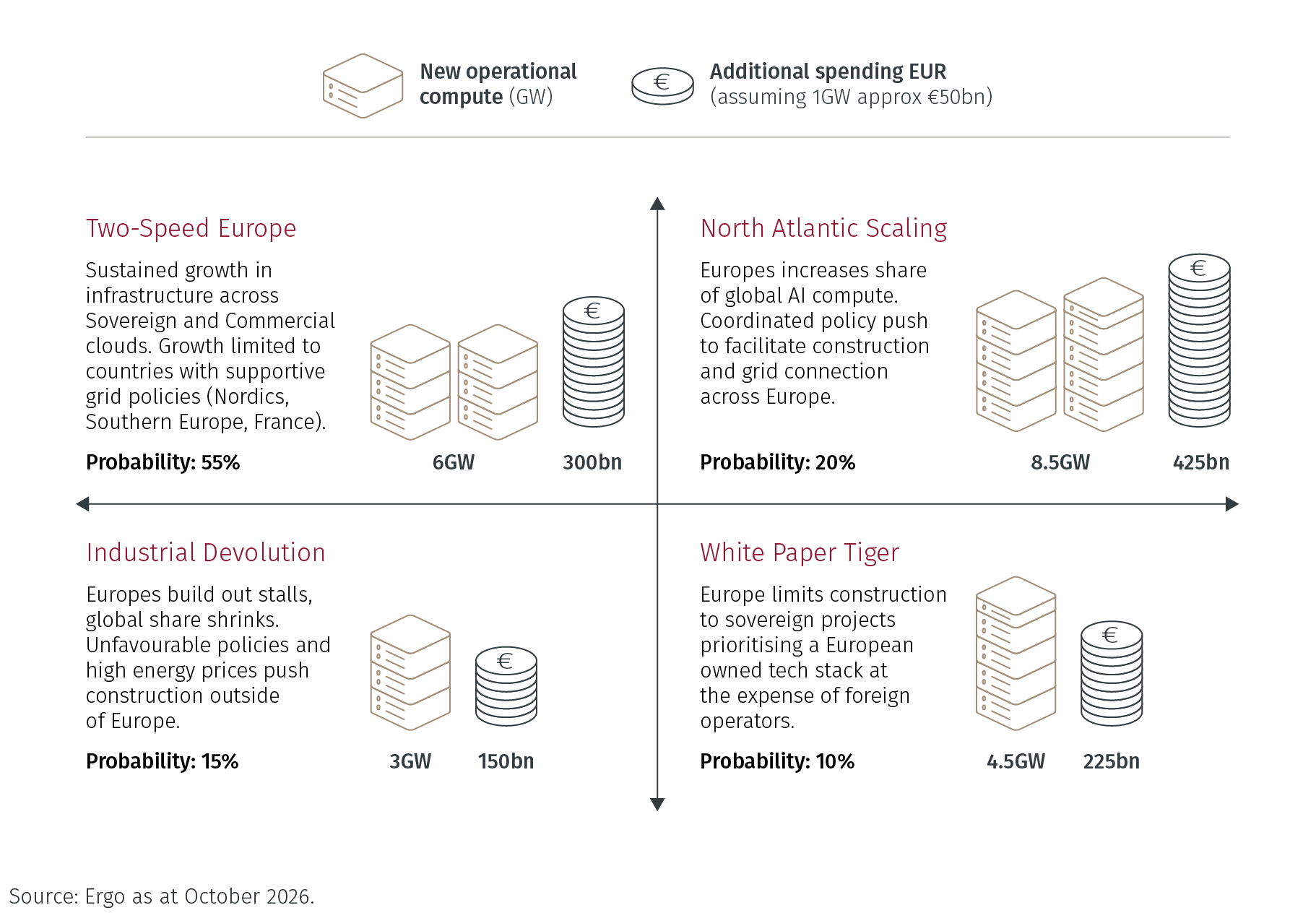
Europe is pursuing tighter safeguards while also promoting greater computing capacity. The EU introduced one of the first comprehensive laws with the AI Act but has since quietly eased regulation, delaying some of the strictest rules, due to take effect from August 2026 to December 2027 and beyond. The focus has shifted towards incentivising the construction of AI infrastructure within Europe. The proposed Cloud and AI Development Act (CADA) aims to simplify permitting and to triple EU data centre capacity over five to seven years, with EU and national financial support alongside private investment. If US construction is delayed, Europe could attract a share of future investment if developers there can secure power and permits sooner.