Emissions pricing: How the EU’s CBAM is impacting global trade and investment

All Insights

Currently reading

Emissions pricing: How the EU’s CBAM is impacting global trade and investment

Investment Insights • Sustainability

3 min read

Emissions pricing: How the EU’s CBAM is impacting global trade and investment

The introduction of the Carbon Border Adjustment Mechanism (CBAM) marks a fundamental shift in how carbon emissions are priced and managed across global markets. By internalizing the cost of carbon on imported goods and aligning it with the EU’s own carbon pricing, CBAM levels the playing field for European industries while exerting pressure on international producers to adopt cleaner technologies and stronger climate policies.

ESG Governance & Frameworks Team

ESG Governance & Frameworks Team

While the mechanism faces resistance from major trading partners and ongoing legal challenges, its ripple effects are already influencing policy discussions far beyond Europe. The prospect of substantial fiscal revenues—potentially exceeding €1 trillion over the next decade—underscores the growing economic significance of carbon regulation, transforming carbon from an abstract concern into a concrete financial metric.

For financial markets, CBAM introduces new dynamics: low-carbon producers can benefit from valuation premiums, while carbon-intensive industries may face continued margin pressures and increased credit risks. Ultimately, CBAM acts as a catalyst for global carbon pricing convergence and a powerful incentive for clean industrial innovation.

The EU Carbon Border Adjustment Mechanism (CBAM)

After a two-year preparation phase, CBAM regulation was enforced at the beginning of 2026, representing a structural shift in how economic systems price carbon.

Together with the ETS (Emissions Trading System), CBAM completes the EU framework to tax greenhouse gas (GHG) emissions. While ETS focuses on emissions produced within EU, the CBAM aims to prevent "carbon leakage," i.e. the relocation of emissions-intensive industries to regions with weaker climate policies, by imposing a carbon cost on imports of selected goods. Importers of products such as steel, cement, aluminium, fertilizers, and hydrogen must purchase CBAM certificates covering the embedded emissions of those imports. The price of these certificates is designed to be equivalent to the EU ETS carbon price, ensuring that foreign producers face the same effective carbon cost as EU producers. The taxation will increase in steps reaching 100% of the embedded carbon emissions of imported goods by 2035. Its scope is set to gradually expand by 2030 to include petroleum products, organic chemicals (polymers), and other industrial gases, covering more sectors and potentially downstream goods like cars.1

CBAM not only ensures EU industries aren't disadvantaged compared to foreign competitors, but in doing so, it extends carbon pricing to global supply chains, encouraging producers outside the EU to adopt stronger carbon pricing or cleaner technologies.2

CBAM’s supporters and opposition

The mechanism is creating some tensions and major EU trading partners have voiced strong objections, labelling CBAM unilateral and potentially trade-distorting, arguing it may violate World Trade Organization (WTO) principles and unfairly penalize developing economies.3 Russia even initiated a WTO dispute regarding EU’s carbon border adjustment and emissions trading schemes.4

The EU on the other hand views CBAM as a fair measure as it aligns the carbon taxation, and it creates an incentive for emissions reductions and the creation of regional homogeneous carbon pricing policies. When a comparable carbon price is paid in the country of origin, that amount is deducted from the CBAM and the countries of origin can retain the proceeds rather than seeing them transferred to the EU, thereby increasing fiscal revenues. Unsurprisingly many jurisdictions – including Canada, the United States, Australia, Taiwan, the United Kingdom and Turkey – are defining or exploring similar policies on their own.5

CBAM stepping in as free allowances phase out

The introduction of the CBAM is structurally linked to the progressive phase-out of free allowances allocated to European industries under ETS I (a process set to take place between 2026 and 2034) increasing the overall scarcity of permits in the carbon market, and potentially pushing carbon prices up by 50% in the next five years.6

European companies are lobbying to soften part of the rules, usually ETS related, and tighten others. The EU is expected to continue revising both ETS and CBAM regulations over the next few months and years and some industries (e.g. fertiliser) may even be temporarily exempted given possible impacts on agricultural prices. However, while changes are to be expected, we do not foresee major adjustments, not least because of significant revenues already included in fiscal planning.

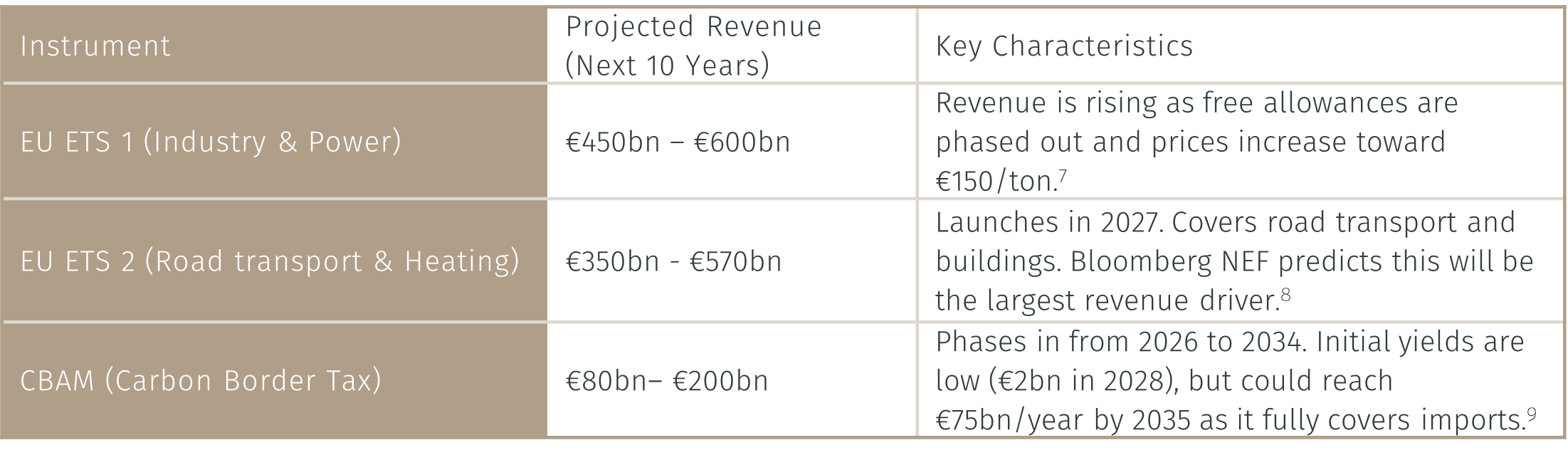
Over the next decade (2025–2035), the European Union is projected to generate between €1 trillion and €1.4 trillion (see table) of fiscal revenues from its carbon pricing mechanisms.


Table 1. Expected EU carbon fiscal revenues

CBAM1.png

Impact of CBAM on financial markets

Considering the many remaining uncertainties, the long-term impact on financial markets is difficult to predict, but we can highlight high-level directions that strengthen the case for increased consideration of climate transition risk into normal investments practices. The distinction between carbon-efficient leaders and carbon-intensive laggards, may become more financially material than today.

It is expected that EU-based firms and global exporters with low carbon intensity (e.g., green steel) can command a "valuation premium" due to the competitive advantage derived from lower emission activities.

In contrast, industries that use steel and aluminium as inputs (e.g., automotive, mechanical engineering, and construction) may face a margin squeeze. Analysis from Boston Consulting and McKinsey suggest these sectors could see a 1%–5% increase in production costs in the next 10 years.10 While this is not a high number, those sectors often already run with low margins, and they may struggle to pass on the increased cost to consumers in a highly competitive global market.

High GHG-emitting companies that lack well-defined emission reduction plans will be compelled to either invest in cleaner technologies or face increasing margin pressure.

Regional view

At a more regional level the phasing out of free emission allowances for EU domestic companies, just as global competitors start paying the border tax, can potentially lead to heightened uncertainty in industrial companies returns. However, considering European companies are generally more advanced in their emissions reduction journey, this might translate in a positive tailwind for the EU carbon intensive sectors.

Meanwhile, some heavy industrial exporters to the EU, can witness some form of "CBAM discount" where investors start discounting higher costs and additional capital expenditure, particularly if no major concerns will be raised by WTO.

Bond market implications

For bondholders, the taxation similarly suggests carbon will further move from a nice to have "environmental metric" to a more relevant credit risk.11

Carbon-intensive companies in CO2 intensive will likely see their credit spreads widen as higher carbon costs erode interest coverage ratios. Analysts estimate that in a high-carbon-price scenario ($150+/tonne by 2030), the default risk for "dirty" industrial issuers could double. In a more aggressive one, if assumptions were adjusted to all future climate costs being priced in immediately, MSCI believes the impacts could surge dramatically, increasing credit risk up to 330%.12

CBAM may accelerate the issuance of Green Bonds or Sustainability-Linked Bonds (SLBs) with coupons tied directly to carbon intensity targets, as firms seek cheaper capital to fund the investments required to lower their CBAM liabilities.

Combined with regulatory pressure to invest in climate aware assets13 this may lead to an increase of “greenium”.14

Conclusions

The implementation of the Carbon Border Adjustment Mechanism (CBAM) marks a transformative step in global carbon pricing, making greenhouse gas emissions a tangible financial factor for industries and investors. By levelling the cost of carbon between EU producers and international exporters, CBAM incentivizes cleaner production and drives policy alignment worldwide, despite ongoing trade tensions and legal disputes. Its impact will influence competitive advantages, support both the long-term credit profile of EU-issued common debt and continued EU climate investments. It introduces new risks and opportunities across equity and fixed income markets, especially for carbon-intensive sectors and some emerging economies. Overall, CBAM signals an important move towards integrating environmental costs into financial decision-making, accelerating the transition to a more sustainable global economy.
 

https://taxation-customs.ec.europa.eu/carbon-border-adjustment-mechanism_en
https://www.politico.eu/article/india-eu-uk-carbon-border-taxes-cbam-products/
https://www.wto.org/english/news_e/news25_e/ds639rfc_19may25_e.htm
https://gmk.center/en/infographic/how-countries-around-the-world-are-responding-to-the-eu-cbam-june-2025/
Bloomberg NEF,  EU ETS II Pricing Scenario.
Based on European Commission’s 2025 Carbon Market Report and Expectation of increased price. Only in 2024 the ETS I mechanism raised €38.8 bln and the amount is expected to increase following the reduction of free allowances and increase in carbon prices.
Bloomberg NEF,  EU ETS II Pricing Scenarios
EU Carbon Border Adjustment Mechanism to raise $80B per year by 2040, S&P Global Energy, 2023
10 Boston Consulting Group, The Carbon Border Adjustment Mechanism: A Challenge for Global Trade; McKinsey, New opportunities: Capturing value from CBAM regulation
11 European Central Bank, Working Paper Series, The low-carbon transition, climate commitments and firm credit risk. Various authors
12 MSCI, How Climate Transition Risk may impact Lending practices
13 See as an example the Swiss “Climate and Innovation Act”
14Greenium (or green premium) is the lower yield that an issuer of a green bond offers compared to a similar conventional bond when investors are willing to pay more (accept lower returns) for a bond funding positive environmental project, resulting in cost savings for the issuer.
 

Required

Required

Required

Required

Required

Required

Required

Please note you can manage your subscriptions by visiting the Preferences link in the emails you receive from us.

Required