What Pythagoras’ theorem can teach us about the Fed

All Insights

Currently reading

GCC: economic resilience and growth diversification

Investment Insights • Macro

3 min read

GCC: economic resilience and growth diversification

The Gulf Cooperation Council economies are showing stronger and more resilient growth, propelled by diversification into non-oil sectors and structural reforms. In this Macro Flash Note Haya Kamal assesses the key drivers behind the region’s evolving growth outlook, assessing the challenges and opportunities.

Oil price dynamics

Historically, growth in the Gulf Cooperation Council1 (GCC) economies has been anchored in hydrocarbon production and exports. Oil and gas production accounted for approximately half of the region’s total gross domestic product (GDP) and as much as 70% of total government revenues between 2011 and 2015.2

As such, GCC economies have been directly exposed to fluctuations in global oil prices. While this has generated large fiscal surpluses during episodes of strong oil prices, periods of price declines have led to a deterioration in fiscal positions and growth prospects, underscoring the need for more sustainable growth drivers. It is therefore positive that the proportion of GDP growth and government revenues accounted for by oil and gas production have declined over the last decade.3

In recent years, OPEC4 oil prices have fluctuated, ranging between 59 and 128 USD per barrel (USD/bbl), contributing to narrower fiscal surpluses across the Gulf. The regional median fiscal breakeven oil price is projected to decline from about 70 USD/bbl in 2025 to 62 USD/bbl in 2030 (see Chart 1). This downward trend reflects fiscal consolidation and diversification efforts that are gradually improving the region’s ability to sustain growth amid lower oil revenues.
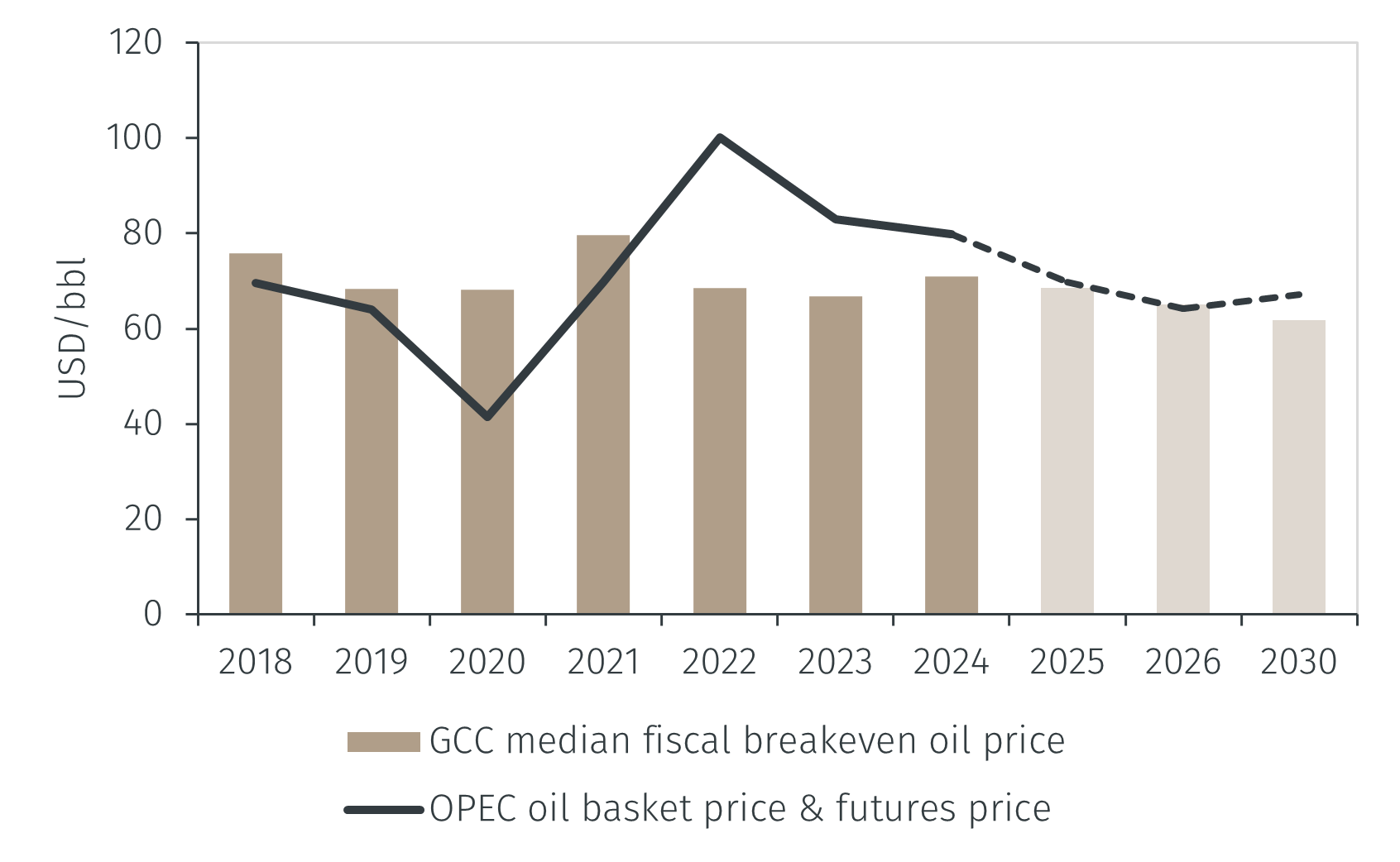
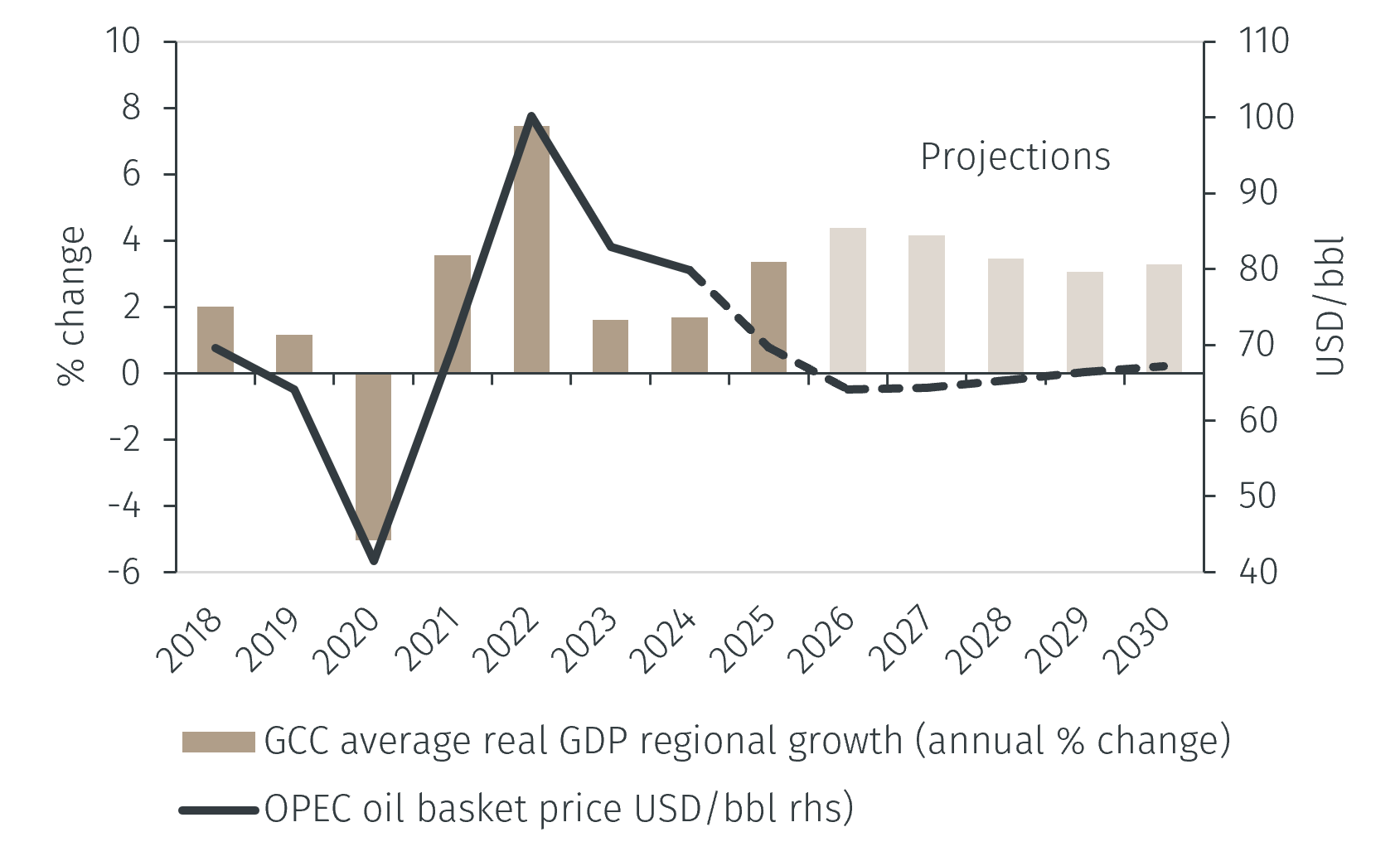
Chart 1. GCC median fiscal breakeven oil price

GCC1.png

Source: LSEG Data & Analytics, IMF and EFGAM calculations. Data as of 06 November 2025.

Evolving and diversifying growth dynamics

Non-oil sectors are increasingly shaping the GCC’s economic landscape. In Q1 2025, these sectors accounted for 73% of real GDP5, up from 32% in Q1 of 2022.6 In some GCC countries, most notably the United Arab Emirates (UAE), non-oil GDP growth in 2030 is expected to be more than double that of the oil sector.

As such, from 2025 to 2030, the IMF projects that GDP growth will stabilise within a range of 3.0% to 4.4% despite futures implying the oil price will fall below 70 USD/bbl (see Chart 2). This reflects the ambitious diversification programmes which are gradually reducing structural dependence on oil and supporting more stable medium-term growth.7

Chart 2. GCC average real GDP growth (year-on-year % change)

GCC2.png

Source: LSEG Data & Analytics, IMF and EFGAM Calculations. Data as of 06 November 2025.

The focus for diversification is centred around structural reforms, strategic public investment and aggressive non-hydrocarbon revenue mobilisation. Governments are pursuing national mandates such as Saudi Arabia’s Vision 2030 and Oman’s Vision 2040, which are supported by fiscal expenditures targeting the transition agenda. A key component of this approach is strengthening the revenue base through comprehensive tax reforms. For example, Bahrain, Kuwait and the UAE have implemented a 15% domestic minimum top-up tax8 (DMTT) aimed at large multinational enterprise groups.

Strategic investments are directing capital towards key non-oil growth drivers such as logistics, fintech, tourism, and large-scale infrastructure projects. Oman provides a successful blueprint of effective fiscal management through its Medium-Term Fiscal Plan (2020–2024), which deployed measures such as the introduction of a 5% value added tax in 2021, constraint of the public sector wage bill, and strategic use of hydrocarbon windfalls to reduce public debt, thereby expanding fiscal capacity to withstand external shocks.9

Strategic government investments across the GCC are designed to foster sustainable economic growth and support the transformation of the economy away from hydrocarbon dependence. Quantitative analysis confirms this spending is effective, indicating a marginal impact of a 0.07 percent change in potential output for a one-time percentage point change in investment.10 This positive effect is conditional on certain fiscal positions; investment yields stronger output growth when supported by periods of debt consolidation.

Risks to the outlook

While the medium-term outlook appears robust given the continued diversification of GDP growth drivers, in the short-term the region remains susceptible to lower oil prices. As downward pressure on oil prices weighs on government revenues, fiscal strains are expected to intensify, predominantly across Kuwait, Oman and the UAE.11

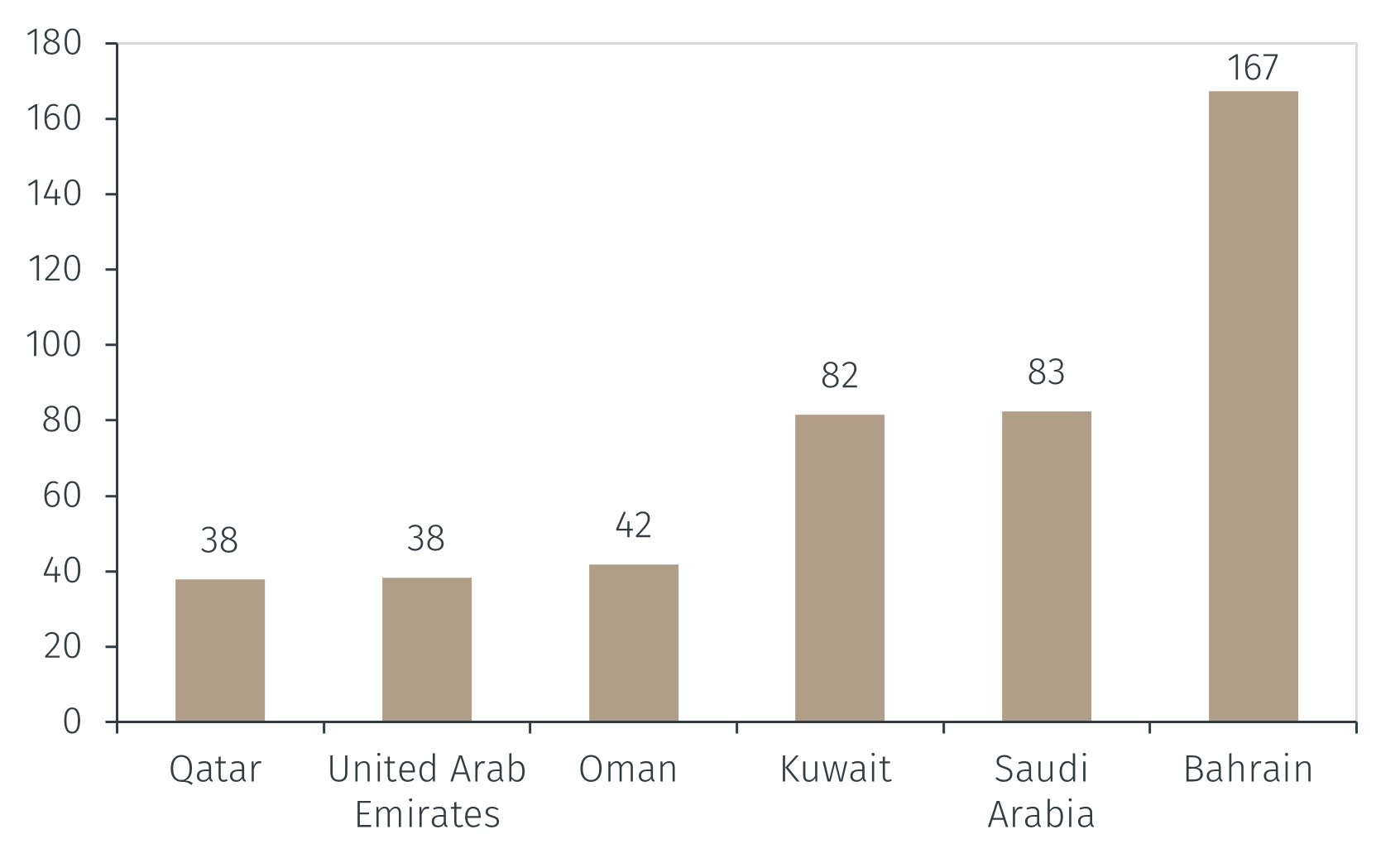
This vulnerability exposes several GCC economies where high reliance on oil revenue persists, specifically those with elevated fiscal breakeven oil prices. Bahrain appears most exposed with a projected fiscal breakeven oil price of 167 USD/bbl in 2030 (see Chart 3).


Chart 3. 2030 fiscal breakeven oil prices (USD/bbl)

GCC3.png

Source: Bloomberg and EFGAM Calculation. Data as of 11 November 2025.

For GCC oil exporters with currencies pegged to the US dollar, further local currency weakness because of a weakening dollar, could improve the competitiveness of non-oil exports like tourism. However, this could also increase the cost of imports, particularly from Asia and Europe, contributing to imported inflation. Although, since many imports are invoiced in US dollars (about 80% for Saudi Arabia, for example) this effect may be tempered.12

Summary

The ongoing diversification of GCC economies is increasingly reflected in the deepening of their financial markets and the growing openness to foreign capital. Foreign participation in GCC equity markets has risen in recent years. The inclusion of the UAE, Saudi Arabia, Qatar, and Kuwait in the MSCI Emerging Markets Index, alongside the potential addition of Oman in 2027, has been a major catalyst, doubling foreign equity inflows to USD 60 billion at the end of 2024 compared to 2022. Also, the GCC’s equity risk premium declined sharply from 6.6% in 2016 to 2.4% in 2025, reflecting reduced perceived risk and greater investor appetite.13

This trajectory underscores how targeted diversification, through government led initiatives and structural reforms, is not only reshaping the GCC’s GDP growth model, but is also integrating the region more deeply into global capital markets, positioning it as a maturing and increasingly resilient economy.
 

1 The Gulf Cooperation Council, established in 1981, is the political and economic alliance of Saudi Arabia, Kuwait, the United Arab Emirates, Qatar, Bahrain and Oman.
2 https://documents1.worldbank.org/curated/en/748461627924058675/pdf/Gulf-Economic-Update-COVID-19-Pandemic-and-the-Road-to-Diversification.pdf#:~:text=and%20international%20oil%20prices.%20Global%20oil%20demand,spending%20on%20upstream%20oil%20and%20gas%20projects.
3 https://www.imf.org/external/np/pp/eng/2016/102616a.pdf
4 The Organisation of the Petroleum Exporting Countries is a permanent, intergovernmental organisation created at the Baghdad Conference in September 1960.
5 https://gccstat.org/images/gccstat/docman/publications/National_accounts_Q1_2025.pdf
6 https://gccstat.org/images/gccstat/docman/publications/GDP_in_GCC_Q1_2022.pdf
7 https://www.pwc.com/m1/en/media-centre/articles/oil-funded-growth-or-true-diversification.html
8 A national tax designed to ensure that large multinational enterprise groups pay a minimum effective tax rate of 15% on their profits within a specific jurisdiction.
9 https://www.mof.gov.om/en/macrofinancial-policies-unit
10 https://documents1.worldbank.org/curated/en/099739006122521594/pdf/IDU-9f13d3a1-2bd9-4785-8b43-980b730b04b0.pdf
11 https://documents1.worldbank.org/curated/en/099739006122521594/pdf/IDU-9f13d3a1-2bd9-4785-8b43-980b730b04b0.pdf
12 https://www.imf.org/en/-/media/files/publications/reo/mcd-cca/2025/october/english/text.pdf
13 https://www.franklintempleton.ch/press-releases/news-room/2025/significant-economic-transformation-across-the-gcc-region-will-result-in-attractive-investment-opportunities-for-investors

Required

Required

Required

Required

Required

Required

Required

Please note you can manage your subscriptions by visiting the Preferences link in the emails you receive from us.

Required