
Bank of England: a skip, not a pause

All Insights

Currently reading

IMF: Global economy in the shadow of war

Investment Insights • Macro

2 min read

IMF: Global economy in the shadow of war

The International Monetary Fund (IMF) recently released its April World Economic Outlook (WEO), presenting a sobering assessment of a global economy tested by the war in the Middle East. In this Macro Flash Note, Haya Kamal summarises the findings.

According to the IMF’s latest WEO, economies around the world face several repercussions related to the conflict in the Middle East, for example through the direct impact of higher commodity prices, indirect second-round effects on inflation and risks to financial market sentiment. At the same time, the outbreak of war introduced a level of uncertainty that makes it difficult to rely on a single-path projection. To deal with this, the IMF provides three sets of forecasts to capture different possible states of the world. The reference forecast assumes the Middle East conflict remains limited in duration, with disruptions fading by mid-2026, consistent with commodity futures pricing as of 10 March.1

Absent the war, 2026 global growth would have been revised upward relative to the January 2026 WEO. Stronger-than-expected data at the end of 2025 and lower effective US tariff rates had laid the groundwork for a more optimistic picture. Instead, the IMF revised down the 2026 growth outlook, due almost entirely to the impact of the war. On this basis, the IMF expects global growth to be 3.1% in 2026, down from January’s forecast of 3.3%. It should be noted that the reduction simply returns the 2026 growth forecast back to where it was in October last year, albeit with some regional variations.
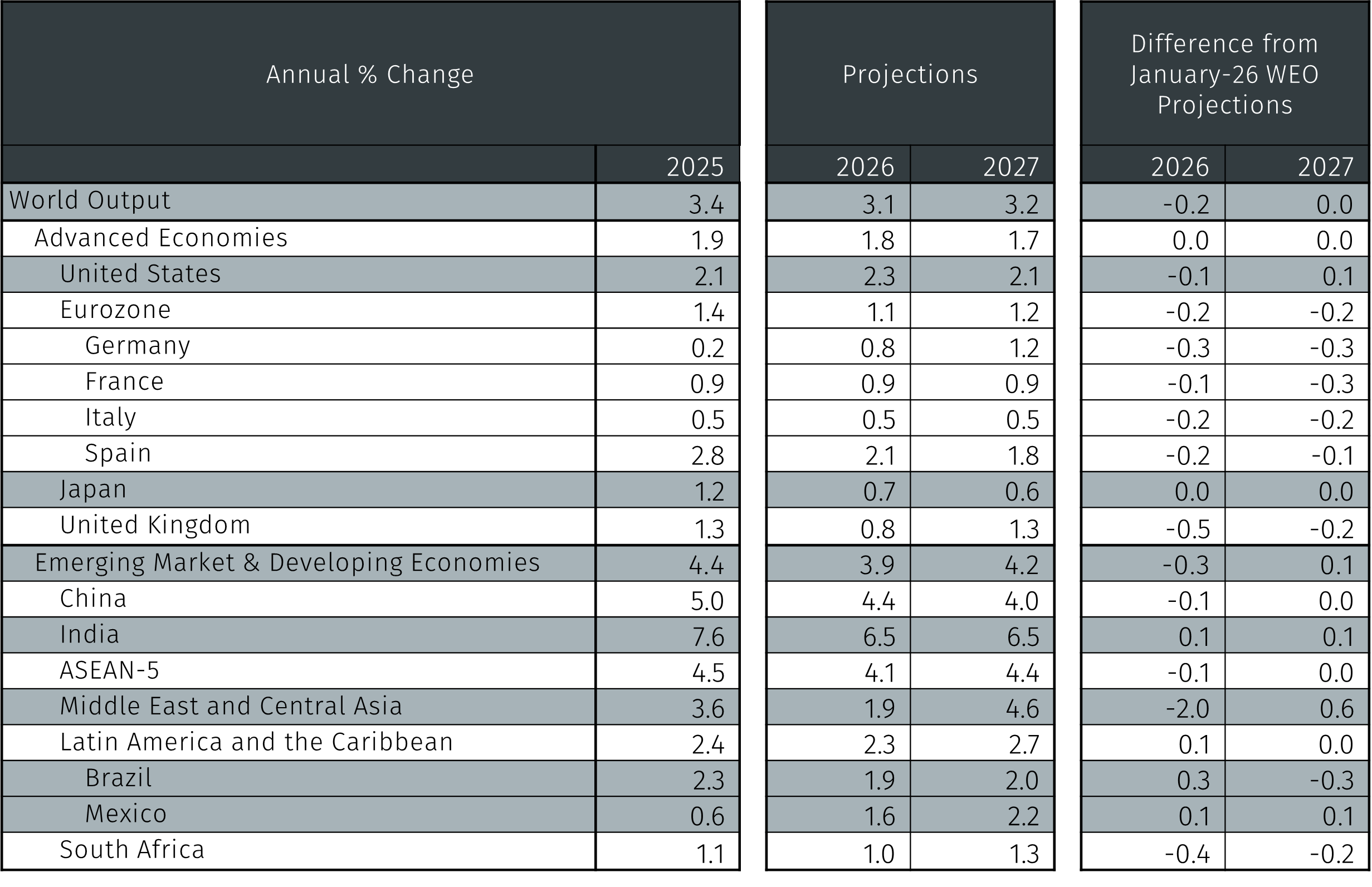
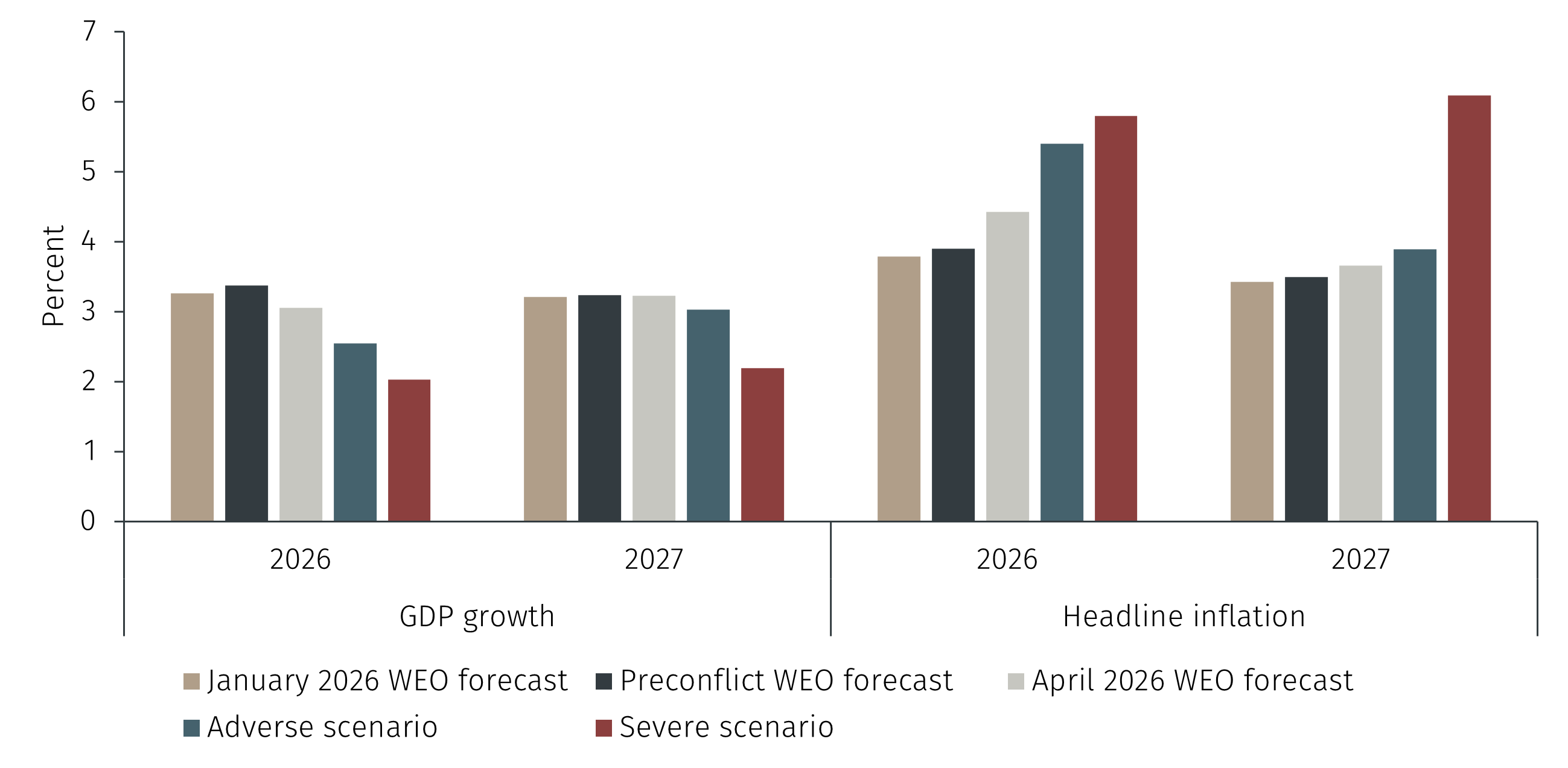
Figure 1. IMF World Economic Outlook Growth Projections (real GDP, annual % change) 

IMF1.png

Source: IMF WEO April 2026.

IMF growth forecasts

Within advanced economies, the United States starts from a position of relative strength. Its net energy-exporter status means the commodity price surge provides a terms-of-trade benefit rather than a headwind. In addition, a post-government-shutdown rebound, stronger productivity growth, and ongoing fiscal support under the One Big Beautiful Bill Act partially offset the negative effects from the conflict.

The IMF highlights that the eurozone and the United Kingdom face a more difficult situation. Both are net energy importers, and the conflict arrives on top of pre-existing vulnerabilities. In the eurozone, what looked in January like a gradual recovery, supported by better-than-expected growth in late-2025, is undermined as the war adds to already elevated energy costs since Russia’s invasion of Ukraine. Moreover, a stronger euro compounds the drag on manufacturing exporters. The UK faces the sharpest downgrade of any G7 economy, down 0.5 percentage points relative to January. This is due to the combination of conflict-driven energy costs and a slower pace of monetary easing than peers.

Japan, by contrast, is one of the few upside revisions: the new government’s fiscal stimulus package, proactive energy price measures, and strong domestic demand carryover more than offset the external drag.

Among emerging markets, the dispersion is more apparent, shaped by three factors identified by IMF. This includes proximity to the conflict, energy import dependence, and the strength of pre-existing policy frameworks. The Middle East and Central Asia region faces the sharpest downward revision, from 3.6% growth in 2025 to 1.9% expected in 2026. For the most exposed economies, the damage reflects direct hits to energy infrastructure, disruption to the Strait of Hormuz, and loss of export capacity.

The IMF has made only a moderate downward revision to China’s 2026 outlook of 0.1% relative to January 2026, as lower effective US tariffs and domestic policy stimulus help offset the impact of the Middle East conflict. With that said, structural drags from the housing downturn, an ageing workforce and slowing productivity remain firmly in place.

In Latin America, the shock is more contained. Brazil sees a small net gain from higher energy prices as a net exporter, while Mexico, coming out of a challenging 2025, is expected to recover only gradually, with its overall trajectory largely unchanged.

Figure 2. Global growth and inflation forecasts 

IMF2.png

Source: IMF WEO April 2026.

Alterative scenarios

The IMF complements its reference forecast with two alternative scenarios, adverse and severe, to illustrate the range of outcomes if the conflict proves more prolonged than assumed. Both point to a materially weaker global outlook, with lower growth and higher inflation than in the reference forecast. In the adverse scenario, a more persistent energy shock and tighter financial conditions weigh heavily on activity worldwide. In the severe scenario, global growth moves close to recessionary territory, while inflation rises well above current projections and remains elevated into 2027. The IMF stresses that the likelihood of these more negative outcomes increases the longer hostilities persist, leaving risks to the outlook clearly skewed to the downside.

However, it is important to note that the IMF’s projections were calculated as of mid-March 2026. Subsequent and improved developments, including ceasefire announcements, suggest the near-term shock may prove less severe than the reference forecast assumes.

Inflation

The conflict interrupted what had been, as of January, a disinflation narrative. Global headline inflation is now expected to rise in 2026, before resuming its decline in 2027. Energy prices are the primary driver, as disruptions to Middle East production and shipping routes push oil and gas costs higher. The country-level picture is divergent, shaped by varying exposure to commodity markets and the persistence of domestic services inflation.2

Conclusion

On the whole, the report describes a global economy that entered the year with positive momentum, only to face the shock of a war that has reduced its resilience. The impact of the conflict is not evenly distributed: energy exporters, fiscally prepared economies, and tariff beneficiaries are able to absorb the shock with minimal disruption. Meanwhile, net energy importers and conflict-proximate emerging markets bear a disproportionate burden. Restoring price stability, rebuilding fiscal buffers, and reinforcing international cooperation remain, in the IMF’s view, the essential conditions for navigating what is an increasingly uncertain global environment. The recent IMF outlook is broadly in line with our house view, as we remain constructive on the US. We also maintain a positive stance on emerging markets, particularly in Latin America and Asia ex‑Japan.

Richiesto

Richiesto

Richiesto

Richiesto

Richiesto

Richiesto

Richiesto

Please note you can manage your subscriptions by visiting the Preferences link in the emails you receive from us.

Richiesto