
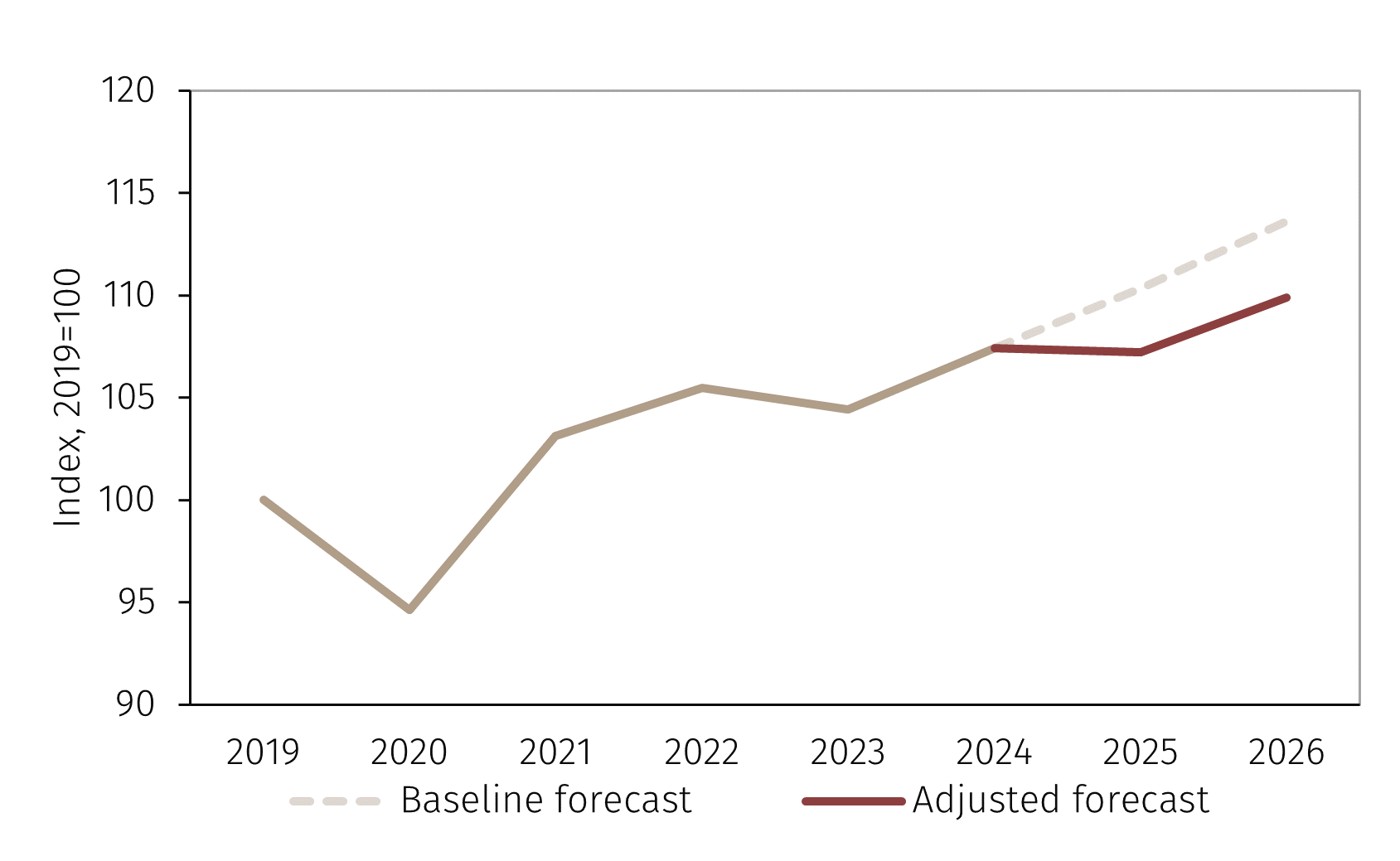
The organisation provides two sets of projections: a baseline forecast, which assumes no change in policy from before Trump’s inauguration and an adjusted forecast, which incorporates tariff increases imposed as of 14 April and models the broader drag from heightened policy risk. In the adjusted scenario, global trade volumes are expected to decline in 2025 by almost 3% in relation to the WTO’s baseline forecast, with only a partial recovery of 2.5% in 2026.
There is no such thing as a bad decision in life
Investment Insights • Macro
3 min read
WTO’s Global Trade Outlook: Trade momentum reverses amid tariff escalation
The World Trade Organization (WTO) downgraded the outlook for global trade in its April 2025 Global Trade Outlook, reflecting the changes in US trade policy and the spill over from rising policy uncertainty. In this Macro Flash Note, Samira Rahman looks at the key takeaways from the report.

Samira Rahman
Merchandise trade
World merchandise trade volumes rose by over 2.5% yearly between 2020 and 2024, setting the stage for continued expansion under the WTO’s baseline scenario, which projected growth of 2.7% and 2.9% in 2025 and 2026 respectively. However, in the adjusted scenario that incorporates increased tariffs and policy uncertainty, goods traded in 2025 are expected to decline by almost 3% in relation to the baseline forecast, before rebounding by around 2.5% in 2026, see Chart 1.
Chart 1. World merchandise trade volume, 2019-2026
Source: WTO and EFGAM. Data as of 14 April 2025.
Note: Trade refers to average of exports and imports. Figures for 2025 and 2026 are projections
North America accounts for the largest drag in goods traded, as export volumes are now projected to decline by 12.6% in 2025, while imports fall by 9.6%. In contrast, Asia remains a modest net contributor to trade volumes, though its export growth is expected to be halved from 3.3% in the baseline to 1.6% in the adjusted scenario. European exports are expected to grow slightly, but intra-EU trade remains a weak spot.
Trade reorientation is a central theme in the report. China’s exports to North America are expected to fall sharply, but exports to other regions could rise between 4% and 9% in the adjusted scenario, depending on trade diversion, as Chinese goods are redirected away from the US market.
GDP outlook
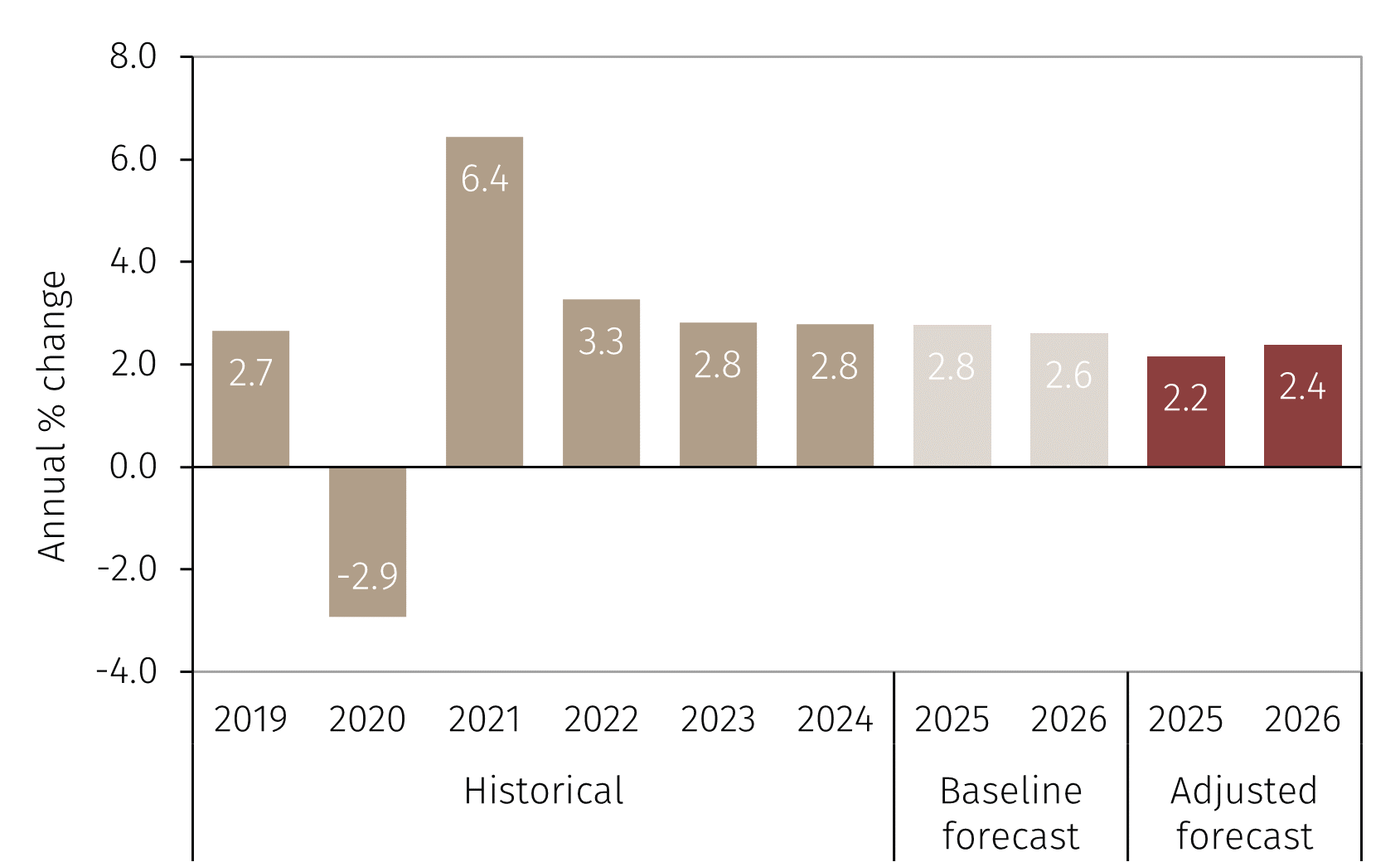
Under the baseline scenario, global GDP was expected to rise by 2.8% in 2025. The adjusted forecast lowers this to 2.2%, reflecting both the direct impact of tariffs and the wider effects of uncertainty on investment and consumption, see Chart 2. The WTO estimates that the reintroduction of reciprocal tariffs alone would reduce global GDP growth by 0.6 percentage points. If trade policy uncertainty spreads more broadly, the combined effect could reduce global growth by 1.3 percentage points relative to baseline.
Chart 2. GDP growth, 2019-2026
Source: WTO and EFGAM. Data as of 14 April 2025.
Regionally, North America would be expected to see the largest impact as GDP growth is forecast to slow by 1.6 percentage points to 0.4%, compared with 2.0% under the baseline scenario. Asia’s growth outlook would be revised down slightly, from 4.1% to 3.7%. Europe’s forecast follows behind with a downward revision of 0.2 percentage points, from 1.4% in the baseline scenario to 1.2% in the adjusted scenario.
The WTO notes that the outlook remains conditional on policy implementation. The adjusted forecast assumes that some tariffs remain suspended. If those measures are fully reintroduced, and if uncertainty increases further, growth could slow more significantly.
Services Trade
The WTO’s April report introduces volume-based forecasts for commercial services trade, also structured around a baseline and an adjusted scenario. Under the baseline scenario, global services exports are projected to grow by 5.1% in 2025 and 4.8% in 2026, see Chart 3. These expectations are revised lower in the adjusted forecast, with growth slowing to 4.0% in 2025 and 4.1% in 2026.
Chart 3. Commercial services trade volume, 2015-2027
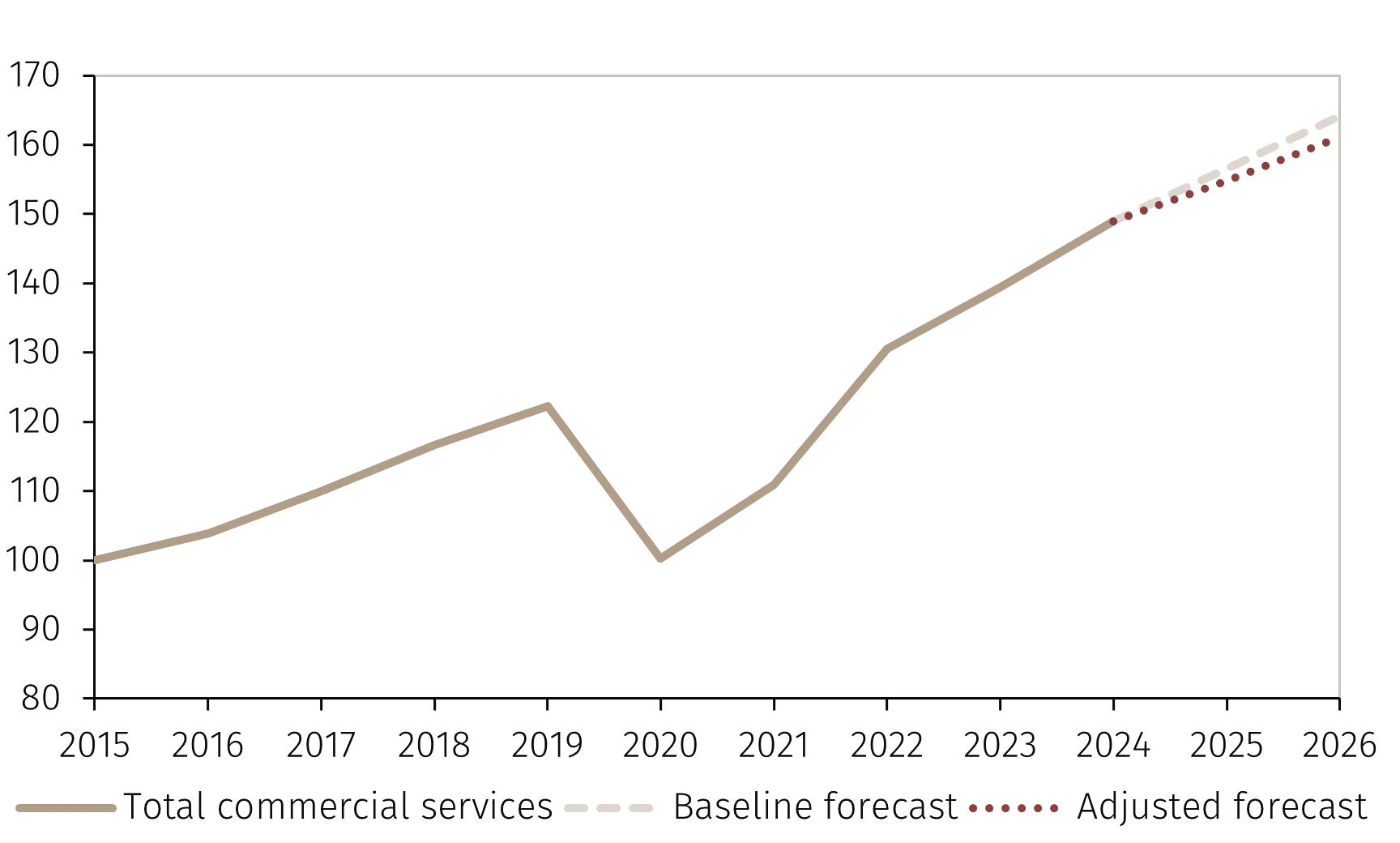
Note: Trade refers to exports. Figures for 2025 and 2026 are projections.
Source: WTO estimates and EFGAM. Data as of 21 May 2025.
The downward revision is driven by expectations of weaker performance in sectors closely tied to goods flows and discretionary household spending. Transport services are now forecast to grow by just 0.5% in 2025, compared with 2.9% under the baseline scenario. Travel services are also expected to underperform, with volume growth of 2.6% compared with 4.2% in the baseline projection. Digital services remain comparatively resilient, but the adjusted forecast also lowers growth expectations from 6.6% to 5.6%.
The WTO’s April report highlights the speed with which policy shifts can alter the global trade landscape. Baseline expectations for a steady trade-led expansion have given way to a cautious outlook shaped by tariffs and policy uncertainty. Services trade remains more stable than merchandise trade but the broader picture is one of softer trade volumes and weaker growth.