

The centre-right CDU/CSU Union won the German elections with 28.5% of the votes (see Chart 1a). Lacking an absolute majority in the Bundestag, the Lower House of Parliament (see Chart 1b), Friedrich Merz, leader of the CDU and the most likely candidate for chancellor, will begin consultations with all the other parties except the far-right Alternative für Deutschland (AfD).1
Key takeaways from the German election
Investment Insights • Macro
3 min read
Key takeaways from the German election
In this Macro Flash Note, GianLuigi Mandruzzato looks at the results of the German elections. There are two main takeaways: (i) fiscal policy will be more expansionary, including more defence spending, and (ii) migration policy will be more restrictive. Addressing the latter may represent the main challenge of the next government.
Chart 1a. German elections, % of popular vote
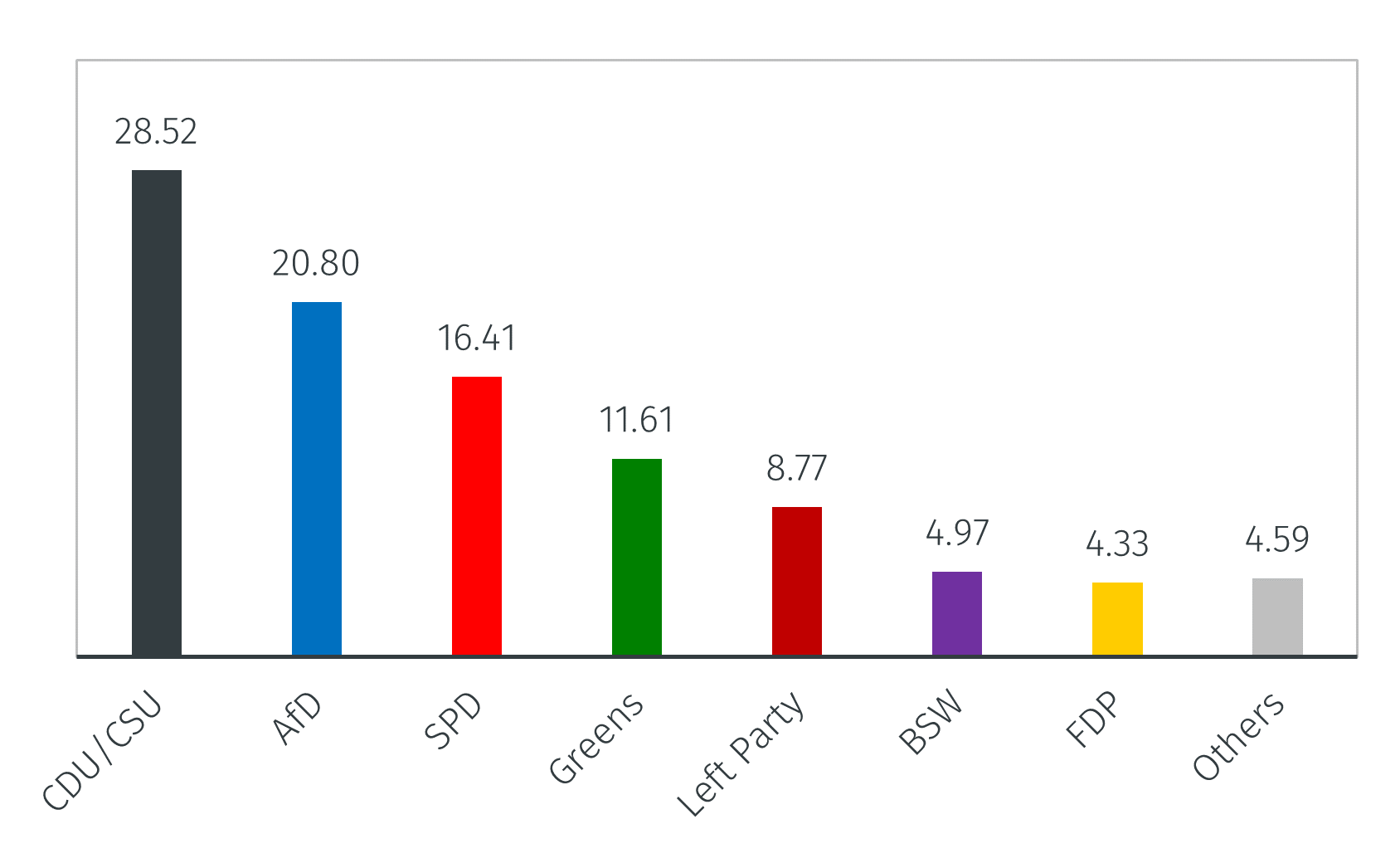
Chart 1b. Seats in the Bundestag
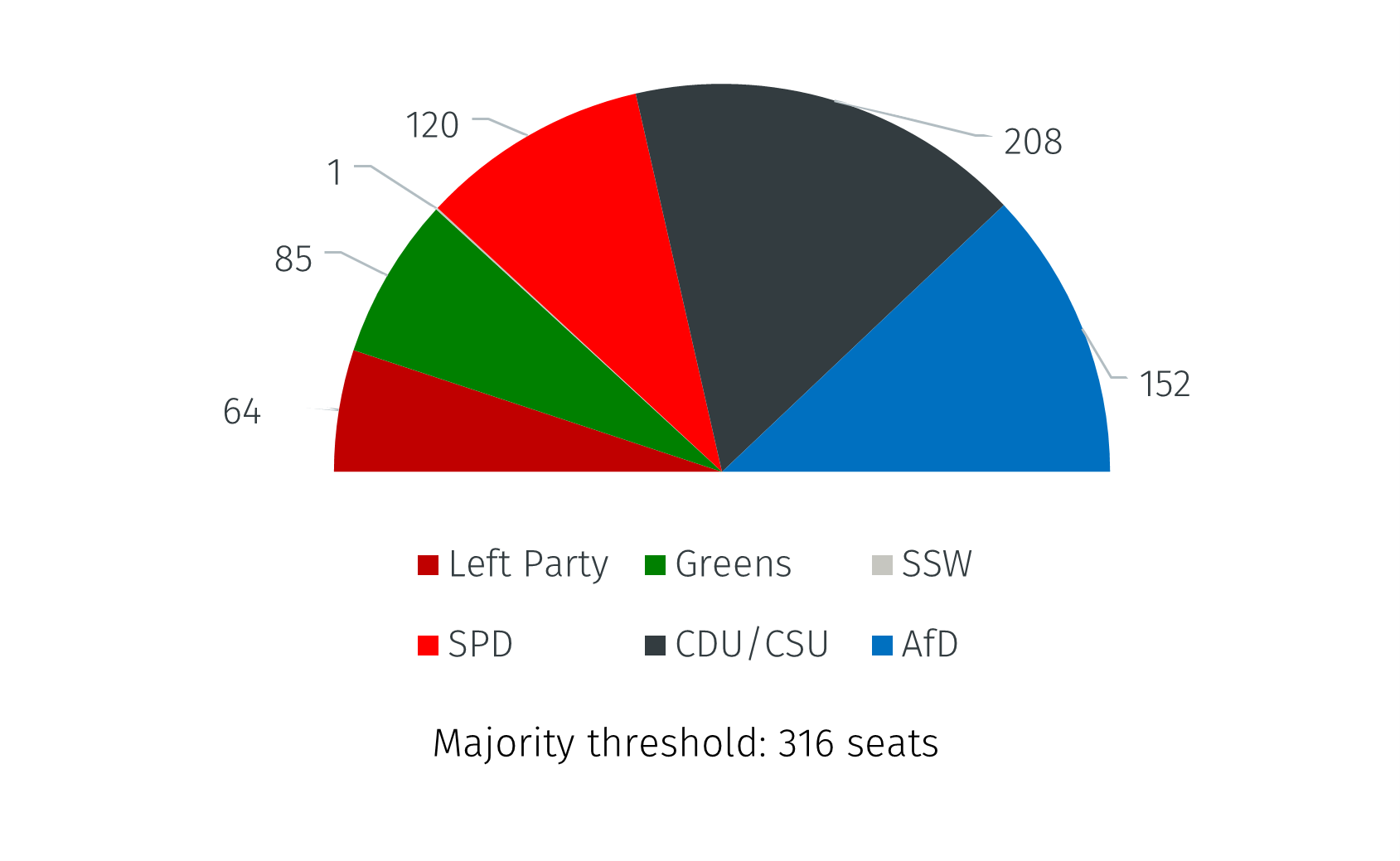
Source: German Federal Returning Office. Data as at 23 February 2025.
A new grand coalition with the Social Democrats (SPD), of outgoing Chancellor Scholz, seems to be Merz’s preferred option. Most commentators agree that this is also the best possible outcome for European financial markets.
Merz said he hopes the new government will be sworn in by Easter but the urgency of the need to address the weak economy could speed up the new government formation. The process could be relatively quick because both parties have campaigned for:
1) cutting household taxes;
2) supporting corporates with lower taxes or investment incentives;
3) reducing bureaucracy and the cost of energy;
4) increasing defence spending.
To address these priorities, the government coalition, when it is formed, is likely to aim for a larger fiscal deficit than in recent years. The EU Commission projects the German government budget deficit at well below the EU 3% limit and its debt-to-GDP ratio is only just above 60% (see Chart 2). This leaves room for a fiscal expansion of about 1% of GDP without violating the limits of the EU Stability and Growth Pact.
Chart 2. German public accounts (% of GDP)
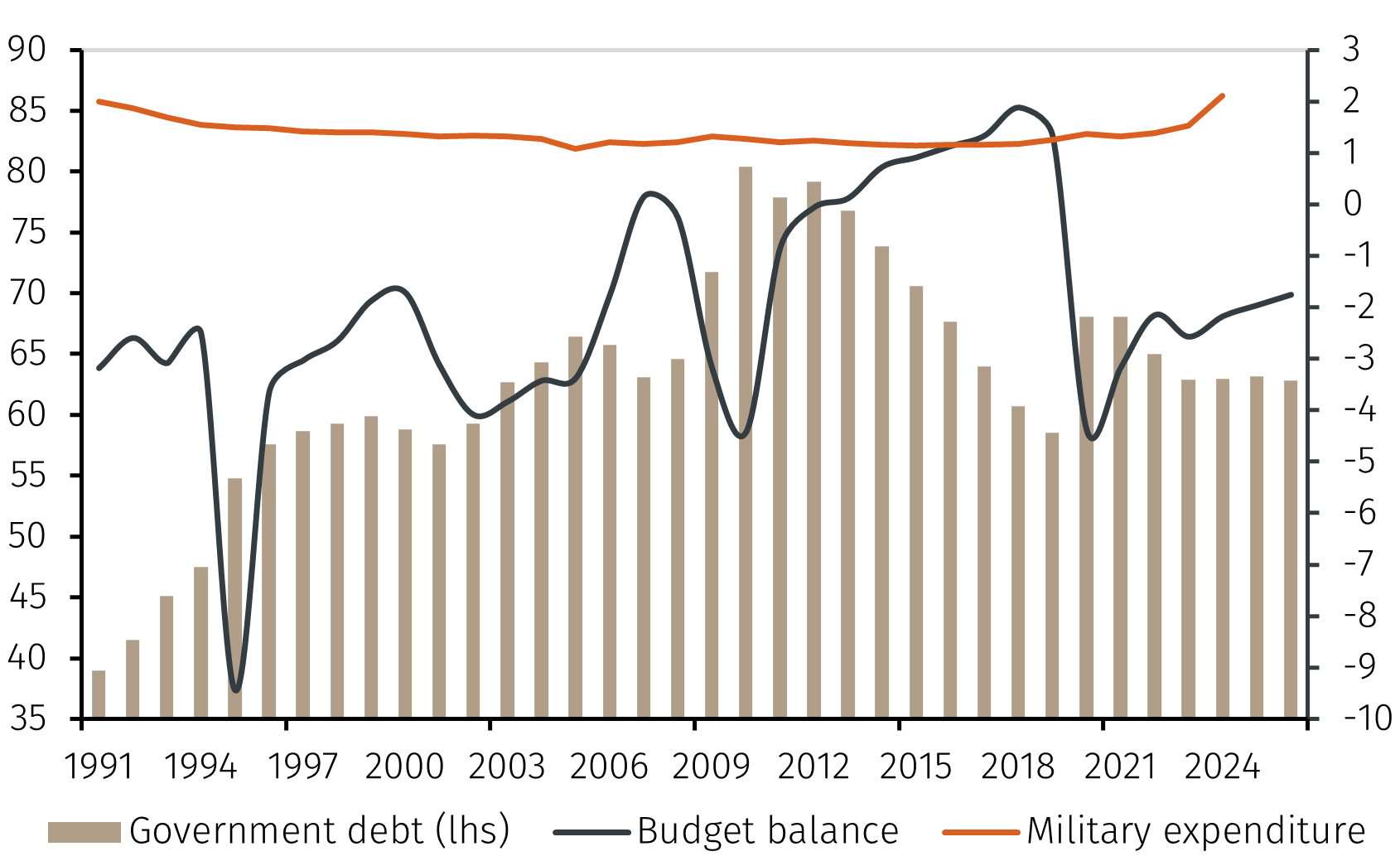
Source: EU Commission, World Bank and NATO. Data as at 23 February 2025.
However, the German government must also comply with the more restrictive national debt brake rule.2 The rule can be temporarily suspended with a simple majority vote of the Bundestag if “natural disasters” or "exceptional emergency situations" outside the government's control negatively affect public finances. Two consecutive years of GDP contraction and the risks stemming from US trade policy, and the need to increase defence spending could justify the suspension of the debt but the decision would risk an appeal to the German Constitutional Court.
However, a structural reform of the debt brake would be a harder task. Amending an article of German Basic Law requires a two-thirds majority in the Bundestag and the Bundesrat (Upper House). The composition of the new Bundestag and AfD's opposition to changing the debt brake make an agreement between the CDU/CSU-SPD coalition and the Greens and the Left Party necessary for an amendment to pass. Both the Greens and the Left Party favour loosening the debt brake, but the Left Party opposes increased military spending. This suggests that any attempt to reform the debt brake will be postponed.
Given the likely difficulties in loosening the debt brake during the next legislative session, it is not surprising that, according to media reports, Merz is in talks with the SPD and the Greens to double Germany's special defence fund to €200 billion before the current Bundestag is dissolved. In the current Bundestag, the CDU/CSU, SPD and Greens together have the two-thirds majority required to pass such a measure and bypass the debt brake. The current €100 billion special fund will run out in a few years, and German defence spending would risk falling well below 2% of GDP. Gaining more leeway on defence spending would also simplify negotiations with the SPD on the government contract of the next coalition.
The new government will also focus on is migration. Both the CDU/CSU and the SPD have proposed restrictions on the reception of asylum seekers and more severe measures against immigrants who commit crimes. At the same time, both parties have proposed measures to attract skilled migrants.
The change in migration policy reflects the increased support for the AfD. The far-right party, which also proposes leaving the euro, has always opposed immigration, something reflected across a growing share of the population (see Chart 3).
Chart 3. Voters’ main concerns
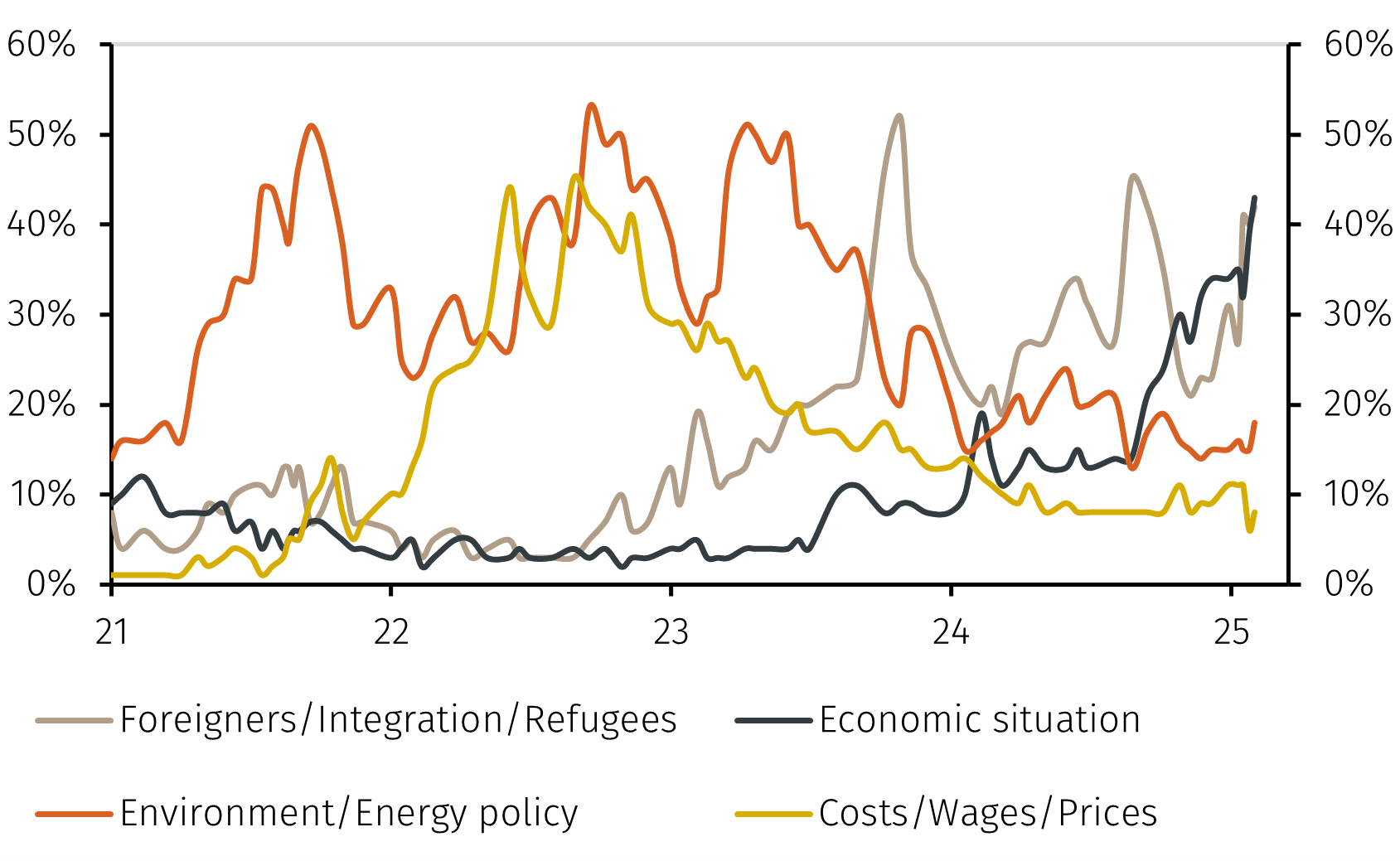
Source: Forschungsgruppe Wahlen Politbarometer. Data as at 23 February 2025.
This is particularly true in former East German Länder, which are economically weaker than the former West. The vote on Sunday highlighted a split between the former DDR, where the AfD was the first party in almost all constituencies, and the rest of the country.
Such a split poses a challenge to pro-EU parties. If the new government fails to reassure Germans worried about rising immigration, further advances by the AfD are likely, magnifying the risks to the eurozone.
1 Only parties that win at least three constituencies of the 299 allocated on a first past the post basis or at least 5% of the popular vote are represented in the Bundestag. The number of seats is allocated proportionally to the shares of the popular vote.
2 See "Germany's key issues and the coming snap elections", EFG Macro Flash Note, November 2024.