6. Opportunities abound in the AI race

Currently reading

6. From defensive to disruptive: How AI Is rewriting healthcare and biotech

Secular Change

2 min read

6. From defensive to disruptive: How AI Is rewriting healthcare and biotech

Key takeaways

  • AI is transforming the drug-development process, with the potential to accelerate discovery, improve research productivity and reduce costs.
  • AI adoption across clinical workflows and administration is set to accelerate, creating opportunities to improve efficiency and lower costs.
  • Evolving regulation, liability concerns and reimbursement frameworks will play a critical role in determining which companies can scale successfully in 2027.

The US healthcare sector is entering a period of fundamental structural change as artificial intelligence moves from experimental pilot programmes to full-scale deployment across the healthcare industry.

By 2027, the primary impact of AI will be felt in two high-stakes areas: it will sharply shorten research and development cycles in biotechnology and be used to automate healthcare administration at scale, for which $300 billion to $600 billion in potential annual revenue is at stake for automation leaders.

While AI drug discovery remains at an early stage, administrative AI is already delivering measurable margin improvements, with some organisations reporting a 40% reduction in administrative costs. This transition is being catalysed by changes in the regulatory environment, including the Food and Drug Administration’s (FDA) new frameworks for generative medical devices and the Centers for Medicare and Medicaid Services (CMS) shift towards outcome-based reimbursement.

To explain this further, a generative medical device can be used to analyse medical images, interpret medical information, generate summaries or recommendations for doctors, and help to develop software that assists with diagnosis or treatment plans. The FDA has been developing and refining its approaches to AI-enabled medical devices, so those being developed will have to meet regulatory standards.

Meanwhile, the CMS, which oversees the major US public healthcare programmes, is moving from paying for a service, such as consultation, scan or procedure, towards linking payment to the quality of care and improvement in the patient’s health. So, AI health technology will need to deliver measurable improvements.

The dominant disruptor
The integration of AI into US biotechnology and healthcare administration has reached a critical inflection point, shifting from speculative innovation to a primary driver of operating profit. By 2027, AI is projected to be the dominant force disrupting US healthcare, moving beyond simple chatbots that assist with individual tasks to agentic AI systems (software that can plan and carry out multi-step tasks with limited human input) that coordinate clinical care and link computational drug discovery with physical drug validation.

The core view is that as AI models become more widely accessible, the competitive advantage will depend increasingly on the depth and scale of companies’ own proprietary data, their ability to integrate AI into core workflows, and their capacity to translate these capabilities into commercial value.

“ AI is projected to be the dominant force disrupting US healthcare... ”

What changes in 2027?
US healthcare adoption of AI models has surged, signaling a rapid shift toward  production-grade scaling. Gartner forecasts that global AI software spending in healthcare and life sciences will increase from $11.6 billion in 2024 to $18.9 billion by 2027. We believe 2027 represents a critical threshold for three reasons.

First, major biotechnology assets initiated during the “AI boom” will enter pivotal phase two and phase three trials in 2027, providing the first large-scale human data to validate whether AI-enabled assets possess a higher probability of clinical success.

Secondly, 2027 marks a stabilisation in the regulatory landscape; the FDA’s 2026 discussion paper on generative AI-enabled medical devices is expected to mature into formal guidance by next year, providing a clear pathway for autonomous clinical tools.

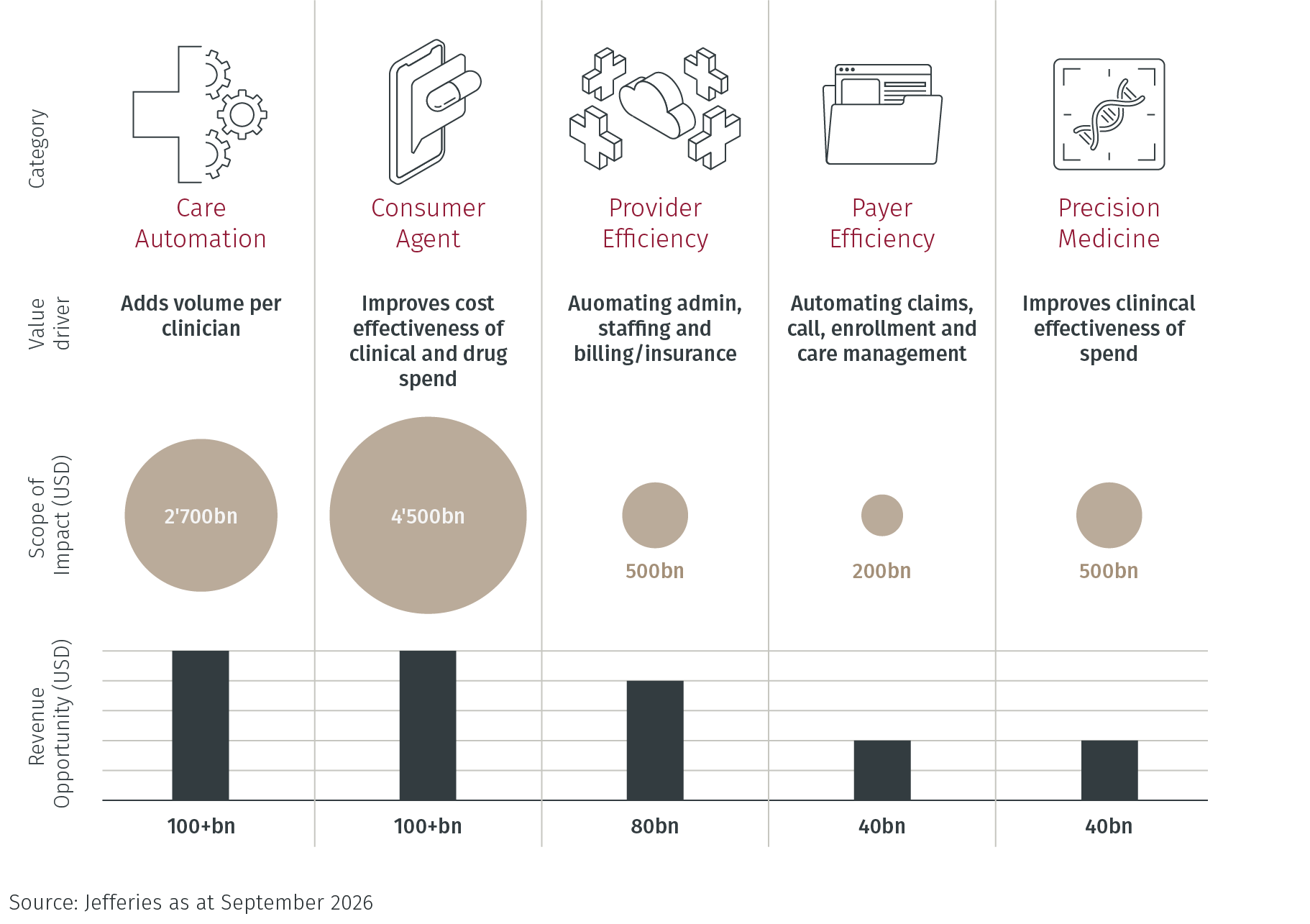
Figure 15. US healthcare AI market opportunity by segment

02_EFG_Outlook_2027_EN_Charts_Website__Figure15_Source.png

Third, the infrastructure is now in place, with cumulative capex from major cloud providers projected to exceed $1 trillion in 2027, helping ensure the compute capacity required for population-scale health analytics is both available and cost-efficient.

Administrative automation: the earliest route to profit
While clinical breakthroughs create headlines, administrative AI is currently the most mature area of healthcare AI and is already commercially viable. The US healthcare delivery market represents a $4.5 trillion landscape, with care admin automation – the use of AI tools to automate routine tasks such as clinical documentation, appointment scheduling, patient records, billing and claims processing –  offering  a  potential $300 billion to $600 billion opportunity.

Evidence of the impact is tangible: a leading US dental provider achieved a 40% reduction in administrative costs and a 98% reduction in provider call wait times through AI-ready infrastructure. By 2027, AI will become a standard part of healthcare administration, helping managed care organisations (essentially health insurers) reduce operating costs and restore profit margins to target levels.

Moving from AI drug discovery to “AI-enabled development”
Biotech companies are increasingly using AI across the drug-development process, rather than just designing new molecules. AbbVie, for instance, has built a platform that connects over two billion points of scientific knowledge to optimise site selection and clinical trial design. AstraZeneca has noted that over 90% of its small-molecule discovery pipeline is now AI-enabled, and other firms report that AI can compress traditional 54-month discovery cycles to just 12–18 months.

By 2027, the focus will be on “lab-in-the-loop” systems where agentic AI coordinates laboratory robots and data analysis in closed-loop discovery workflows, potentially reducing synthetic manufacturing scale-up times by 50%.

Two paths for 2027, and the signposts to watch
The upside case rests on proof. If a major “AI-designed” drug meets its primary endpoint in a phase three trial, which could happen in late 2026 or early 2027, investors would have the first large-scale evidence that AI improves the odds of clinical success. That could prompt a significant re-rating of the sector, as valuations move away from judging companies on the speed of discovery and towards pricing in a higher probability of success. The clearest early gauge is how many of the 60+ AI-native assets now in phase one trials graduate to phase two. On the regulatory side, finalisation of the FDA’s “competency-based” evaluation model for generative AI devices, targeted for late 2026 or early 2027, would give developers a clearer route to market.

The downside case is regulatory rather than scientific. If individual US states create a “patchwork” of rules, for example, Texas requiring conspicuous AI disclosure and strict human review that conflicts  with  federal FDA clearance, healthcare providers may fear being held legally responsible for autonomous AI care and hold back from adopting it. That would limit growth at healthcare technology companies and weigh on their valuations. A delay to the FDA framework would be an early warning of slowing adoption. So would slow progress by the CMS in replacing legacy claims systems with standardised digital workflows by 2027, because fragmented systems limit how far administrative automation can go.

Between the two sits the commercial test, which investors can track every quarter. Margin sentiment among S&P 1500 healthcare companies (a broad index of US large, mid and small-cap firms) offers a read on whether administrative AI is paying off, and firms that mention AI usage currently benefit from better investor sentiment than those that do not. If that gap persists or widens, the positive case strengthens. If it narrows, expectations may be running ahead of results.

By 2027, the investment environment will shift from valuing AI potential to recognising the value of AI once it has measurably improved a company’s profitability. This creates a divergence between large-cap incumbents capable of funding massive AI infrastructure and small and mid-cap biotechnology companies using AI to scale without a proportional rise in headcount.

“ ...healthcare providers may fear being held legally responsible for autonomous AI care and hold back from adopting it. ”

Our view for 2027

The year ahead will be a pivotal one for AI in healthcare and biotech as advances in R&D accelerate drug discovery and increasingly autonomous systems drive a step-change in healthcare service delivery and administrative efficiency. The opportunity is substantial, but success will depend on identifying the companies that can turn AI capabilities into measurable commercial gains. Evolving regulation will remain a critical factor in determining which businesses can scale and sustain their competitive advantage.

For you as an investor, the message from the healthcare AI theme is to focus on scale, data ownership and life-science tools, while being selective with AI-native biotech and mindful of regulatory and clinical risks. The points below translate this into concrete portfolio actions for the year ahead.

Action for investors:

  • Focus on providers of life science tools. Every AI-generated hypothesis requires physical validation creating a “reinvestment flywheel” where AI-driven research efficiencies drive demand for instruments.
  • Selective exposure to AI-native biotech. Favour firms with clear near- term clinical catalysts, while recognising that trial outcomes can be binary.
  • Monitor the laggards. Remain cautious on managed care organisations that fail to integrate consumer agents (AI assistants that help patients navigate care) rapidly.

Richiesto

Richiesto

Richiesto

Richiesto

Richiesto

Richiesto

Richiesto

Please note you can manage your subscriptions by visiting the Preferences link in the emails you receive from us.

Richiesto