
What Pythagoras’ theorem can teach us about the Fed

All Insights

Currently reading

Japan: uncertainty begins to fade

Investment Insights • Macro

2 min read

Japan: uncertainty begins to fade

The economic picture in Japan has been clouded by tariffs and an upper house election. Now that a bilateral trade agreement has been reached with the US and the election is in the rear-view mirror, the outlook appears clearer. In this Macro Flash Note, Economist Sam Jochim assesses the forces prevalent in Japan’s economy.

Following the events of “Liberation Day” on 02 April, when the Trump administration imposed sweeping tariffs on many of its trading partners, the outlook for Japan’s economy appeared to deteriorate. The US announced it would impose a 24% tariff on imports of goods from Japan. This had the potential to prove a crippling blow to the Japanese economy, which sent more goods to the US in 2024 than to any other country.1

Despite an initial 90-day pause on US tariffs on 09 April, with a lower rate of 10% imposed during this period, Bank of Japan (BoJ) Policy Board members still revised their forecasts lower for real gross domestic product (GDP) growth in fiscal years 2025 and 2026.2 These revisions reflected the view that the Trump administration’s trade policies would result in lower exports and production both globally and domestically. 

In July, Japan agreed a bilateral trade deal with the US, with its tariff rate set at 15% in exchange for a US-destined USD 550 billion Japanese investment package. The deal is not expected to lead to significantly higher GDP growth, with only a 0.1 percentage point upward revision to the forecast for fiscal year 2025 at the BoJ’s July meeting (see Chart 1).3
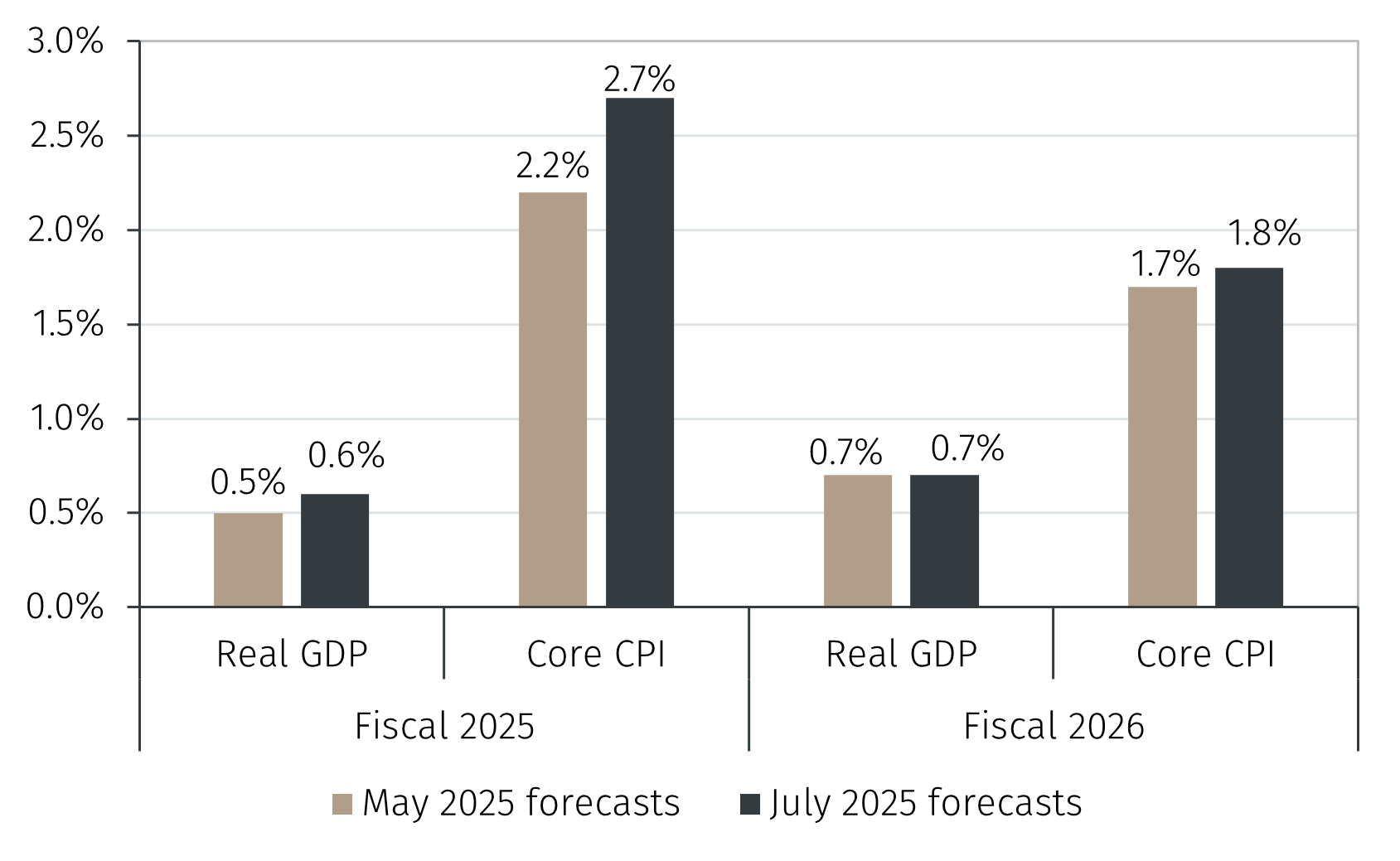
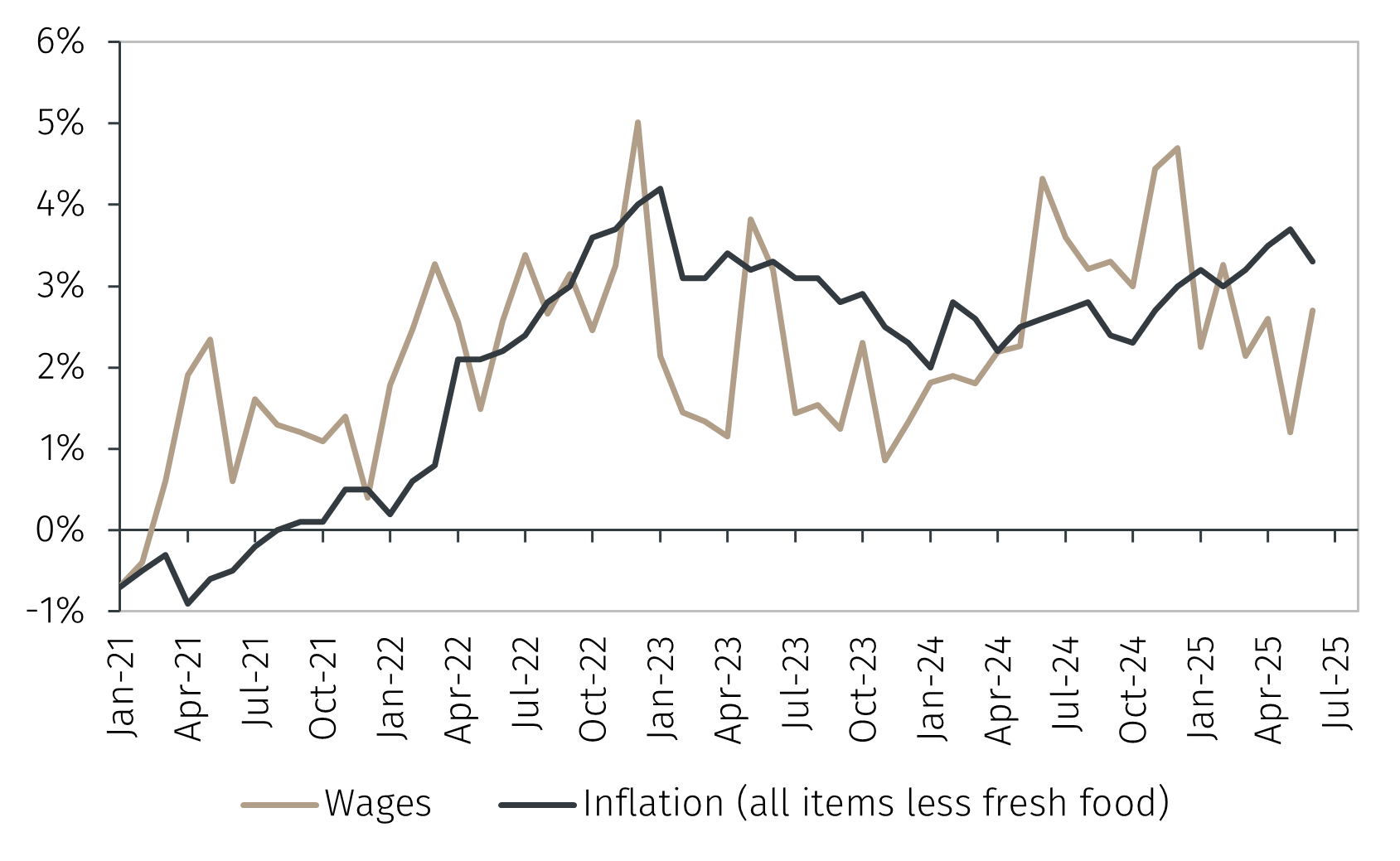
Chart 1. BoJ forecasts (% change, year-on-year)

Japan1.png

Source: Bank of Japan. Data as at 01 August 2025.

While the trade deal is not expected to dramatically raise GDP growth, it does remove some of the uncertainty that was clouding the outlook. Against this backdrop, it is notable that conditions have been in place for the BoJ to continue to raise rates for some time, a point made repeatedly in BoJ policy documents.4
  
Core consumer price index (CPI) inflation has been above the BoJ’s 2% target since April 2022 and wage growth has been strong over the same period (see Chart 2). In addition, although the BoJ has raised rates by 60 basis points since April 2024, its real policy rate has remained significantly negative.5 BoJ staff have estimated a range for the neutral real policy rate of between -1% and -0.5%.6 If the current 0.5% policy rate were maintained, the inflation forecasts from the BoJ’s July meeting would imply an expected average real policy rate of -2.2% and -1.3% in fiscal years 2025 and 2026 respectively.

Chart 2. Core CPI inflation and wage growth (% change, year-on-year)

Japan2.png

Source: LSEG Data & Analytics and EFGAM calculations. Data as at 13 August 2025.

The other major source of uncertainty clouding Japan’s economic outlook stemmed from the domestic political situation. A snap general election called in October 2024 proved to be a major political miscalculation by Prime Minister Shigeru Ishiba, with the Liberal Democratic Party (LDP) losing its parliamentary majority in the lower house for the first time since 2009.

The upper house election in July marked a chance for the LDP to restate its legitimacy as Japan’s ruling party. Instead, the election saw Ishiba’s party lose its majority in the upper house, meaning the party has no majority in either house for the first time in its history.

The main consequence is that domestic political uncertainty will remain prevalent in Japan for the time being. While Ishiba has vowed to stay on as Prime Minister, his position appears untenable after losing two elections in less than a year. A leadership election is possible in the coming months before negotiations to form a new government with opposition parties intensify. 

The LDP may still be the ruling party, but its power is severely hampered by its inability to pass policy without the support of smaller parties which will have a disproportionately greater role in policymaking than their number of seats would usually suggest. Given the LDP sits on the more conservative end of the fiscal policy spectrum, a more fiscally expansive government is another likely consequence of the upper house elections. 

In summary, the outlook in Japan has been clouded by uncertainty related to tariffs and an upper house election. A bilateral trade agreement with the US means the majority of tariff-related uncertainty is now in the rear-view mirror. Although, domestic political uncertainty remains elevated following the upper house election, a leadership election and new government are possible in the coming months and could further reduce uncertainty. If this is the case, above-target Inflation, strong wage growth and significantly negative real rates justify further BoJ rate hikes.

1 The US was the top export destination for Japan, receiving around 20% of Japan’s total goods exports in 2024 (EFGAM calculations based on trade data from Japan’s Ministry of Finance. Data as at 06 August 2025).
2 See EFG Macro Flash Note: ‘BoJ still has a bias to raise rates’ (06 May 2025) https://www.efginternational.com/uk/insights/2025/boj-still-has-a-bias-to-raise-rates.html
3 https://www.boj.or.jp/en/mopo/outlook/gor2507b.pdf
4 https://www.boj.or.jp/en/mopo/outlook/gor2504a.pdf 
5 The BoJ real policy rate refers to the BoJ policy rate (uncollaterized overnight call rate) minus the year-on-year core (all items less fresh food) inflation rate. 
6 https://www.boj.or.jp/en/research/wps_rev/wps_2024/data/wp24e12.pdf

Richiesto

Richiesto

Richiesto

Richiesto

Richiesto

Richiesto

Richiesto

Please note you can manage your subscriptions by visiting the Preferences link in the emails you receive from us.

Richiesto