

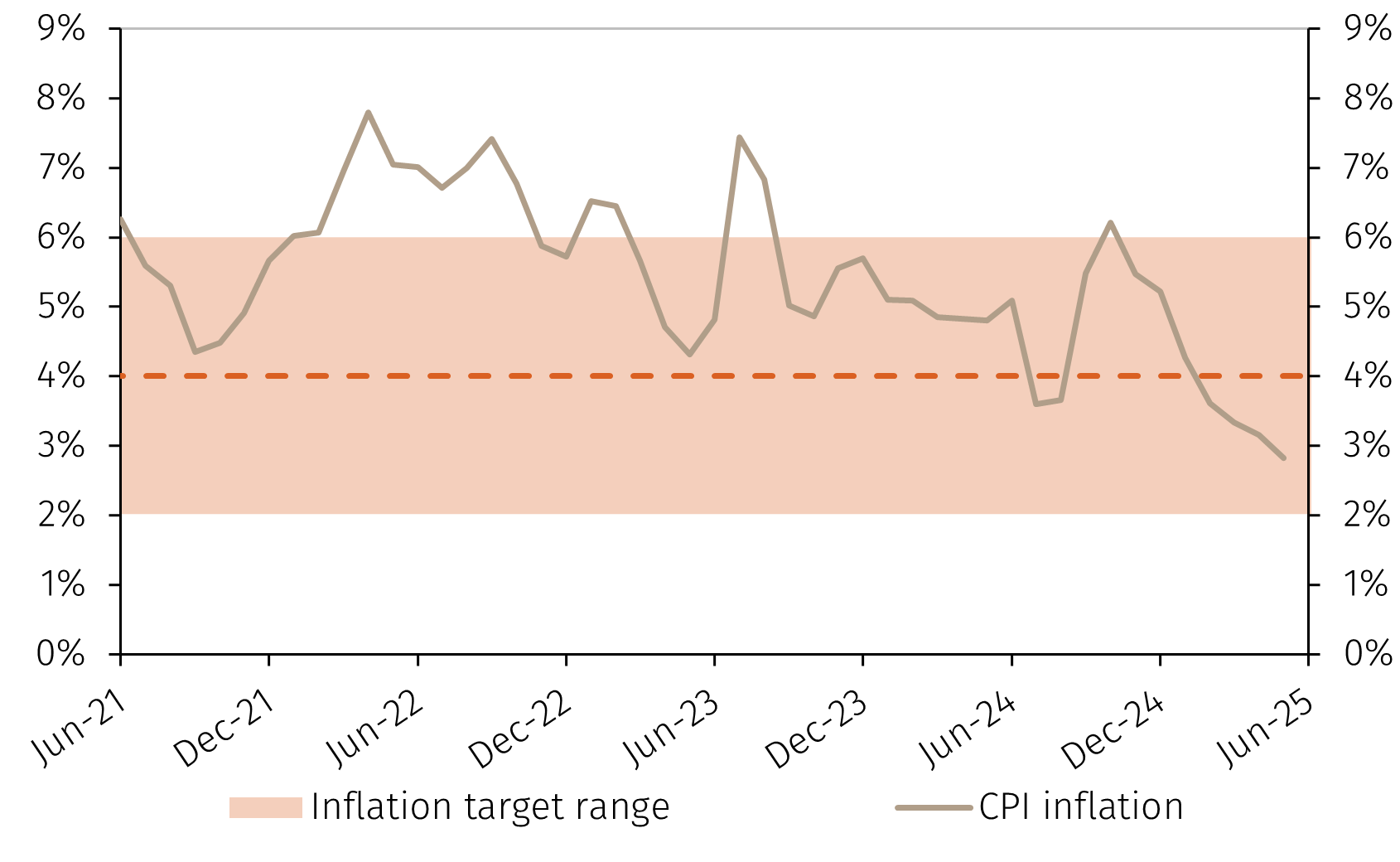
In Q3 2024, India’s GDP grew 5.4% year-on-year, the lowest level of growth recorded since Q4 2022. At the same time, inflation moderated towards the lower end of the Reserve Bank of India’s (RBI) 4% ± 2% target range (see Chart 1).
India’s encouraging economic outlook
Investment Insights • Macro
2 min read
India’s encouraging economic outlook
India’s economy faced a tough Q3 2024 but has since bounced back strongly, supported by rate cuts from the Reserve Bank of India. In this Macro Flash Note, Economist Sam Jochim assesses the recent data and the outlook for the Indian economy over the next year.
Chart 1. Indian Consumer Price Index inflation (% change, year-on-year)
Source: LSEG Data & Analytics and EFGAM calculations. Data as at 03 July 2025.
Part of the RBI’s mandate is to maintain price stability while also supporting growth. Falling inflation has therefore allowed the RBI to focus on the growth side of its mandate, delivering 100 basis points of interest rate cuts since February.
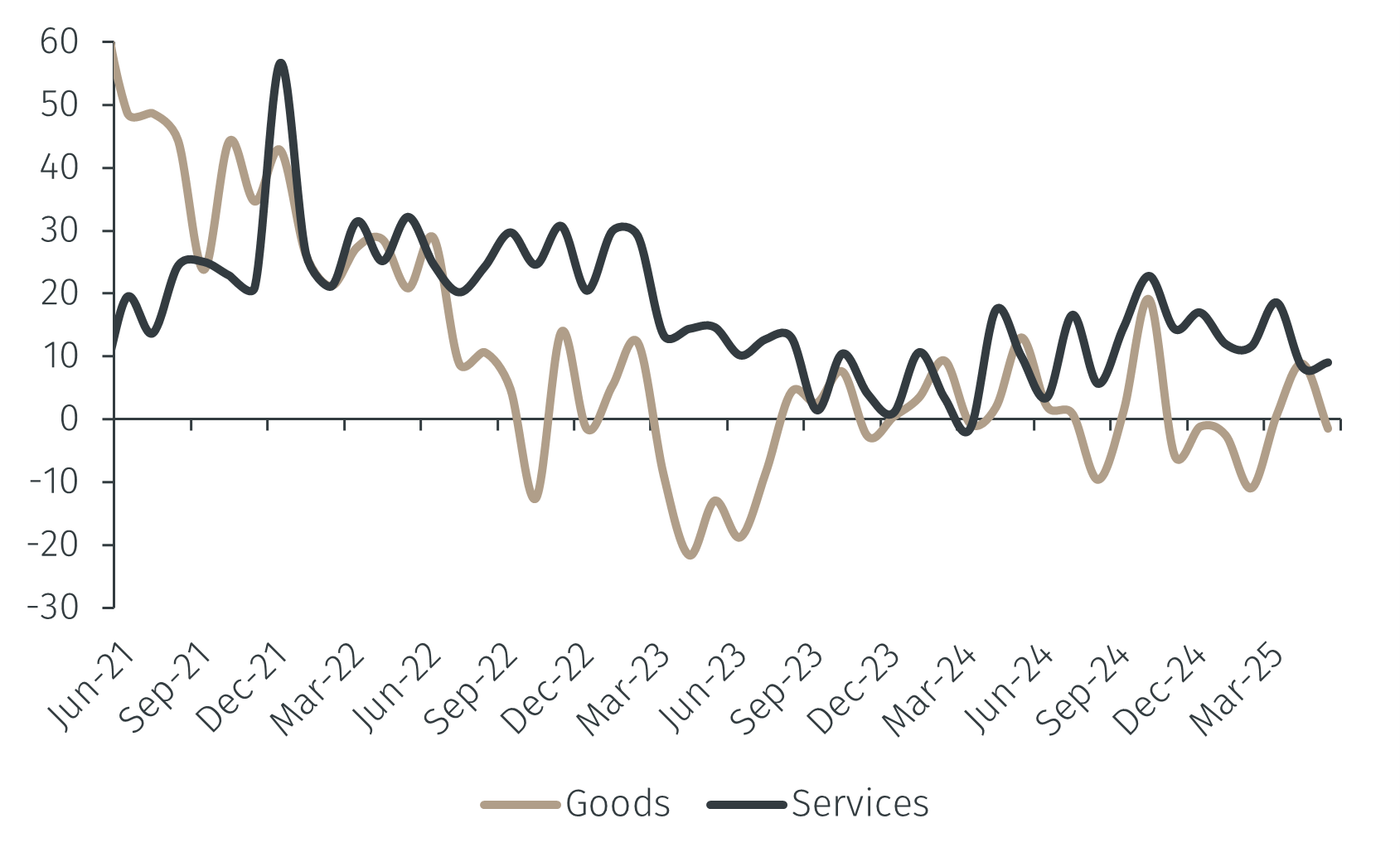
The need to ease policy was amplified by uncertainty caused by far-reaching changes in US trade policy brought by the Trump Administration. Merchandise exports, which are impacted directly by tariffs, have been weak so far in 2025 (see Chart 2). However, services exports, which are not directly impacted by tariffs, have remained strong.
Chart 2. Indian exports of goods and services (% change, year-on-year)
Source: LSEG Data & Analytics and EFGAM calculations. Data as at 03 July 2025.
Despite uncertainty related to trade policy, the outlook for India’s economy in fiscal year (FY) 2025-26 remains encouraging. The RBI expects real GDP to grow 6.5% in FY 2025-26, the same rate as in FY 2024-25, supported by strong domestic demand and government capital expenditures.
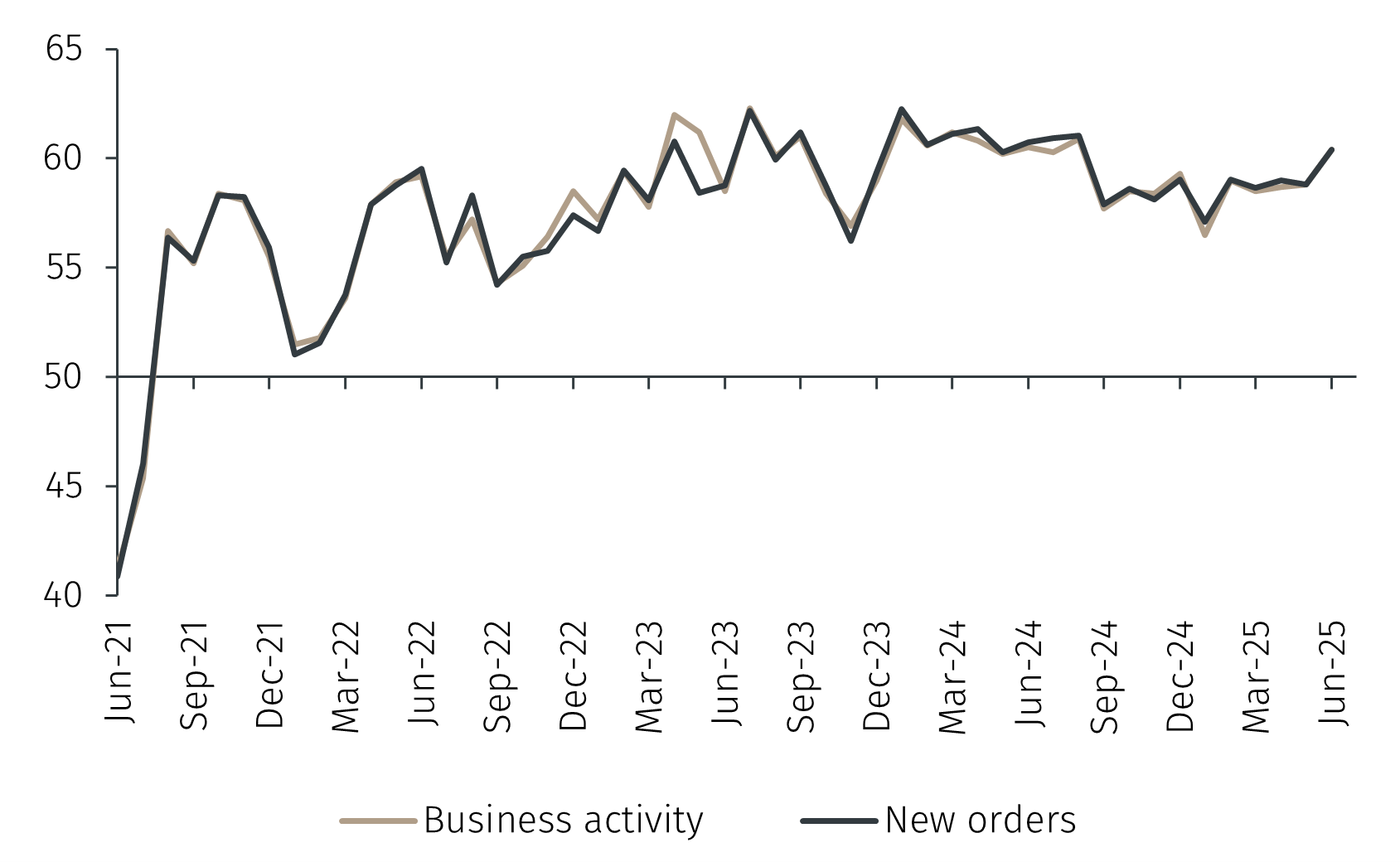
Above average southwest monsoon rainfall is expected to lift output in the agricultural sector in India.1 In turn, this should boost income for India’s rural population, further strengthening demand for fast-moving consumer goods.2 Similarly, urban demand is expected to remain robust, supported by strength in the services sector. This is highlighted by purchasing managers’ index data, which has been significantly above the 50-level separating expansion from contraction for both the business activity and new orders components for the last 47 months (see Chart 3).
Chart 3. Indian services purchasing managers’ index3
Source: LSEG Data & Analytics and EFGAM calculations. Data as at 03 July 2025.
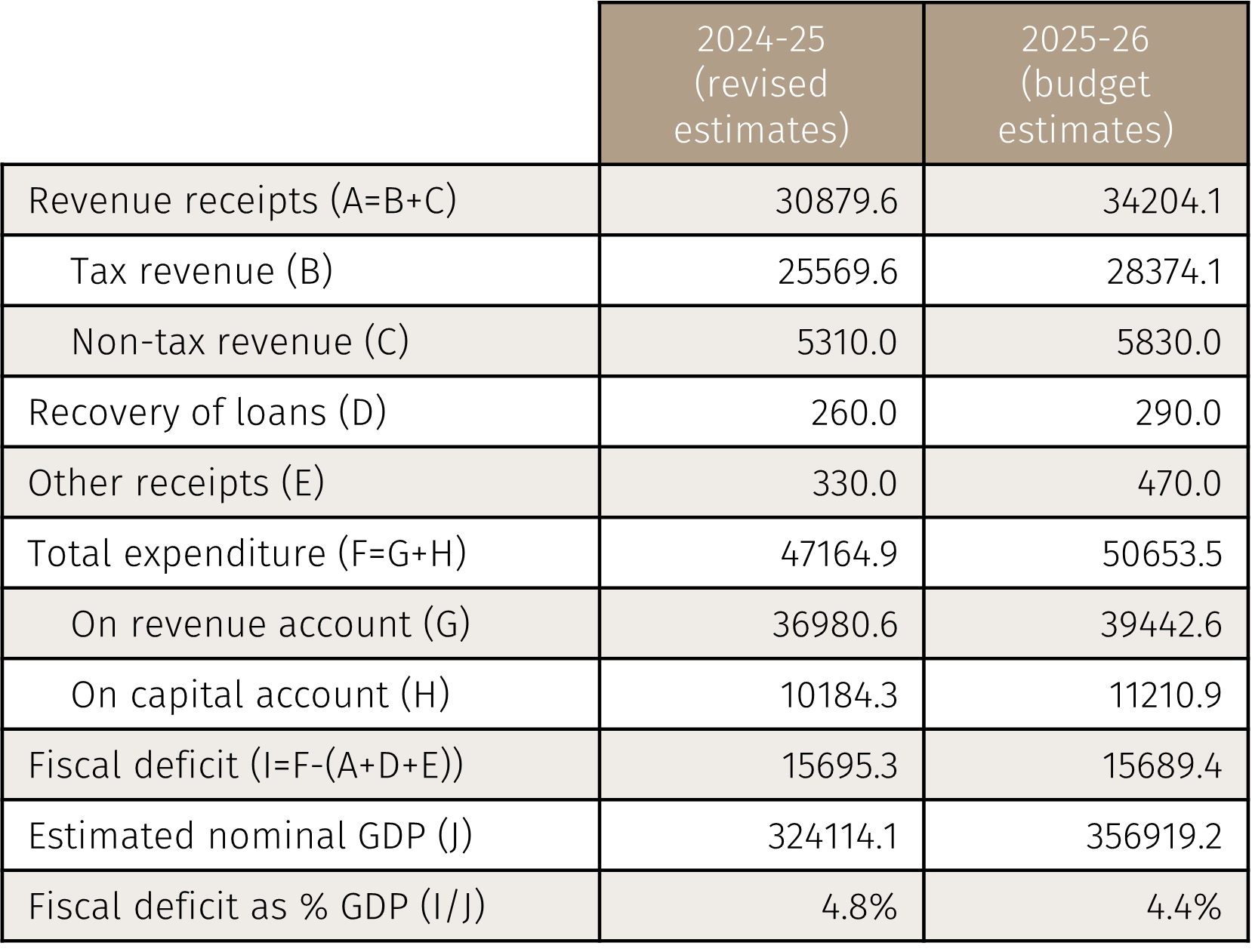
Having grown by 5.2% in FY 2024-25, the Indian government’s effective capital expenditure is budgeted to grow by 17.4% in FY 2025-26.4 The focus of the capex will be on infrastructure, a key pillar of the Modi government’s plan for promoting economic growth.5 Impressively, this is expected to be done while consolidating the fiscal position, with the fiscal deficit projected to decline from 4.8% of GDP to 4.4% of GDP as strong nominal GDP growth leads to higher tax revenues (see Table 1).
Table 1. Indian budget 2025-26 (Indian rupees, billions)6
Source: India Ministry of Finance and EFGAM calculations. Data as at 03 July 2025.
With the growth outlook improving, the Reserve Bank of India changed its policy stance from “accommodative” to “neutral” in June, adopting a data-dependent approach for future monetary policy decisions. Thus, in the absence of shocks it is unlikely that monetary policy is changed during the remainder of the fiscal year.
In summary, the RBI has cut its policy interest rate by a cumulative 100 basis points since February, taking advantage of the policy space provided by low inflation to support weak GDP growth. Growth has now rebounded, and no further rate cuts should be expected in FY 2025-26. The outlook for India’s economy is encouraging, with activity likely to be supported by strengthening consumption and government capital expenditure.
1 Monsoon rainfall is projected by the India Meteorological Department to be 106% of the Long Period Average. https://mausam.imd.gov.in/Forecast/marquee_data/press_release_2nd_stage_lrf_may2025_final%20(3).pdf
2 Fast-moving consumer goods (FMCG) are products sold quickly and at low cost. Urban households in India have shifted towards e-commerce and FMCG growth is now driven by rural households. https://nielseniq.com/global/en/insights/analysis/2025/fmcg-growth-momentum-shifts-rural-india-and-small-players-take-charge/
3 A purchasing managers’ index is a diffusion index which can take a score between 0 and 100. A score above 50 signals expansion while a score below 50 signals contraction.
4 EFGAM calculations based on the FY 2025-26 Union Budget. Effective capital expenditure refers to the sum of capital expenditure and grants-in-aid for creation of capital assets.
5 See InFocus piece: ‘What Modi’s re-election means for India’s economy’.
6 https://www.indiabudget.gov.in/doc/budget_at_glance/bag1.pdf