

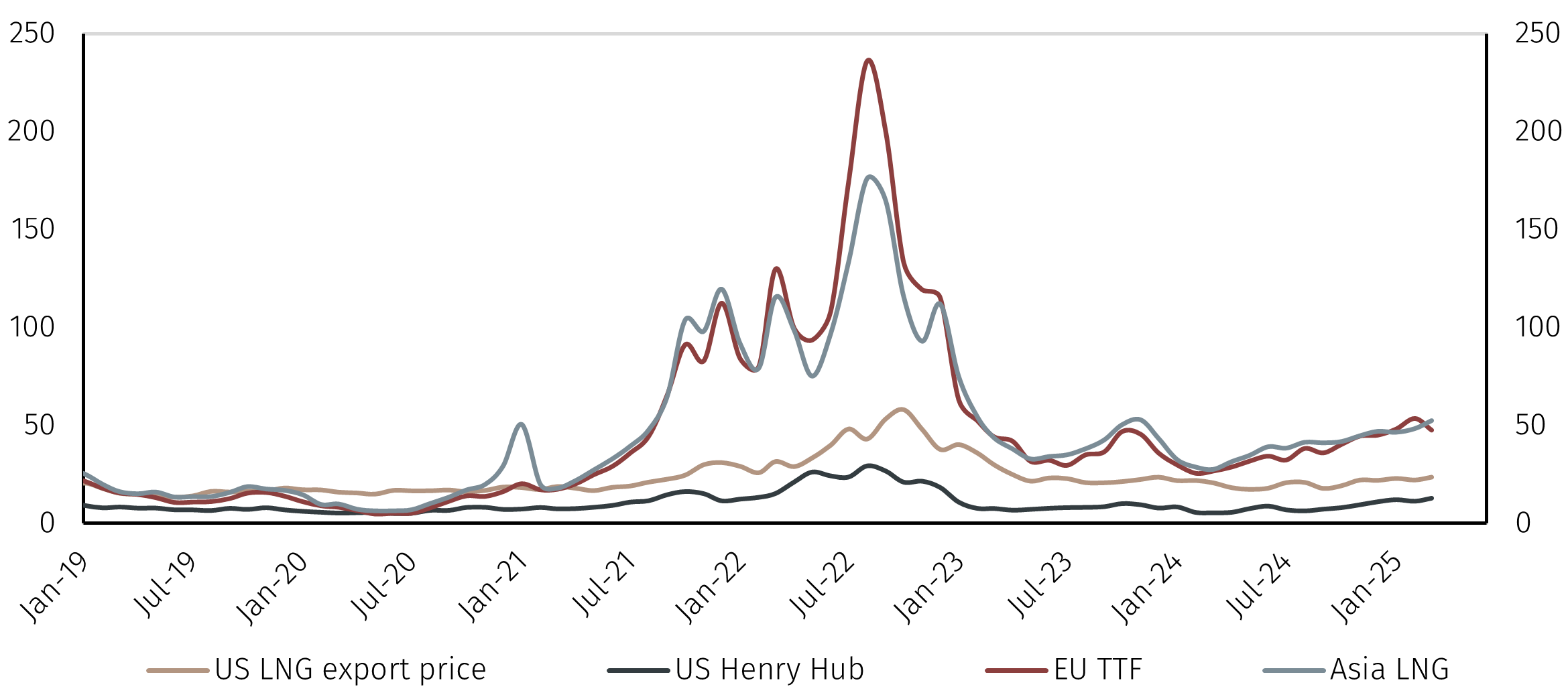
On 10 February, the European benchmark price of natural gas rose to EUR 59 per megawatt hour (MWh), the highest since early 2023 (see Chart 1). Although much lower than the 26 August 2022 intraday peak near EUR 350 MWh, the price was 155% above the February 2024 low. The price has currently fallen to about EUR 50 MWh but remains more than twice as high as a year ago.
EU natural gas prices to gradually normalise
Investment Insights • Macro
3 min read
EU natural gas prices to gradually normalise
The European price of natural gas has doubled in the last twelve months. In this Macro Flash Note, Senior Economist GianLuigi Mandruzzato looks at the causes of the price increase, the outlook for the coming months and the possible implications for the eurozone economy.
Chart 1. Natural gas prices (EUR per MWh)
Source: LSEG Data & Analytics and EFGAM calculations. Data as at 18 February, 2025.
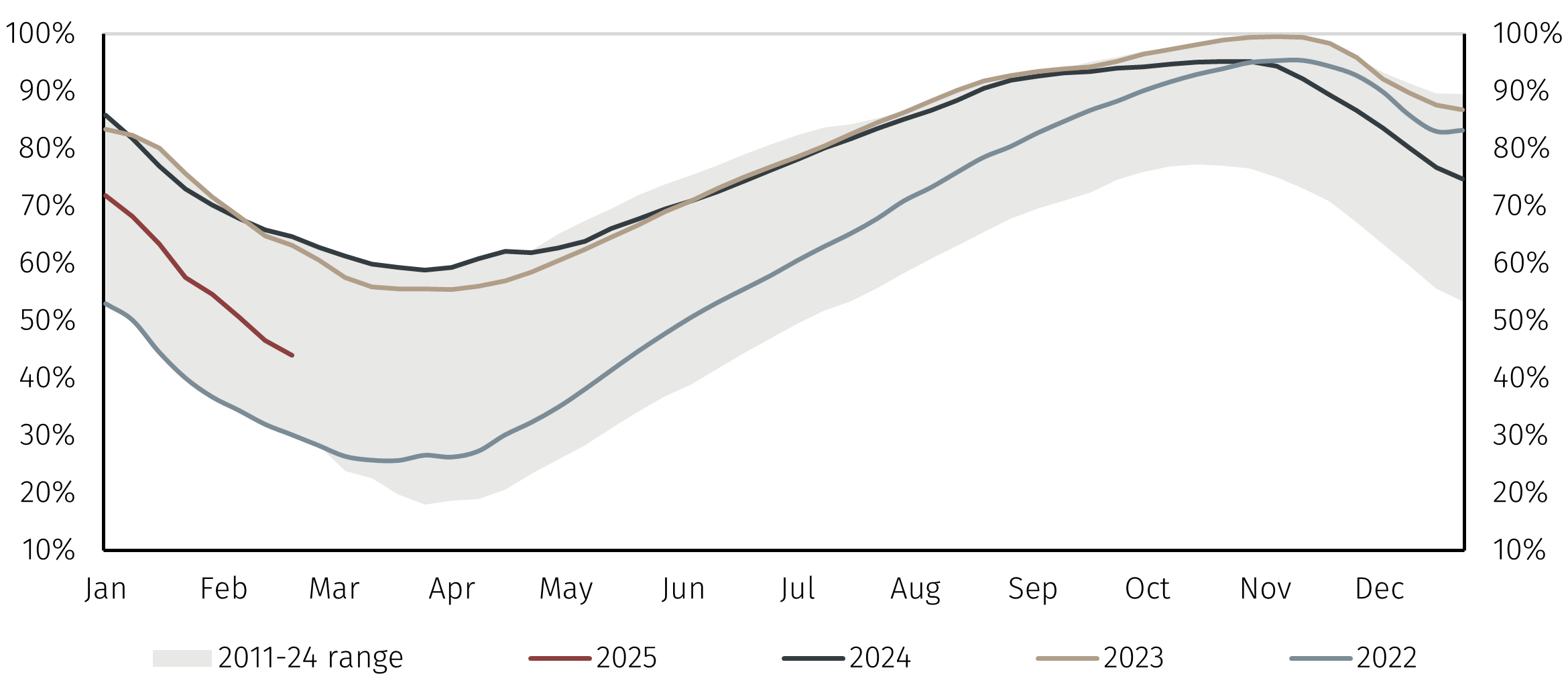
Commentators have linked the price surge to a fear that a rapid decline in inventories heralded another crisis like in 2021 and 2022 (see Chart 2). To assess this risk, it is important to consider the factors behind the accelerated decline in inventories. First, colder temperatures than in recent winters and weak wind power production boosted natural gas demand for heating and electricity generation. Second, the halt to natural gas imports from Russia via pipelines from 01 January 2025 cut inflows to Europe by about 10%.
Chart 2. EU natural gas storage, % of capacity
Source: LSEG Data & Analytics and EFGAM calculations. Data as at 18 February, 2025.
However, the cold temperatures were short-lived, and the inventories decline has recently slowed close to the rates of the past two years, also reflecting the weakness of European manufacturing activity. If the recent trend continues, European gas inventories would trough between 35% and 40% of capacity, well above the historical lows.
Barring new shocks, in our view European natural gas prices should decline but only gradually as sustained imports will be needed to rebuild inventories to around 90% of capacity before next winter. The premium on European gas prices over US prices should normalise before next winter helping to return prices to more sustainable levels.
Futures contracts on European gas prices point to a drop around EUR 45 MWh by the end of 2025 and close to EUR 30 MWh in 2027. This suggests that investors view the current gas market tensions as transitory.
However, high natural gas prices will affect eurozone inflation. Applying estimates of the Bank of Spain, a shock like that experienced last year could boost eurozone inflation by nearly half a percentage point in 2025H2.1 Rising gas and electricity bills could also weigh on eurozone GDP growth, with an asymmetric impact on member countries depending on their reliance on natural gas.
Hence, the eurozone faces an increased risk of a mild stagflation in the next few months. If this risk materialises, the European Central Bank might slow the pace of interest rate cuts, potentially hurting both the stock and the bond markets and perhaps also the euro.
1 See “The pass-through of higher natural gas prices to inflation in the euro area and in Spain”, Lucía López, Susana Párraga and Daniel Santabárbara, Bank of Spain Economic Bullettin, 3/2022.