No need for negative SNB rates

All Insights

Currently reading

Autumn Budget: Reeves bets on delayed tax rises and higher spending to boost growth

Investment Insights • Macro

3 min read

Autumn Budget: Reeves bets on delayed tax rises and higher spending to boost growth

On 26 November UK Chancellor Rachel Reeves presented the Autumn Budget. She announced a series of tax increases and government spending cuts in an attempt to reignite GDP growth in the coming years. In this Macro Flash Note, Economist & Strategist Joaquin Thul discusses the impact of the budget.

The budget came against a backdrop of controversy, in which the Office for Budget Responsibility (OBR), the UK’s fiscal watchdog, leaked its Economic and Fiscal Outlook ahead of the budget announcement. Despite this, Chancellor Reeves presented a more optimistic view of the UK economy than what was initially anticipated.

The Chancellor announced a series of tax increases aimed at raising revenues by £26bn by Fiscal Year (FY) 2029-30. These intend to keep one of Labour’s pledges not to change corporation tax nor income tax, national insurance or VAT. This is difficult as the latter three taxes represent over 60% of the UK’s total tax revenue.1 Additionally, Reeves’ spending measures focused on reversing changes to welfare policies, looking to benefit lower income households.

Despite the lack of direct measures to reduce the UK’s fiscal deficit, markets welcomed these announcements. However, officials acknowledged the fiscal situation remains challenging and long-term debt sustainability remains a concern. For that, the government chose the path of tax increases and short-term increase in spending to generate conditions for the private sector to drive economic growth.

Budget details
The government plans to make a series of back-loaded changes to personal taxes that are only expected to take effect from FY 2028-29. These include freezing the income tax thresholds and lowering the tax incentives for salary sacrifice programs. It plans to increase income tax rates on property, savings and dividends, which are expected to take effect FY 2026-27.

Additionally, it expects to make a number of other changes including writing down allowances, introducing milage-based charges on electric cars, changing gambling duties, and introducing a surcharge on high-value council taxes. The estimated effects of these measures are summarised in Table 1.
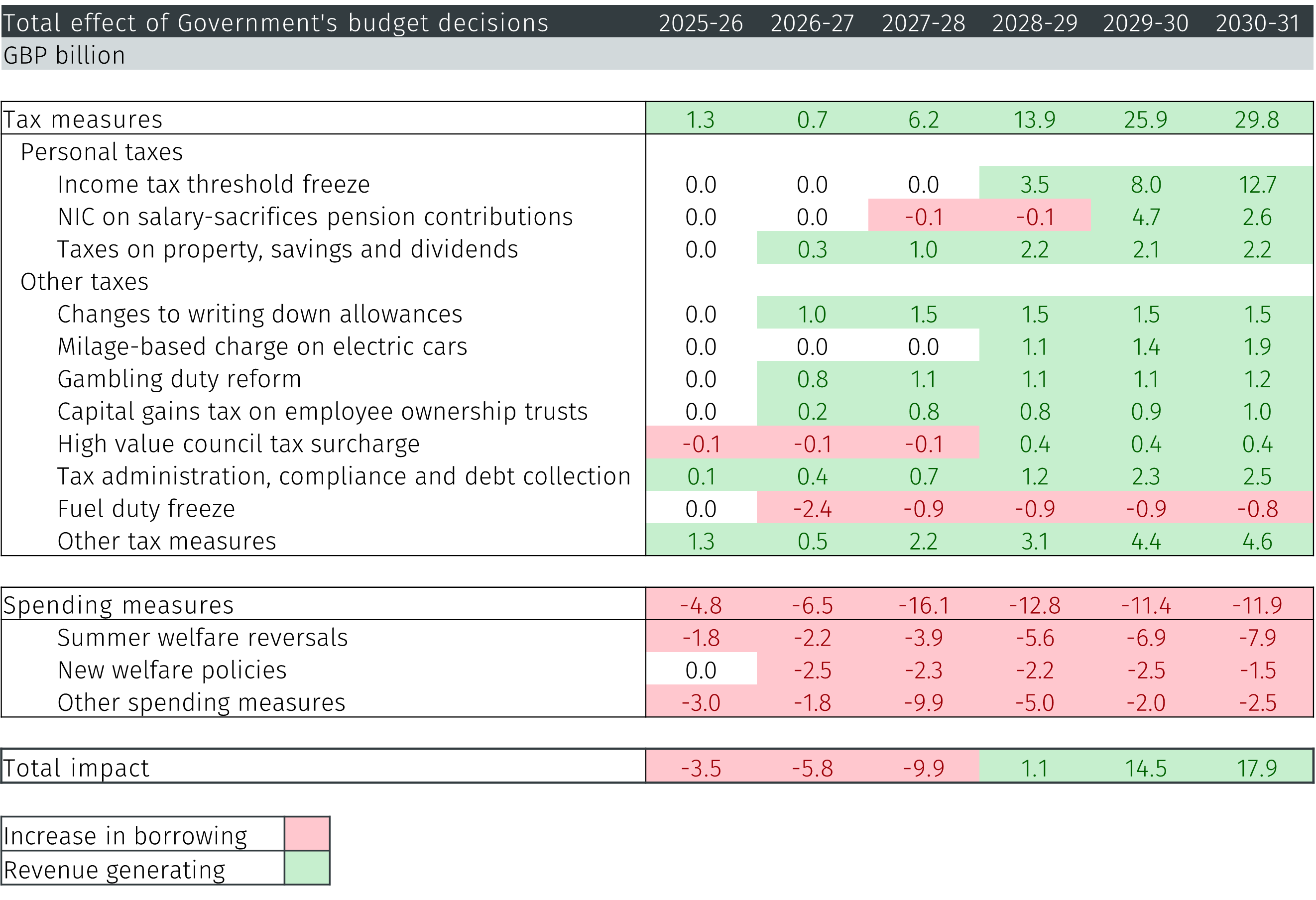
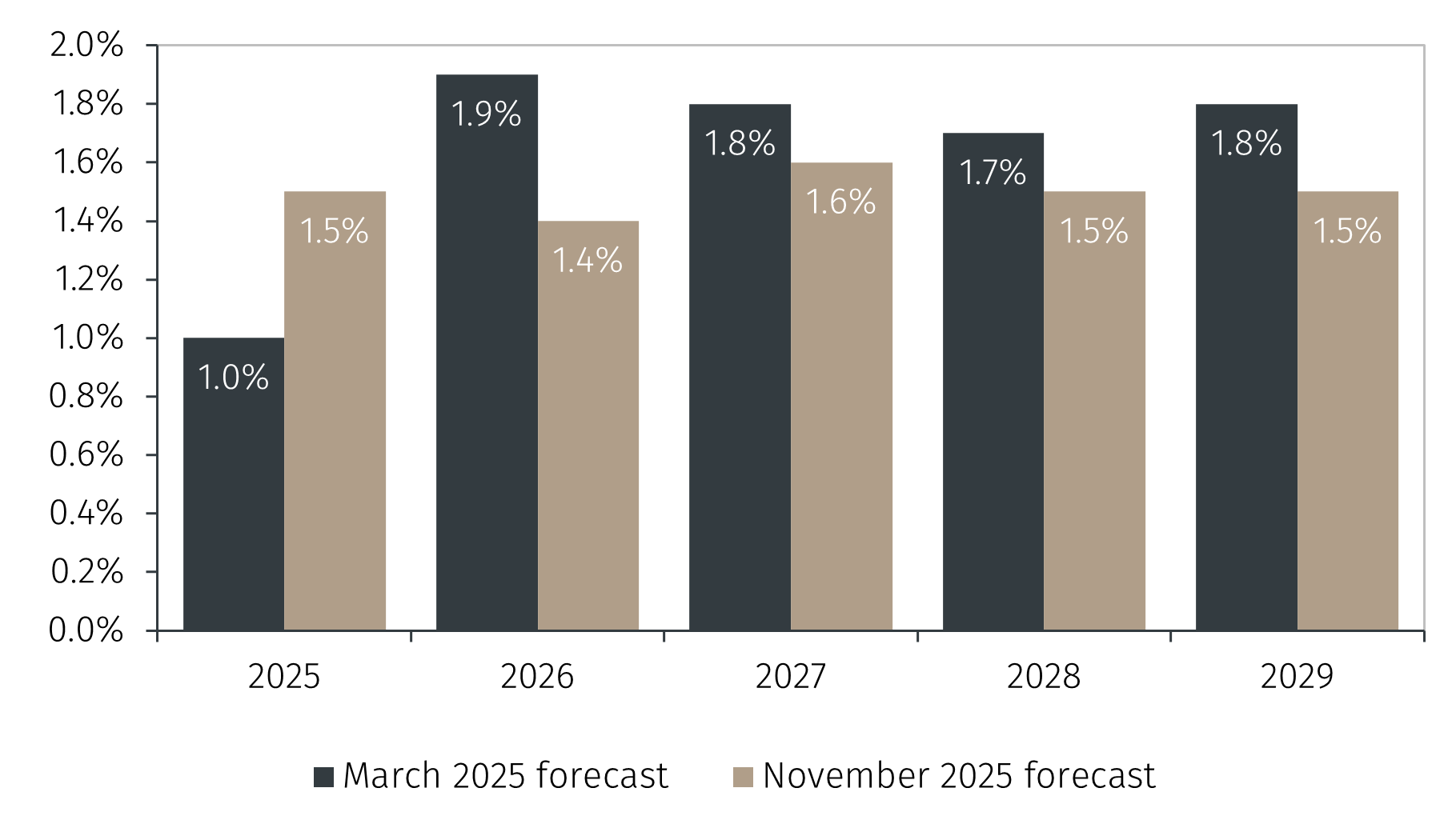
Table 1. Total effect of Government’s budget decisions

UKB1.png

Source: OBR and EFGAM. Data as of 26 November 2025.

Perhaps the most notable deviation from expectations was the absence of any announced cuts to government spending. On the contrary, the government announced a series of measures in the form of new welfare policies, reversals of previously announced cuts to winter fuel payments and health-related benefits, and a removal of the two-child limit benefits. All these are expected to increase public spending by £11.4bn by 2029-30, see Table 1.

The expected total impact of these measures is to increase government spending in the next two fiscal years, 2026-27 and 2027-28. From FY 2028-29 the changes announced to the tax policy are expected to more than offset this increase in spending.

These announcements were released together with a better-than expected OBR forecasts. The UK’s fiscal watchdog upgraded its projection for UK GDP growth in 2025 from 1.0% to 1.5%. However, it downgraded its projections for the remaining of the forecast period until 2029, see Chart 1.

Chart 1. OBR UK GDP growth projections

UKB2.png

Source: OBR and EFGAM. Data as of 26 November 2025.

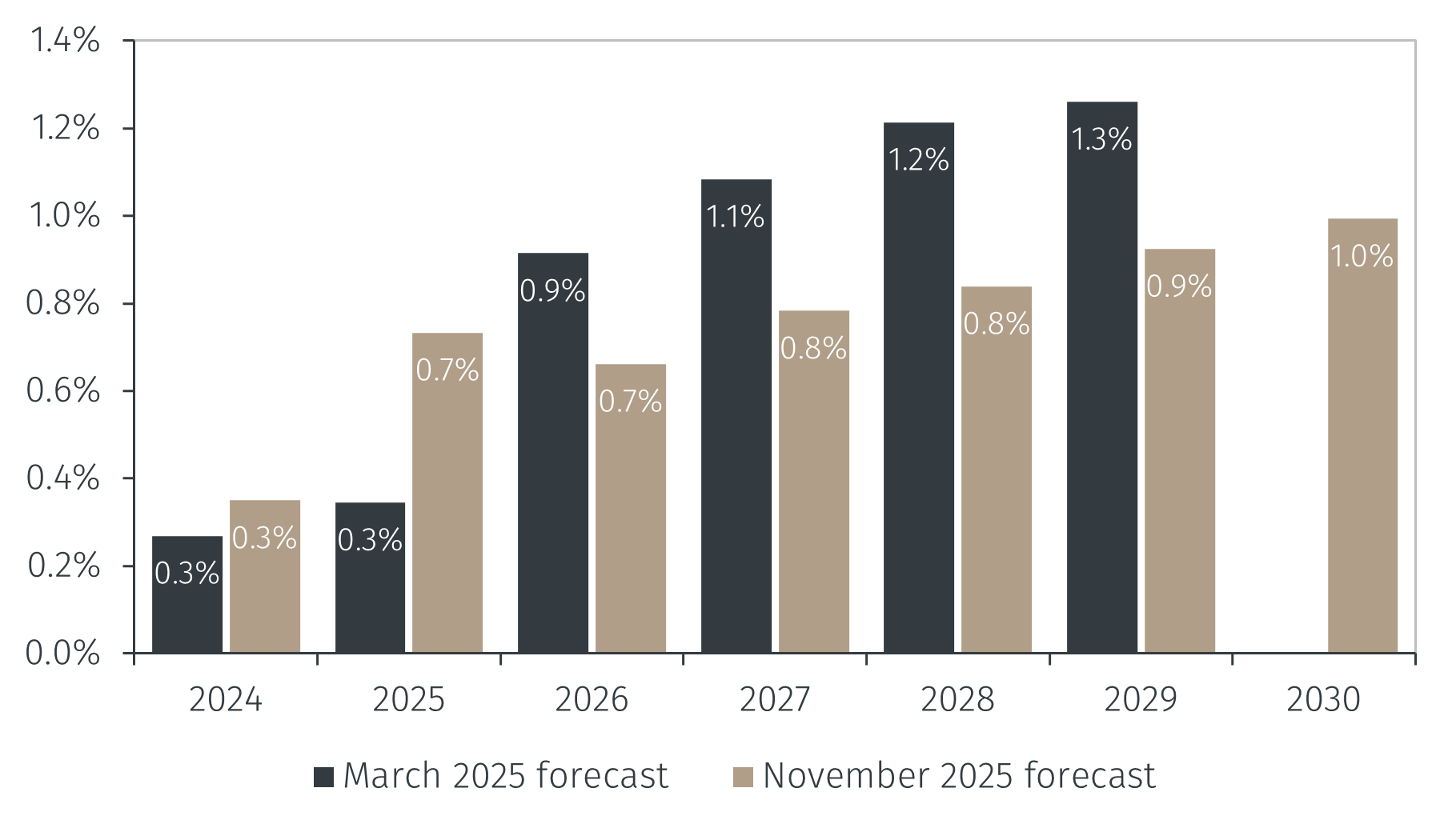
The upgrade to GDP growth in 2025 is justified by a better-than-expected output growth in the second half of 2024 and in Q1-2025. However, part of this impact has been attributed to temporary frontloading of exports, as firms tried to get ahead of potential tariff increases, and property transactions, as households looked to avoid changes to the stamp duty threshold. The outlook for the coming years has been downgraded in relation to weaker productivity growth in the UK economy, see Chart 2.

Chart 2. UK productivity growth estimates

UKB3.png

Source: OBR and EFGAM. Data as of 26 November 2025.

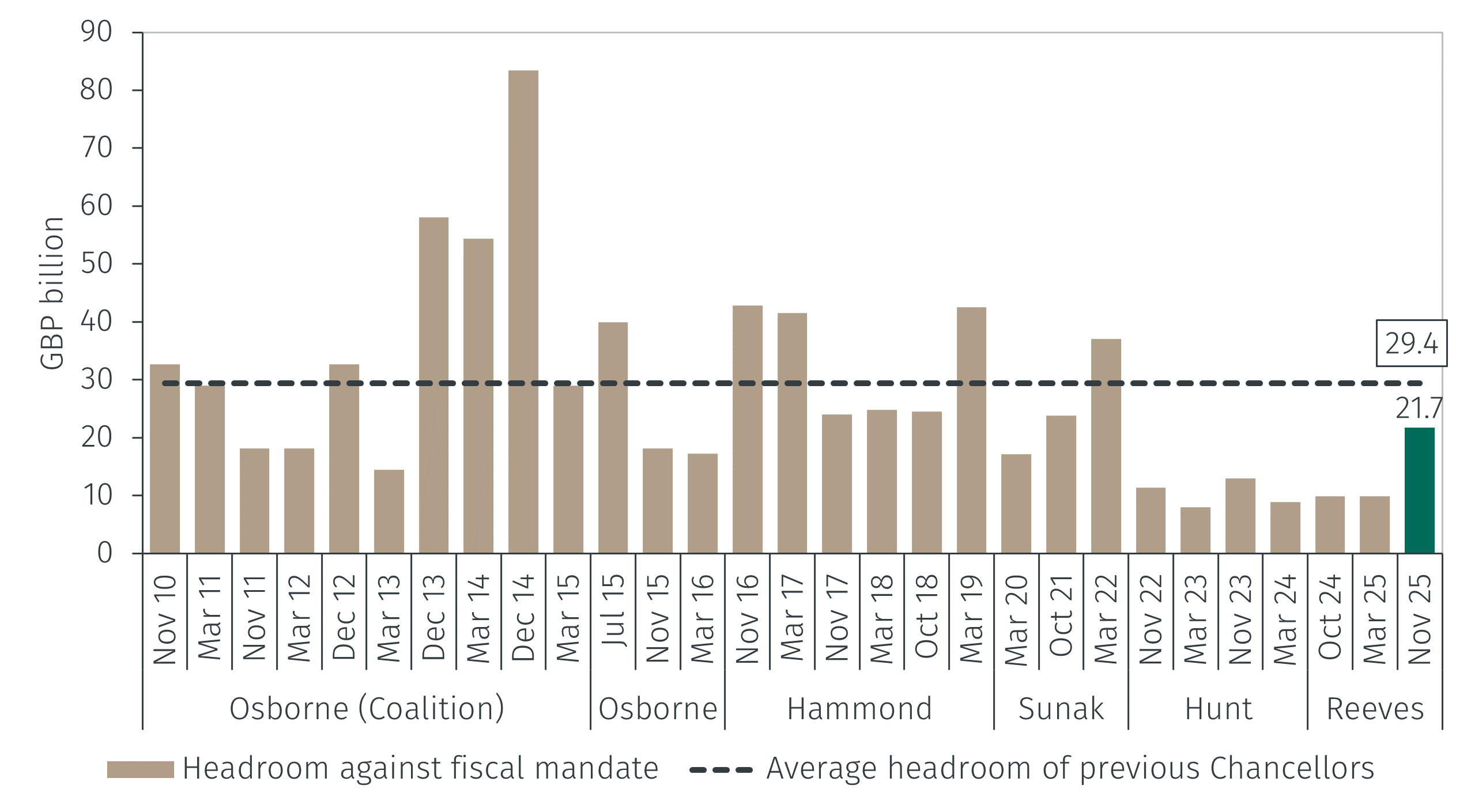
Given the OBR’s GDP growth forecasts, the government’s proposed changes to taxes and spending, and the projections for the UK’s productivity growth in the coming years, the margin allowed for the government to meet its fiscal rules is expected to increase from £9.9bn to almost £22bn. This is commonly referred to as the “fiscal headroom”. Although this represents an improvement in the headroom available in relation to recent years, it remains below the average of £29.4bn, see Chart 3. As estimated by the OBR, this headroom is still small in relation to the uncertainty around growth, productivity estimations and the potential impact from changes to Bank rate from the Bank of England.

Chart 3. Headroom against the fiscal mandate (GBP billion)

UKB4.png

Source: OBR and EFGAM. Data as of 26 November 2025.

Conclusion
Chancellor Reeves delivered better news than what was initially anticipated. The document provides a gradual increase in the tax pressure in the coming years with no cuts to government spending. However, given a revised forecast from the OBR, the actual headroom available for the Chancellor to meet its goals is expected to increase.

The market’s reaction to the budget was positive, with GBP rising 0.2% against the US dollar to $1.3240 while yields on UK gilts fell immediately after the announcements as investors welcomed parts of the budget. Yields on 10-year UK gilts fell to 4.41% on the day after the budget, but continued the upward trend later last week as investors started to assess the impact of delayed tax increases.

Additionally, some of the proposals to freeze fuel duty and lower household energy bills are expected to have a positive, downward, impact on UK inflation in the coming months. This will be welcomed by the Bank of England in its objective to bring inflation down to 2%, giving them more evidence to support further interest rate cuts. However, it is still uncertain whether these measures will be enough to boost GDP growth in the UK given much of the impact from the announced tax increases will only be felt at the end of this Parliament period.

Within our asset allocation, we remain underweight to UK large-cap equities despite attractive relative valuations. This is due to recent headwinds to productivity growth and high interest rates. However, in this context a continuation in the rate-cutting cycle from the BoE in December 2025 and through 2026, on the backdrop of a gradual deceleration of inflation, could provide an attractive tailwind for mid-cap companies.

1 Data from the Institute for Fiscal Studies, as of 2024.

Richiesto

Richiesto

Richiesto

Richiesto

Richiesto

Richiesto

Richiesto

Please note you can manage your subscriptions by visiting the Preferences link in the emails you receive from us.

Richiesto