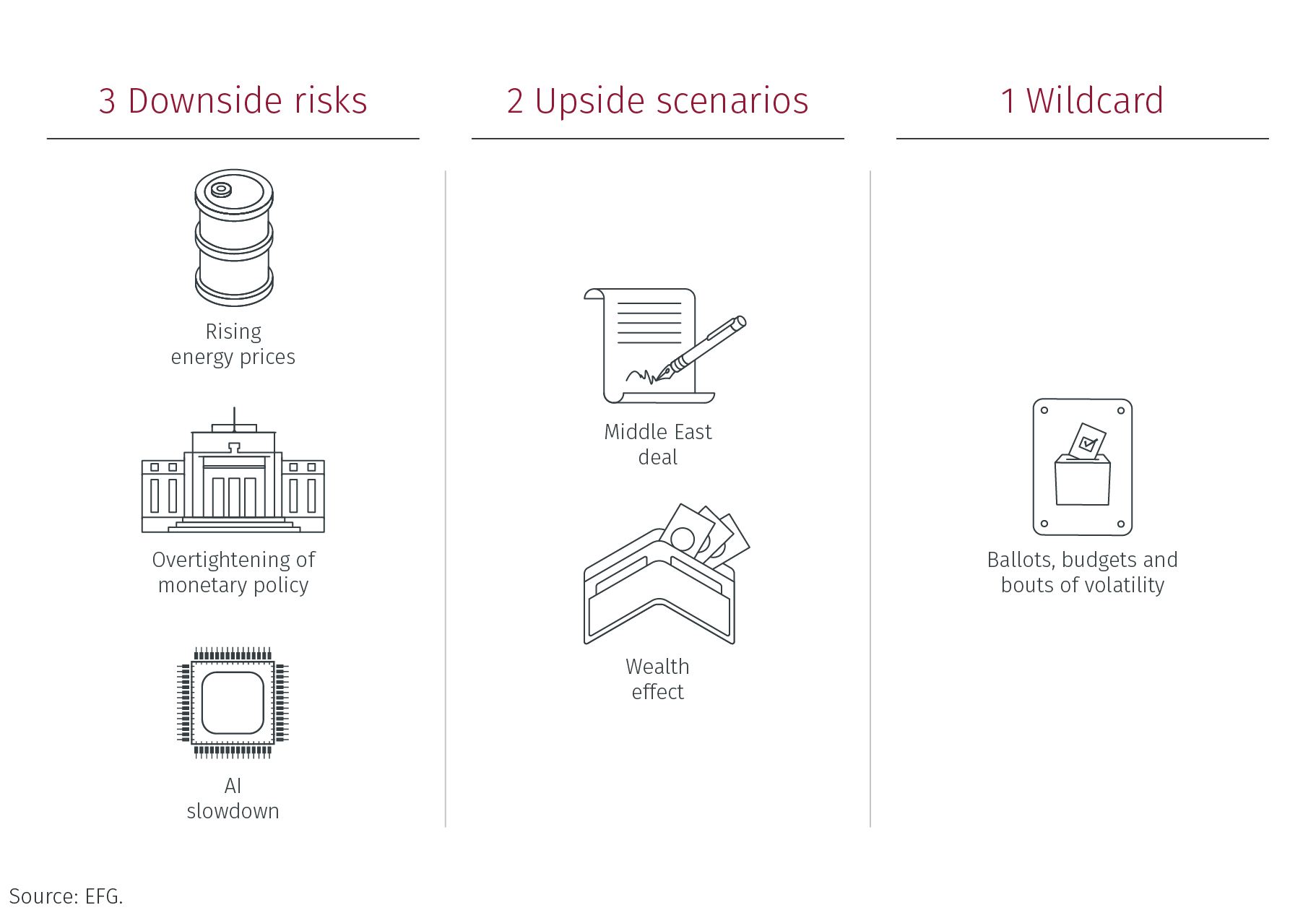
Three negative scenarios
1. Energy starts to matter – So far, higher energy prices have neither fed through meaningfully to core inflation nor significantly affected activity. However, the longer the war persists and the higher prices move, the greater the risk of a more profound impact. Companies may be able to absorb higher energy input costs temporarily, provided they are not too large. If costs rise by too much, for too long, companies will be forced to raise prices to protect profit margins, increasing the risk that higher energy costs spill over into broader inflation.
2. Central banks overshoot – Central banking is always difficult, not least because of long and variable lags between the enactment of policy and its effects. It may only become clear after the event whether policy rates were set at the right level. If central banks respond too aggressively to headline inflation, they could raise rates to a point at which growth slows meaningfully. Higher borrowing costs would weigh on consumer spending and could further weaken housing markets that are already sluggish in parts of the world. This is particularly relevant in economies where many households must refinance their mortgages at higher rates.
For example, it is estimated that roughly 800,000 homes in the UK currently facing a mortgage rate of 3% or less will need to remortgage in 2027.1 There has also been a sharp rise in housing-related expenditures in the EU recently, a part of which is related to higher mortgage costs.
In contrast, 30-year fixed-rate mortgages are common in the US, implying that the impact of higher borrowing costs will feed through only slowly for existing home owners. Nonetheless, higher mortgage costs on new loans have deterred buyers from entering the market and reduced transaction volumes, something that may drag on activity more broadly in the future.
3. AI: from growth engine to speed bump – Gartner estimates that global AI infrastructure spending will reach nearly $2.0 trillion in 2027 (Figure 2), with broader AI-related spending on software and services adding a further $1.7 trillion.2 This would represent a combined increase of $1.0 trillion relative to 2026, equivalent to a growth rate of 36%.