On Saturday 4 January, US President Donald Trump announced the US had conducted a military operation in Venezuela which resulted in the capture of Venezuelan President Nicolas Maduro and his wife Cilia Flores. Trump announced Maduro was transported to New York where he is expected to appear in US federal court, facing charges of overseeing a state-sponsored drug trafficking network.
Longstanding tensions and allegations
The US has long regarded Maduro as a dictator and the illegitimate leader of Venezuela, following what it considers fraudulent elections in 2018 and 2024. However, allegations linking him to drug-trafficking date back to the time he was first elected to the Venezuelan National Assembly in 2000. According to the US Drug Enforcement Agency, Venezuela is a transit country for Colombian drugs, but it is not linked to the production or shipment of fentanyl, a topic which is politically sensitive for Trump.
As a result of this operation, President Trump claimed the US will “run Venezuela until such time as we can do a safe, proper and judicious transition”. In the wake of Maduro’s arrest, Venezuelan Vice President Delcy Rodriguez has been named as the de-facto leader. She appeared in public shortly after her appointment condemning the US actions and asking for Maduro to be released. Following contact between US authorities and Delcy Rodriguez, President Trump warned Venezuela’s new leader that she could pay a “big price” if she does not follow US orders.
Historical comparisons
The operation resembles that from 36 years ago, when US forces arrested Panamanian dictator Manuel Noriega, who was also convicted on drug trafficking charges. His arrest on 3 January 1990 led to the end of Panama’s military dictatorship. Questions were raised over the possibility that Venezuela could follow the same path.
Reactions around the world have been varied. Governments close to Trump, such as Argentina’s Milei, praised the US actions. The Presidents of Colombia and Brazil issued a joint statement together with leaders from Chile, Mexico, Uruguay and Spain, reiterating concerns about US intervention in a sovereign territory. Despite being highly critical of Maduro, they emphasized that the operation represent an infringement of international law.
Short-term implications
The initial stage of the transition is likely to be limited to stabilising the political situation and avoiding violence on the streets. This will require the US, or its appointee, to negotiate with government officials.
Since the news of Maduro’s arrest became public, there has been speculation over who would become Venezuela’s new leader. Local opposition and international commentators have argued in favour of either Maria Corina Machado, a recent Nobel Peace Prize winner, or Edmundo Gonzalez Urrutia, the leader of the opposition, to take over. Gonzalez Urrutia claims to have won the last election in 2024.
However, this is unlikely to happen in the short term. For now, Delcy Rodriguez, former Vice President under Maduro, seems likely to remain in power given that she brings a series of things that are needed at this point of the transition:
- Rodriguez provides administrative continuity in the country. She can enable ministries to continue working, together with transport infrastructure, public banks and PDVSA, the state-owned oil company to continue working.
- She also has direct contact with the lines of power in Venezuela, with access to the military and intelligence agencies. The US needs to keep these under control given they are potential sources of unrest.
- Rodriguez also has the legal authority, to sign executive orders and provide information as acting President. This is also in the US’ interests as she can provide stability in a period of uncertainty.
The search for stability
Although Maria Corina Machado has international recognition and domestic support, she lacks control of logistics, military, and territory across Venezuela. It is not clear that she could guarantee stability across the country, as supporters of Maduro would likely see her leadership as illegitimate. While Edmundo Gonzalez Urrutia is seen as a potential consensus leader, he also lacks control over the government apparatus. The appointment of Delcy Rodriguez remains better from a US perspective as she is someone the Trump administration can control in the short term.
A second stage would then involve setting the conditions for a new government, taking the measures to ensure security, cut ties with drug-trafficking networks, and restore calm. This would create conditions for democratic elections. This is when figures such as Maria Corina Machado or Gonzalez Urrutia would be expected to be involved.
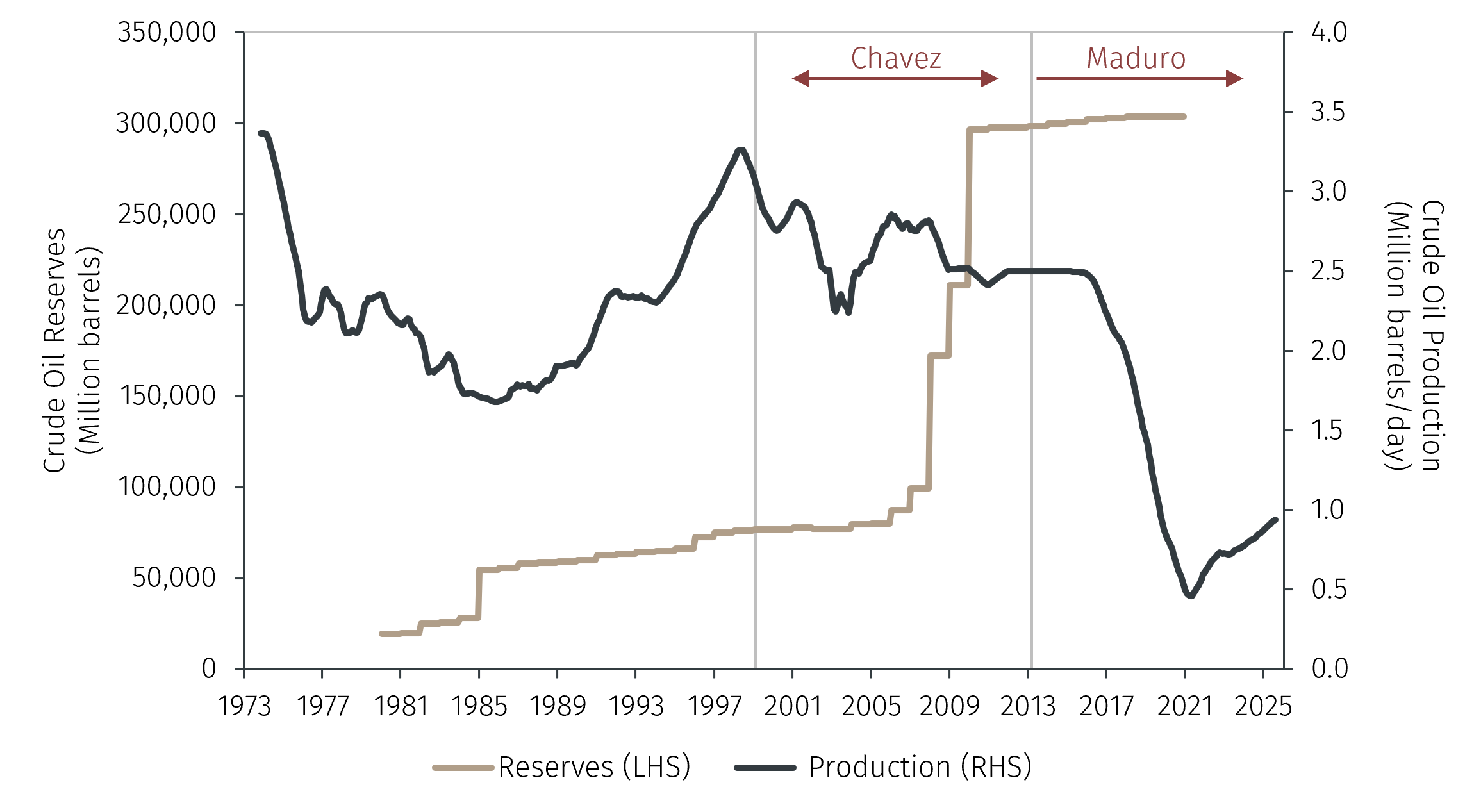
Oil production: the elephant in the room
At the press conference following the operation, President Trump said that US oil companies will be returning to Venezuela and investing billions of dollars to get oil flowing again. However, this is easier said than done.