
© 2026, ProLitteris, Zurich
News & interviews
2 min read
Jean Tinguely, the pioneering Swiss sculptor and founding member of the Nouveaux Réalistes, redefined the relationship between humans and machines. Rather than depicting the human figure directly, he constructed kinetic sculptures from scrap metal, motors and discarded objects – creating mechanical bodies that seem uncannily alive. His works do not celebrate technological perfection; instead, they expose fragility, imperfection and movement as essential conditions shared by both humans and machines.

Marketing & Communications
© 2026, ProLitteris, Zurich
Text: Francesca Martinoli
Art Curator, EFG Corporate Collection
Augmented Imperfection
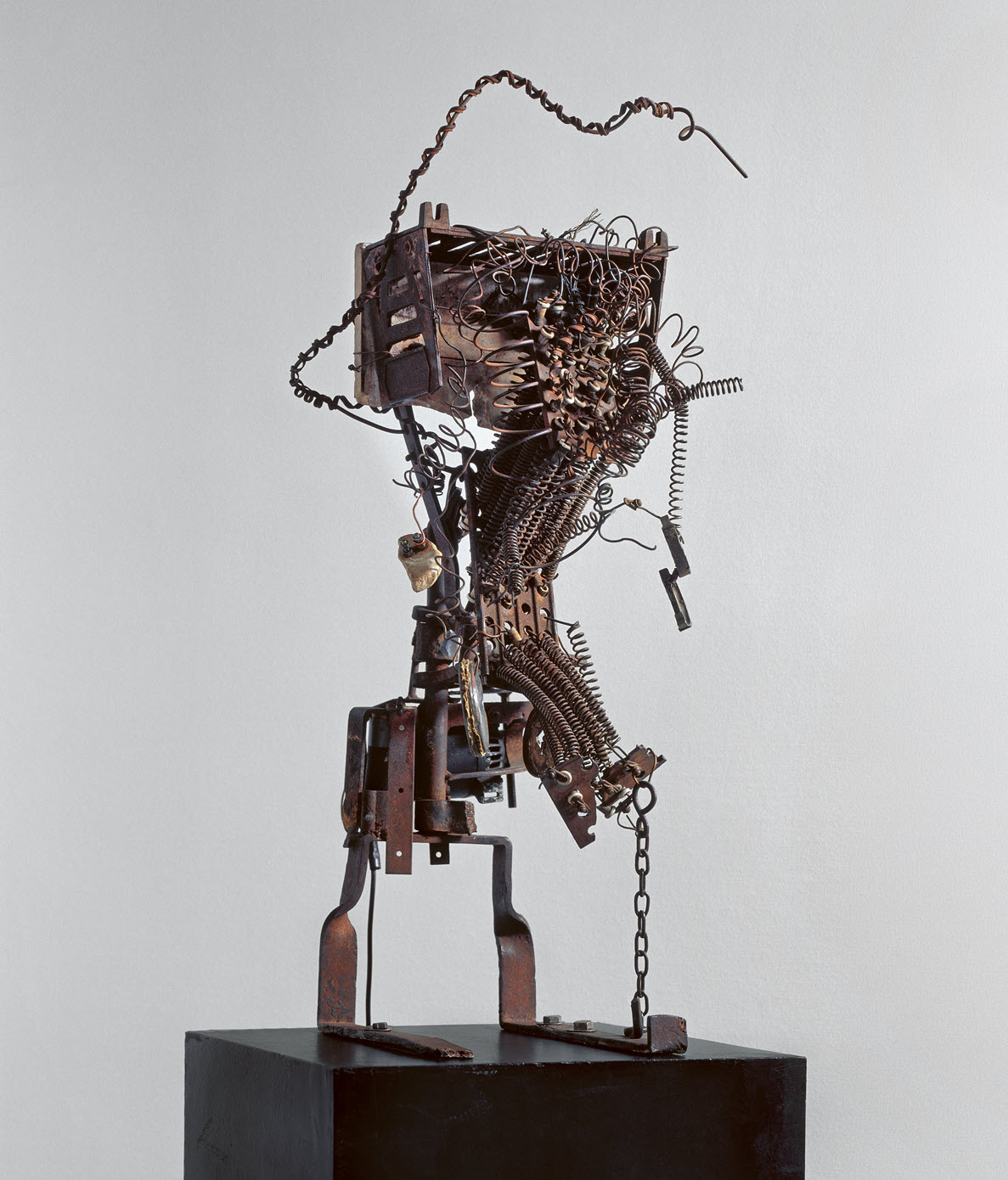
Totem IX (1960) is a striking embodiment of this vision. Built from twisted iron, wire and a salvaged motor, the sculpture rises on two legs like a precarious figure. Its structure evokes a body with a rib-like frame, a spinal column and tangled springs spilling outwards like entrails. When activated, it jerks into motion with erratic, almost nervous gestures, accompanied by clattering sounds. Yet rather than appearing threatening, this mechanical “creature” feels oddly vulnerable and even likeable.
In the context of augmenting mankind, Totem IX offers a surprisingly prescient perspective. Today, augmentation often implies enhancement, efficiency and seamless integration between human and machine. However, Tinguely presents a different narrative − one in which the machine mirrors human limitations rather than transcending them. His sculpture suggests that any extension of the human body through technology inevitably carries the same instability, unpredictability and incompleteness.
Created during a prolific period following his time in New York, Totem IX also reflects Tinguely’s liberation through material experimentation. Discovering that “any and every material could be worked,” he embraced scrap as both medium and message. Reality itself became the raw material of art, aligning with the Nouveaux Réalistes’ belief that art should not imitate life but directly incorporate it.
By naming the work a “totem” Tinguely adds an ironic layer to it. Traditionally a symbol of power or spiritual protection, this totem is instead fragile, restless and imperfect. It does not promise mastery over technology but reveals a deeper truth: That in augmenting ourselves, we do not escape our nature − we reproduce it. In this sense, Totem IX is less a monument to progress than a poetic reminder that even in an age of machines, humanity remains unresolved, dynamic and profoundly human.
Personalise your content
Let us know where you’re located so we can tailor our information to make your experience more relevant.
Your regional contact: