What Pythagoras’ theorem can teach us about the Fed

All Insights

Currently reading

How Korea turned lemons into lemonade

Investment Insights • Macro

3 min read

How Korea turned lemons into lemonade

After a troublesome end to 2024, few investors would have tipped Korea’s equity market to be among the top performers in 2025. Yet year-to-date returns have topped 50% in USD terms and the outlook appears to have brightened. In this Macro Flash Note, Economist Sam Jochim assesses the main reasons behind Korea’s equity market performance this year.

Political uncertainty and subdued economy

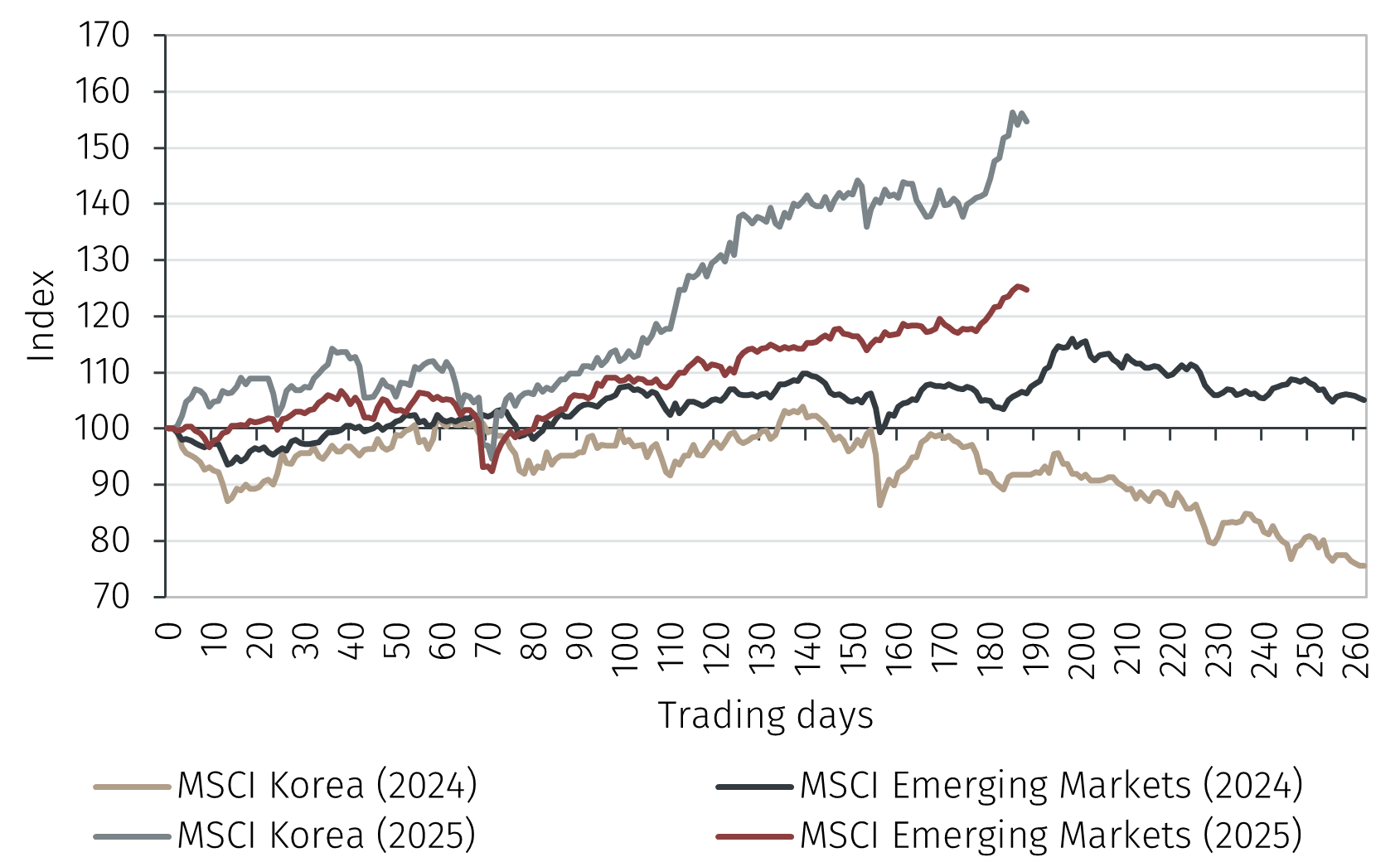
On 3 December 2024, South Korean President Yoon Suk Yeol imposed martial law, a serious political misstep which ultimately led to his impeachment.1 Between the declaration of martial law and the end of 2024, the MSCI Korea Index fell 8.6% in USD terms, bringing its overall performance for the year to -24.5% (see Chart 1). Over the same period, the MSCI Emerging Market Index rose 5.1%. 

Chart 1. Equity indices (rebased 100 = last day of previous year)

Korea1.png

Source: LSEG Data & Analytics and EFGAM calculations. Data as at 21 September 2025. Past performance is not indicative of future results.

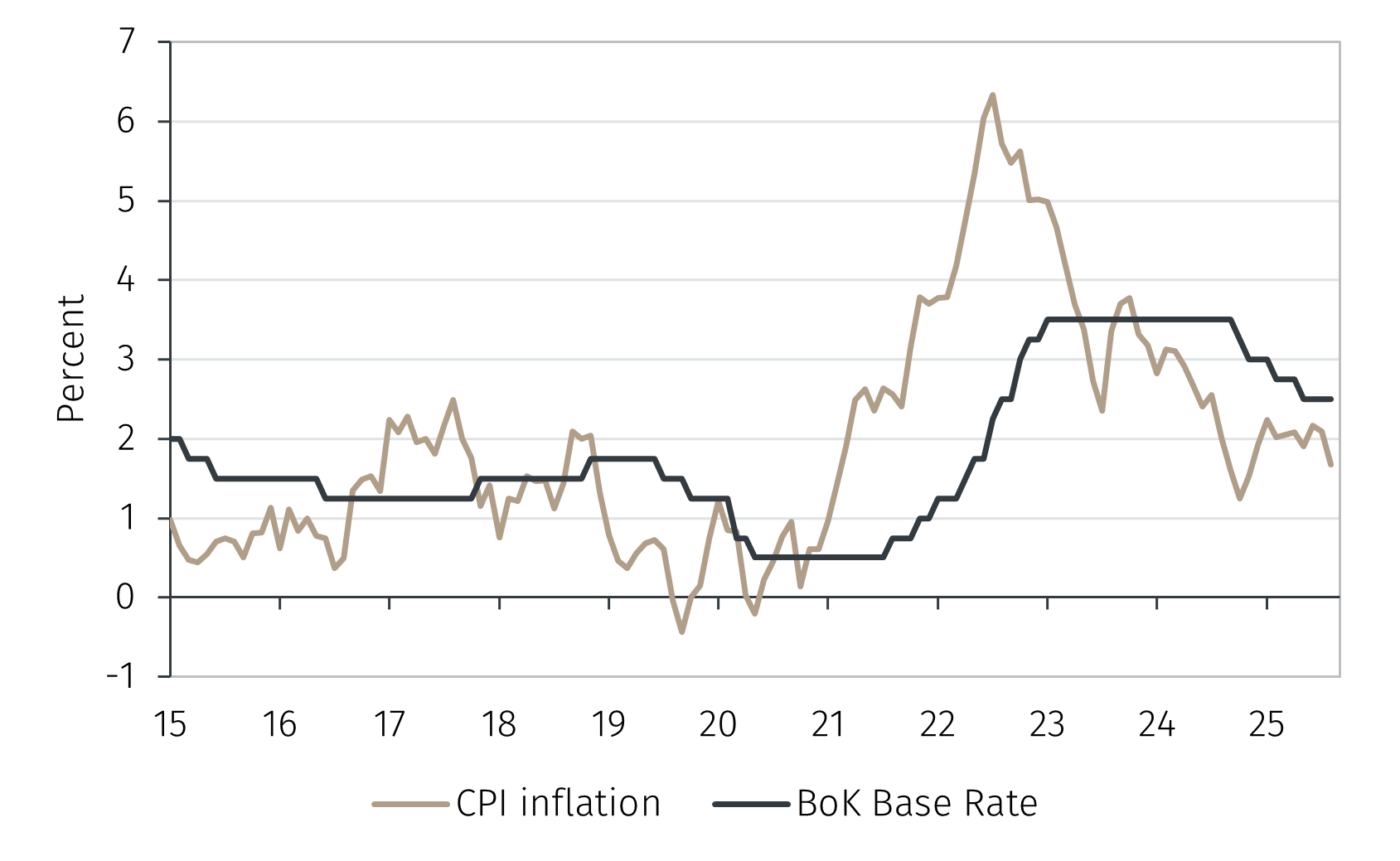
Compounding the political instability was weak economic activity. Quarterly gross domestic product (GDP) growth contracted in Q2 2024, after a strong Q1, and was feeble in the three quarters that followed.2 As the economy hovered around stalling speed, softer demand meant price pressures faded, and inflation fell below the Bank of Korea’s (BoK) 2% target (see Chart 2). The central bank reduced the restrictiveness of its monetary policy and has cut rates by a cumulative 100 basis points since October last year. 

Chart 2. Consumer Price Index inflation (% change, year-on-year) and BoK base rate (%)

Korea2.png

Source: LSEG Data & Analytics and EFGAM calculations. Data as at 21 September 2025.

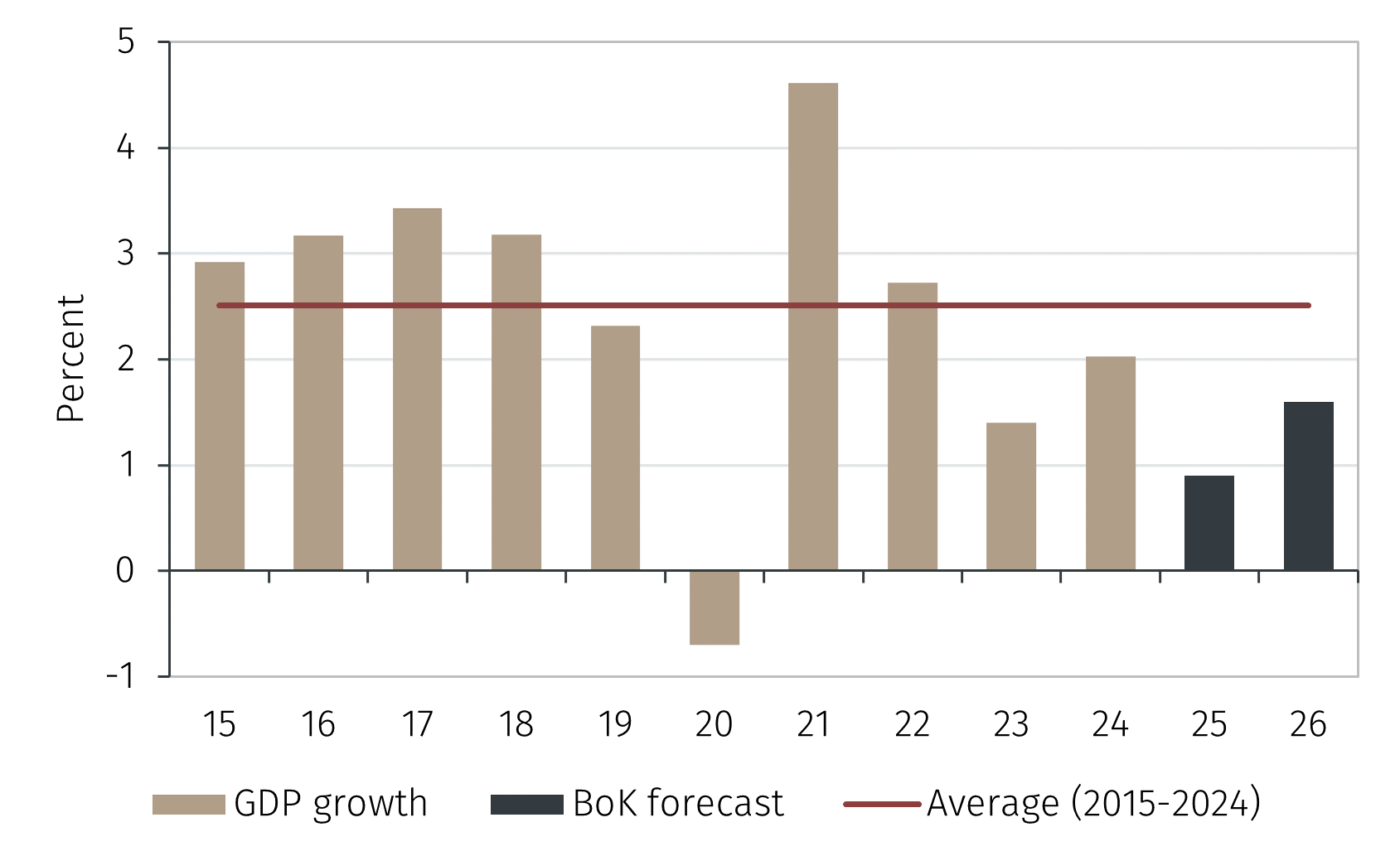
GDP growth rebounded in Q2 2025, and inflation remains stable around the BoK’s target. Nonetheless, the BoK expects annual GDP growth of 0.9% this year and 1.6% next year, below the average growth rate of 2.5% over the last ten years (see Chart 3).3

Chart 3. Korea GDP growth and BoK forecast (% change)

Korea3.png

Source: LSEG Data & Analytics, Bank of Korea and EFGAM calculations. Data as at 21 September 2025.

New government prioritising corporate governance

While the economic outlook remains relatively subdued, political uncertainty has faded with the election of Lee Jae-myung in June. President Lee’s party, the Democratic Party of Korea, holds a sizeable majority in the National Assembly and will be able to easily pass its agenda which focuses on corporate governance reform. 

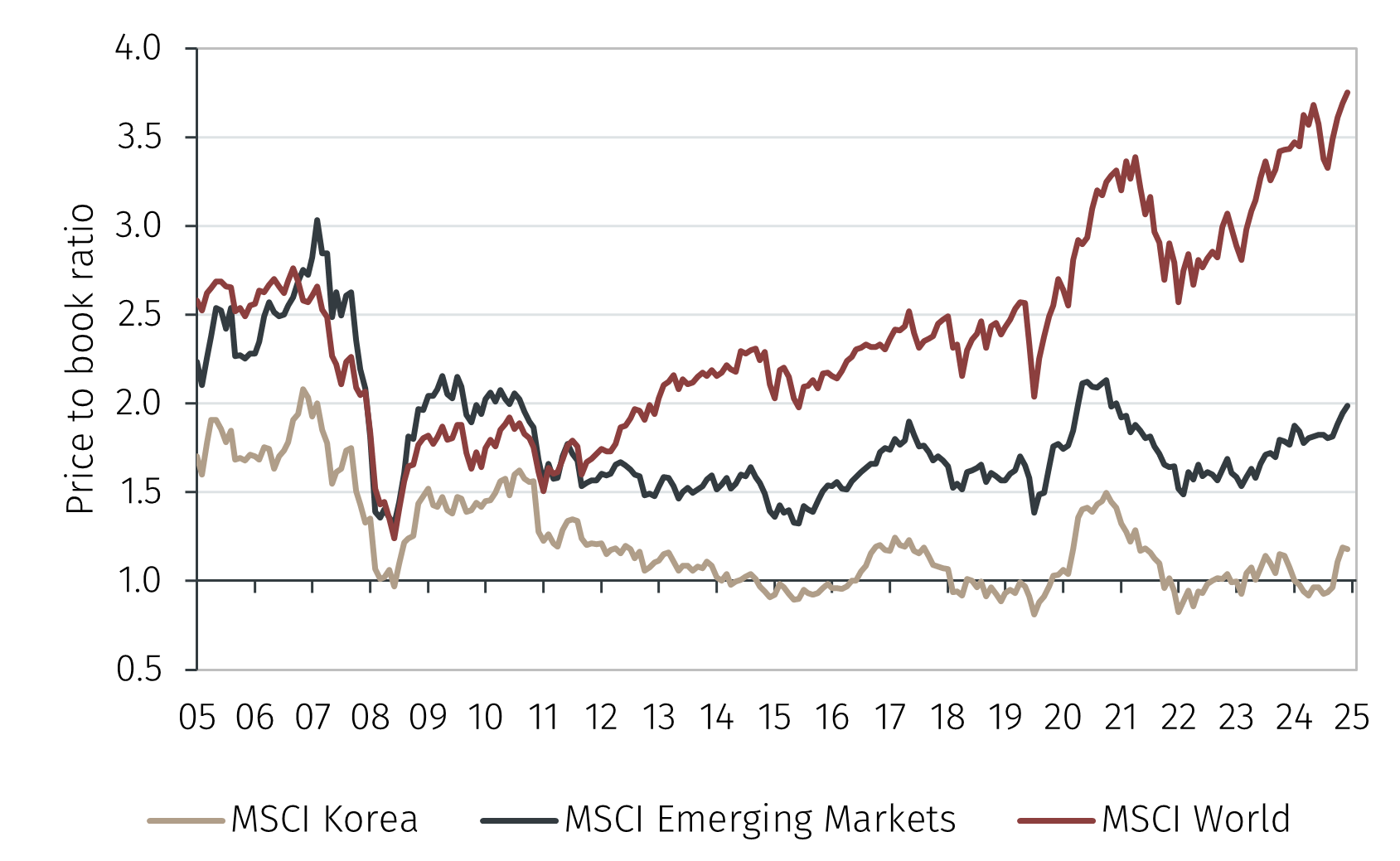
In February 2024, Korea launched its ‘Corporate Value-Up Plan’, seeking to narrow the “Korea discount”. This refers to the phenomenon where Korean companies are valued lower than their global counterparts (see Chart 4). “Korea discount” is often shown through the price-to-book ratio (P/B) - the price of a share in a company divided by the book value per share of the company. A P/B ratio below one indicates that the company’s market value it below its book value.  

Chart 4. Equity indices price to book ratio

Korea4.png

Source: FactSet. Data as at 21 September 2025. Past performance is not indicative of future results.

The ‘Corporate Value-Up Plan’ aims to elevate capital efficiency, strengthen payout practices, improve governance and increase protection for minority stakeholders.4 The program is voluntary and incentivises firms to participate by offering tax incentives for companies with outstanding disclosure practices, though there is a lack of detail on specifics.5

The voluntary nature of the program is one of its major potential drawbacks. Under the previous President, Yoon Suk Yeol, only fourteen percent of listed South Korean companies had signed up to the scheme.6 Data suggests that rate is yet to increase significantly under the premiership of Lee Jae-myung.7

However, the passing of new legislation in July marks the most significant step in the program to date. Company director’s fiduciary duties have traditionally only been to the company in Korea, meaning the interest of all shareholders has not been required to be legally safeguarded.8 Under the new legislation, company directors are obligated to act in the best interest of all shareholders.9

While the law change is potentially significant and justifies market positivity, headwinds remain and should be considered when assessing the potential impact of the ‘Corporate Value-Up Plan’. Among them is the potential for the program’s incentivisation of strengthened payout practices to lead to lower capital investment, which could lower Korea’s GDP growth.10

Summary

In summary, the outlook in Korea has improved since the end of last year. GDP growth has rebounded from low levels, supported by a more accommodative monetary policy, and political stability has returned. The prioritisation of corporate reform by Lee Jae-myung’s government and changes to fiduciary duty laws are positive. However, excessive exuberance should be avoided, primarily due to the limited participation in the 'Corporate Value-Up Plan' thus far. Whether the 'Corporate Value-Up Program' can narrow the "Korea discount" in the long run remains to be seen.


 

1 https://www.ft.com/content/a9c6d2c6-b4ed-4f07-961d-72e1c199d5e9
Quarter-on-quarter GDP growth from Q1 2024 to Q2 2025 was 1.3%, -0.2%, 0.1%, 0.1%, -0.2% and 0.7%. GDP is a measure of the value of goods and services produced in an economy.
The BoK lowered its GDP growth forecast for 2025 from 1.5% to 0.8% in May, partially due to the impact of Trump’s tariffs. The forecast was revised up to 0.9% in August due to better-than-expected export growth.
4 https://www.fsc.go.kr/eng/po110101/82795
5 https://www.investkorea.org/upload/kotraexpress/2024/05/images/Special_Contribution.pdf
6 https://www.ft.com/content/5ee12c61-b561-4c36-9c16-77a397adda4
7 https://www.mk.co.kr/en/stock/11409876#:~:text=detail,DB%20Securities%20submitted%20periodic%20disclosures
8 https://law.asia/south-korea-ma/
9 https://www.reuters.com/sustainability/boards-policy-regulation/south-korea-assembly-passes-commerce-bill-expanding-duty-boards-shareholders-2025-07-03
10 https://www.ft.com/content/5ee12c61-b561-4c36-9c16-77a397adda4f

Required

Required

Required

Required

Required

Required

Required

Please note you can manage your subscriptions by visiting the Preferences link in the emails you receive from us.

Required