1. US set to lead economic growth

Currently reading

1. Resilient world, shifting leadership: Where growth – and capital – go next

Macro and Policy

1. Resilient world, shifting leadership: Where growth – and capital – go next

Key takeaways

  • Global growth in 2027 is likely to stay resilient and US-led, broadly similar to 2026.
  • The main risks are another rise in energy prices, central banks tightening too far, and an AI-related debt or employment shock.
  • Elections in several major economies are likely to add to volatility, especially in the run-up to various elections.

An investor starting 2026 with perfect foresight about the war in the Middle East, the sharp rise in energy prices and the dramatic shift in central bank expectations from rate cuts to rate rises might reasonably have expected a very difficult year for the global economy. Yet growth has been remarkably resilient across most major economies, and this resilience underpins our central expectation that it will continue into 2027.

Our core views on global growth remain similar to 2026. We see the world economy growing at around 3.5%, with the US likely to remain the fastest‑growing major developed economy. Eurozone growth should lag the US but may pick up relative to 2026 as defence spending rises and some countries, such as Germany, adopt a more flexible stance on fiscal deficits. The UK is also expected to grow slightly faster in 2027 than in 2026, although uncertainty remains high because the new Prime Minister and his team are untested and fiscal headroom is limited. Japanese growth is expected to be similar to 2026, with the country continuing its gradual normalisation.

Among emerging markets, China dominates. Depending on the measure used, it is either the world’s first or second largest economy. Unlike much of the developed world, China is expected to grow more slowly in 2027 than in 2026, constrained by high debt levels and limited proactive policy support. Other emerging economies will be shaped by their own fiscal positions, reform agendas and exposure to energy prices and global demand.

For investors, the message is that growth is still there to be captured, but it is more uneven. Where you invest matters more than it did in a world of synchronised expansion.

3-2-1: The cone of uncertainty
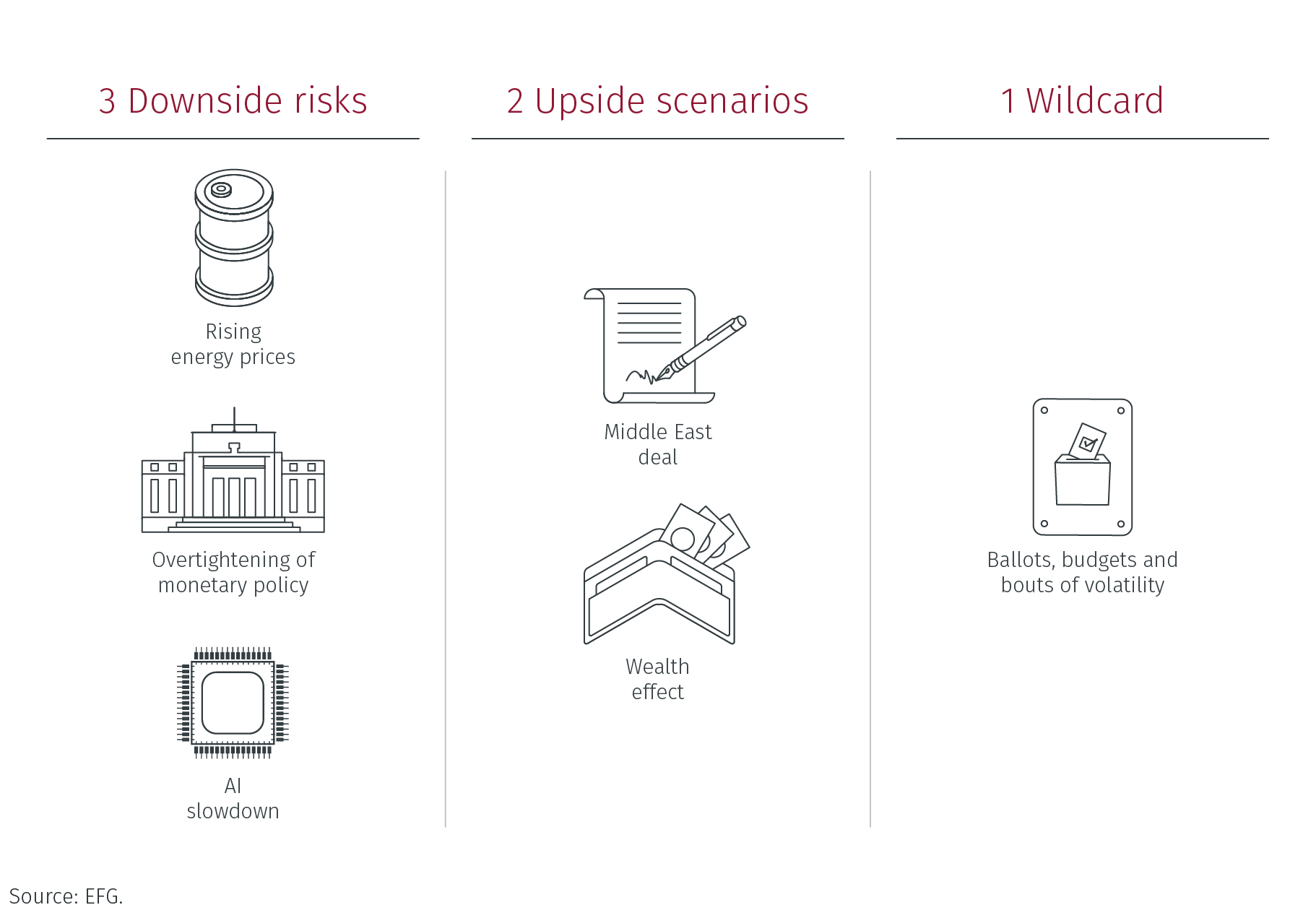
What has changed in the outlook for 2027 is not the central growth forecast, but the width of the uncertainty around it. The “cone of uncertainty” – the range of plausible outcomes (Figure 1) around our central view – has widened, and our confidence in that central view has diminished. We see three main downside risks, two upside scenarios and one wildcard factor that could all influence how 2027 unfolds.

Figure 1. Potential downside, upside and wildcard outcomes

02_EFG_Outlook_2027_EN_Charts_Website__Figure1_Source_Landscape.png

Three negative scenarios

1. Energy starts to matter – So far, higher energy prices have neither fed through meaningfully to core inflation nor significantly affected activity. However, the longer the war persists and the higher prices move, the greater the risk of a more profound impact. Companies may be able to absorb higher energy input costs temporarily, provided they are not too large. If costs rise by too much, for too long, companies will be forced to raise prices to protect profit margins, increasing the risk that higher energy costs spill over into broader inflation.

2. Central banks overshoot – Central banking is always difficult, not least because of long and variable lags between the enactment of policy and its effects. It may only become clear after the event whether policy rates were set at the right level. If central banks respond too aggressively to headline inflation, they could raise rates to a point at which growth slows meaningfully. Higher borrowing costs would weigh on consumer spending and could further weaken housing markets that are already sluggish in parts of the world. This is particularly relevant in economies where many households must refinance their mortgages at higher rates.

For example, it is estimated that roughly 800,000 homes in the UK currently facing a mortgage rate of 3% or less will need to remortgage in 2027.1 There has also been a sharp rise in housing-related expenditures in the EU recently, a part of which is related to higher mortgage costs.

In contrast, 30-year fixed-rate mortgages are common in the US, implying that the impact of higher borrowing costs will feed through only slowly for existing home owners. Nonetheless, higher mortgage costs on new loans have deterred buyers from entering the market and reduced transaction volumes, something that may drag on activity more broadly in the future.

3. AI: from growth engine to speed bump – Gartner estimates that global AI infrastructure spending will reach nearly $2.0 trillion in 2027 (Figure 2), with broader AI-related spending on software and services adding a further $1.7 trillion.2 This would represent a combined increase of $1.0 trillion relative to 2026, equivalent to a growth rate of 36%.

There is a risk these numbers do not materialise. If the cost of issuing debt to fund this spending becomes prohibitive, investment could fall short of expectations, dragging on global activity. AI-related layoffs could also reach a scale where they have broader economic consequences. A single company cutting 20% of its workforce may reduce its own costs; many companies simultaneously doing so would weigh on consumption and the wider economy. Additionally, growing opposition to data centres could limit the extent to which companies are able to follow through on their investment plans.

Two positive scenarios

We consider two factors that could contribute positively to growth in 2027.

1. A Middle East deal that sticks –A comprehensive and credible agreement between Iran and the US could lead to a sharp retreat in oil and gas prices, bolstering confidence and freeing up spending for households and companies. This would be particularly helpful for countries that are net energy importers and could be reinforced if central banks responded to a more favourable inflation outlook by easing policy sooner.

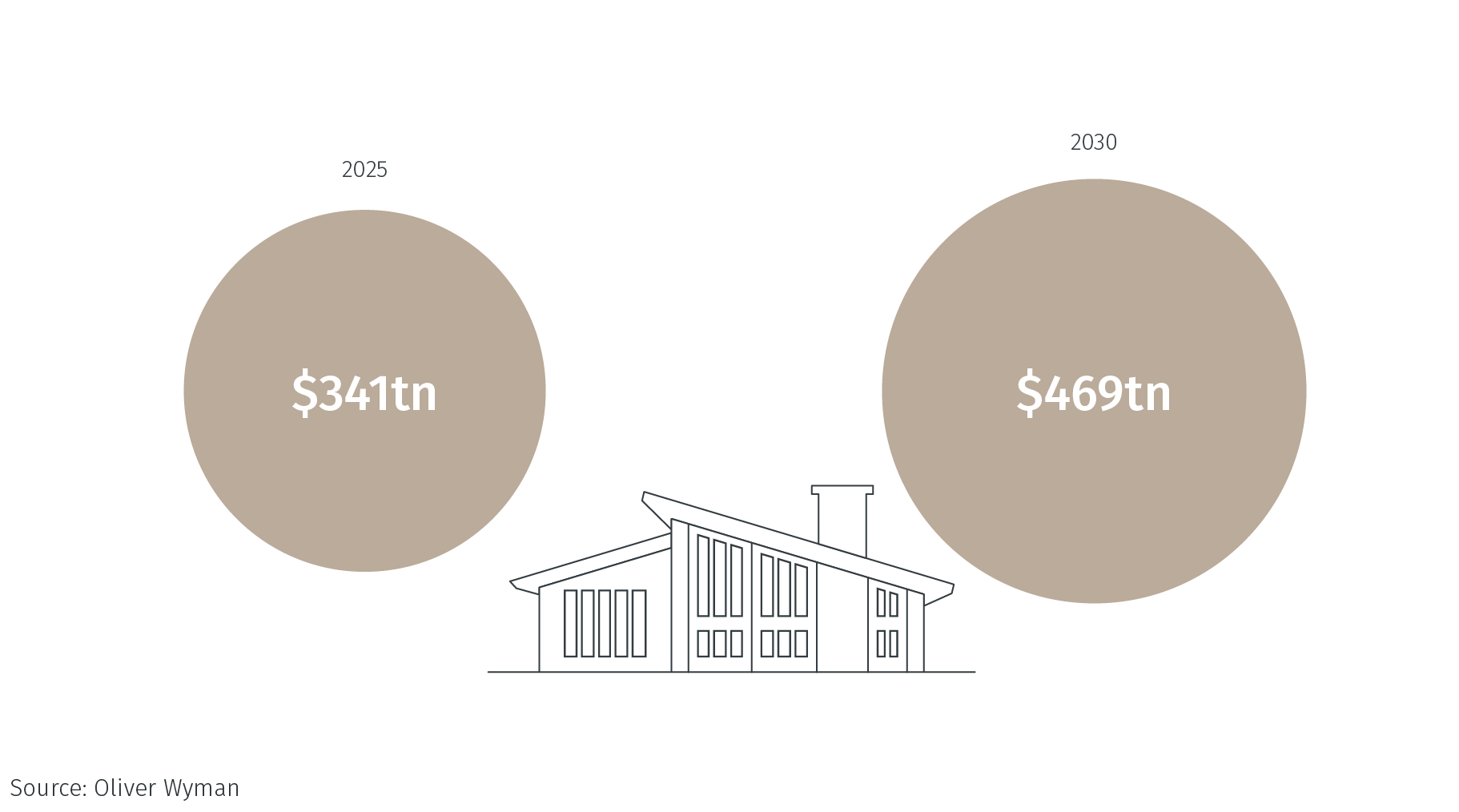
2. The wealth effect finally shows up – The strength of global markets in recent years has surprised many. This is reflected in healthy household balance sheets. For example, from end-June 2025 to end-June 2026 (the latest official data), US household net worth increased by about $20 trillion. Separately, Oliver Wyman estimates household financial wealth will increase by $158 trillion by 2030 (Figure 3), equivalent to a little over $30 trillion per year.3

There is a boost to consumption associated with such an increase – known as the wealth effect – that can have a beneficial impact on growth. A relatively modest 3% to 5% wealth effect on consumption would imply a boost to the US economy of between $0.6 and $1.0 trillion and an uplift of $0.9 to $1.5 trillion per annum to the global economy.

For investors, this is a reminder that staying invested in growth assets can have macro consequences, not just portfolio ones.

Figure 3. Estimated global household financial wealth

02_EFG_Outlook_2027_EN_Charts_Website__Figure3_Source_Landscape.png

One wildcard: ballots, budgets and bouts of volatility

Next year brings several elections around the world, creating conditions for higher market volatility.

One of the crucial elections in 2027 will be in France, where Marine Le Pen’s far-right National Rally party stands a reasonable chance of winning. It is too early to tell what policies the National Rally will follow and how they might impact the already-precarious French budget situation. However, it is noteworthy that since Giorgia Meloni became Prime Minister of Italy in 2022, she has adopted a more moderate and conciliatory tone than suggested by the pre-election rhetoric. Meloni is now the longest-serving Italian Prime Minister since the Second World War and faces re-election in 2027.

“ ...the wealth effect...
can have a beneficial impact on growth. ”

Other elections, including in Poland and Argentina, could also generate localised uncertainty, with potential implications for Europe, and, in Argentina’s case, for the UK. For diversified investors, the key is to recognise that elections can move markets in the short term but rarely change long‑term return drivers. The risk is more about the reaction to the event and whether any significant policy changes are likely as a result of it.

Our view for 2027

We believe the global growth outlook for 2027 is much the same as for 2026: steady growth globally, led by the US, but with heightened risks.

The negatives could include another rise in energy prices, an overtightening of monetary policy and an AI-related shock or dislocation. The positives could come from a rapid resolution to the Middle East conflict and a strong wealth effect from continued gains in equity markets.

Several high-profile elections will take place in 2027, so elevated market volatility is likely in the weeks before them. Ultimately, the outlook will depend on how these competing forces unfold, with the balance of risks and opportunities likely to drive both market direction and volatility through 2027.

For you as an investor, the message from Theme 1 is to stay globally diversified with a deliberate tilt towards the US. It will be important to manage interest rate and energy risk and remain invested while using volatility to help position portfolios. The points below translate this into concrete portfolio actions for the year ahead.

Action for investors:

  • Stay global, lean to the US. Maintain broad global equity exposure but consider a modest overweight to US equities, which are expected to remain the growth leader among developed markets.
  • Manage interest rate and energy risk. Use a mix of shorter-duration bonds and inflation-linked bonds or quality dividend-paying equities to reduce sensitivity to potential rate shocks and energy price spikes.
  • Stay invested, manage risk actively. Avoid panic selling on headlines, but do not be passive about risk. Use volatility to rebalance, upgrade quality and keep your portfolio aligned with your long-term objectives and risk tolerance.

Obligatorisch

Obligatorisch

Obligatorisch

Obligatorisch

Obligatorisch

Obligatorisch

Obligatorisch

Please note you can manage your subscriptions by visiting the Preferences link in the emails you receive from us.

Obligatorisch