
What Pythagoras’ theorem can teach us about the Fed

All Insights

Currently reading

Is US consumer confidence rebounding?

Investment Insights • Macro

2 min read

Is US consumer confidence rebounding?

In this Macro Flash Note, EFG Chief Economist Stefan Gerlach reviews recent US consumer sentiment data and notes a recovery in June, suggesting that consumers may have overreacted to the April tariff announcements.

There is currently intense focus on the US economy as observers assess whether, and how, it has been affected by the sweeping tariff increases announced by the Trump administration on “Liberation Day,” 2 April. These measures marked a sharp shift in trade policy and raised concerns about potential effects on macroeconomic conditions.

So far, however, the available evidence from several of the most closely watched economic indicators shows no sign of deterioration. The Job Openings and Labor Turnover Survey (JOLTS), which provides detailed labour market data through April, suggests conditions remain broadly unchanged. Nonfarm payrolls and the consumer price index (CPI), both available through May, likewise show no material weakness in employment or a surge in prices.

In contrast, the University of Michigan’s index of consumer sentiment recorded a marked decline in early 2025, as it became clear that the Trump administration would impose higher tariffs than many had anticipated. The index rose during the autumn of 2024 and peaked at 74.0 in December. From January through April, sentiment declined steadily, reaching 52.2, and remaining at that level in May.

Interestingly, the preliminary survey data for June shows a notable rebound, with the index rising to 60.5.
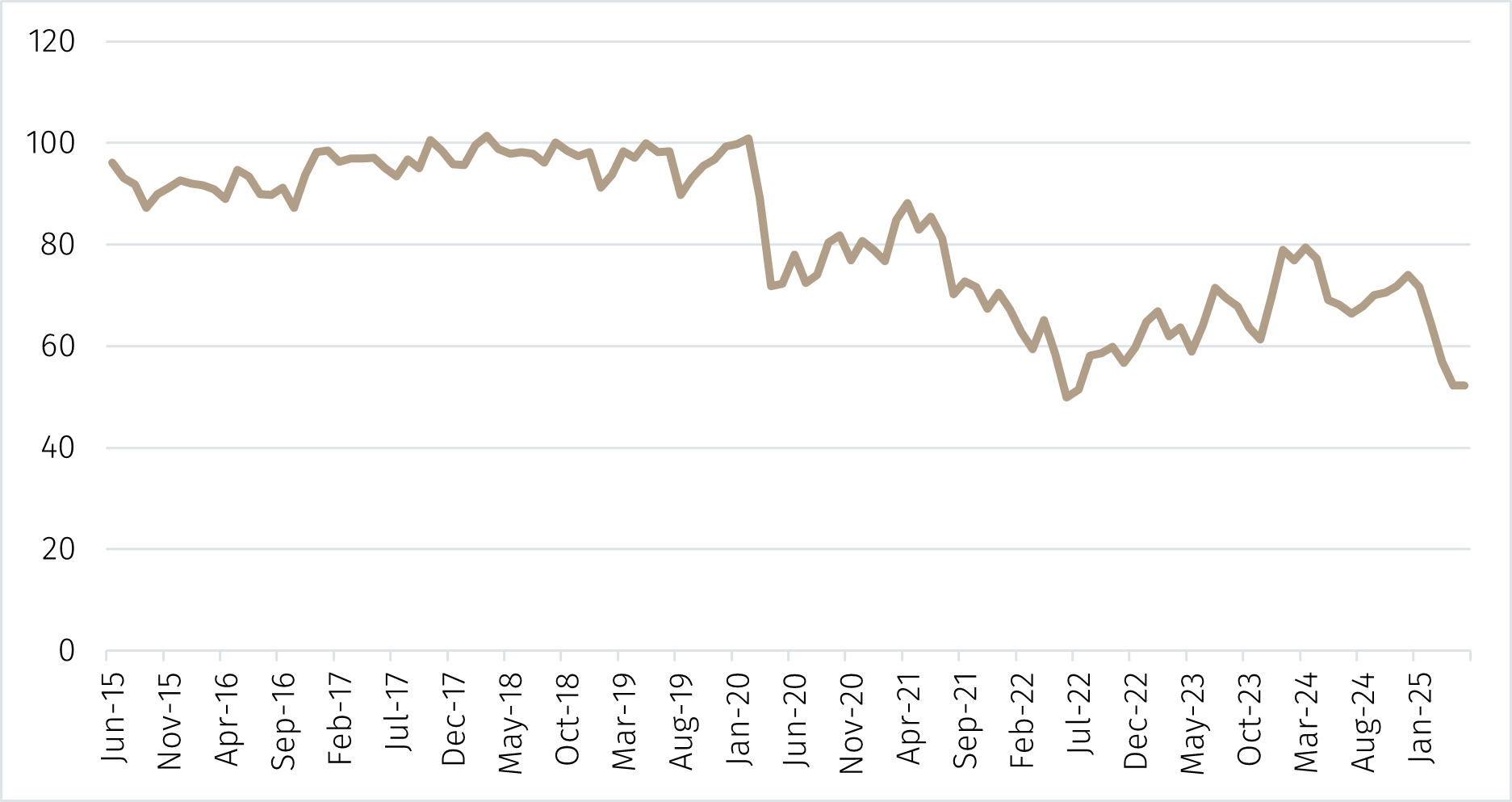
 

Chart 1. Consumer sentiment

Chart 1.png

Source: University of Michigan Survey of Consumers, data as of 13 June 2025.

This divergence between indicators raises the important question of how these conflicting signals should be interpreted.

As noted above, economic conditions can be assessed using “hard” or “soft” data. Hard data are based on observed economic outcomes—such as prices, output, and employment. They are generally informative about what has happened in the economy. However, they are published with a lag and are often subject to revision, sometimes substantially. As a result, they can be slow to reflect turning points or new shocks.

Soft data, by contrast, come from surveys that capture expectations or sentiment — how households and firms perceive current and future conditions. These data are available more quickly and may provide early indications of behavioural shifts. But because they reflect opinions rather than outcomes, they can overreact to news or policy uncertainty. In periods of heightened uncertainty — such as the unexpected return to tariff levels last seen nearly 90 years ago — it is unsurprising that sentiment may weaken even if behaviour has not yet changed.

A further complication is that US trade policy remains in a state of flux, with frequent delays, revisions, and carve-outs. Faced with this uncertainty, many firms may have opted to wait before adjusting employment, pricing, or investment — delaying decisions until the policy path becomes clearer.

For these reasons, it is not surprising that hard and soft data have told different stories. In early spring, sentiment indicators pointed to rising concern, while hard data showed little change. The preliminary consumer sentiment survey for June suggests that consumers may have overreacted, and that the initial pessimism will not be fully reflected in the economic data. The coming months will help clarify whether sentiment has simply moved ahead of the facts or whether a downturn is merely delayed in the hard data.  

Obligatorisch

Obligatorisch

Obligatorisch

Obligatorisch

Obligatorisch

Obligatorisch

Obligatorisch

Please note you can manage your subscriptions by visiting the Preferences link in the emails you receive from us.

Obligatorisch