3. Equity Market-Neutral
Equity market-neutral strategies are positioned to benefit from high stock-level dispersion without requiring a directional call on the overall equity market.
Equity market-neutral strategies are positioned to benefit from high stock-level dispersion without requiring a directional call on the overall equity market. In 2027, concentrated index leadership, AI-driven changes in industry economics and the broadening of market leadership beyond mega-cap technology should all increase the importance of relative stock performance, creating opportunities to monetise idiosyncratic winners and losers while maintaining near-zero net exposure.
This makes market‑neutral approaches attractive for investors seeking to harvest equity alpha while limiting dependence on the direction of broad indices.
In a best-case 2027 scenario for equity market-neutral funds, equity dispersion remains high, sector and style leadership rotates in a way that rewards fundamental and quantitative stock selection, and AI-related shifts in business models create clear relative winners and losers; in that environment, market-neutral managers can generate attractive, low-beta returns by exploiting mispricing across sectors and factors.
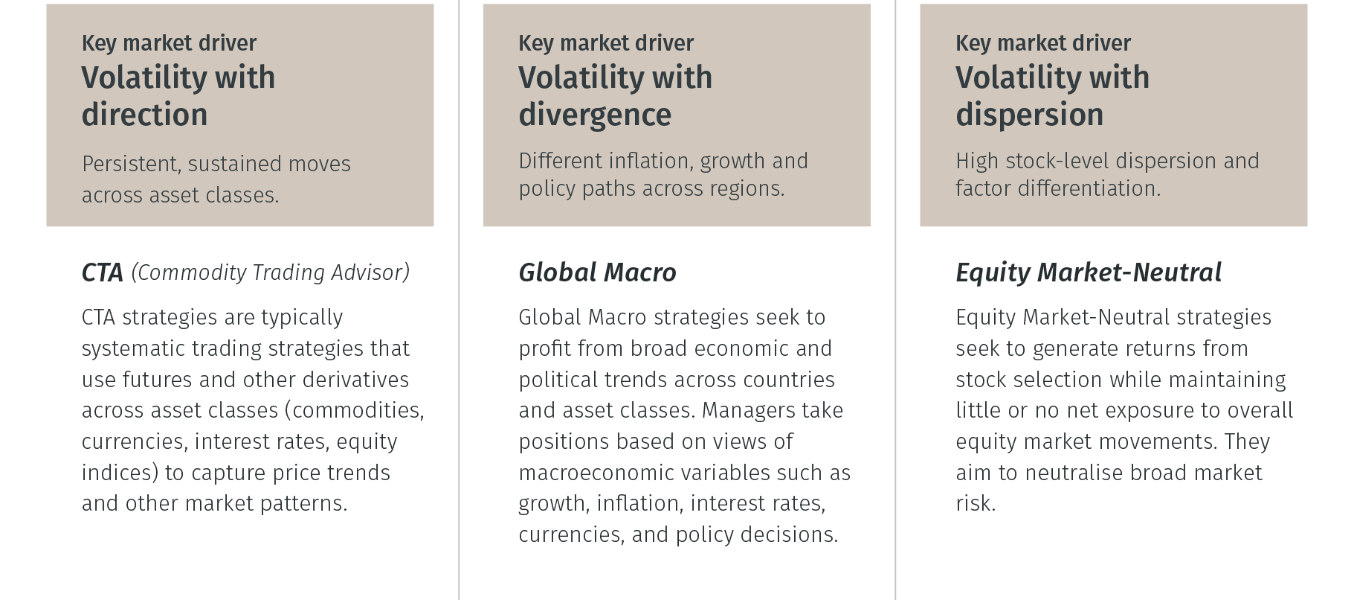
Putting the three strategies into context Taken together, these three strategies monetise different dimensions of the uncertainty likely in 2027. Systematic trend-following CTAs rely on persistence in macro and commodity trends, global macro benefits from policy and geopolitical divergence, and equity market-neutral depends on stock level dispersion and factor differentiation.
The macro backdrop described in the broader Outlook, with resilient, but less certain, global growth, elevated energy and geopolitical risks, AI-driven sectoral change and shifting monetary policy expectations, suggests that all three could find attractive opportunities, but each is sensitive to how volatility manifests: CTAs need volatility with direction, macro needs volatility with divergence, and market-neutral needs volatility with dispersion rather than uniform market-wide moves.