What Pythagoras’ theorem can teach us about the Fed

All Insights

Currently reading

Public debt and government revenues

Investment Insights • Macro

2 min read

Public debt and government revenues

Public debt levels vary sharply across countries and are a growing concern in many advanced economies. Less often noted is that governments’ ability to raise revenue also differs widely, shaped by political, economic, and institutional factors. In this Macro Flash Note, EFG Chief Economist Stefan Gerlach examines the relationship between public debt and government revenues.

Concerns about public debt and fiscal sustainability are mounting across many advanced economies. In part, this reflects the fact that debt levels are already high relative to GDP, limiting fiscal space and raising questions about long-term debt dynamics.

In the US, these concerns are exacerbated by the economic policies pursued under the Trump administration. The so-called “Big Beautiful Bill” is widely expected to drive a significant increase in the federal deficit and, over time, in public debt. The combination of tax cuts and increased spending may set the US on a fiscal trajectory that is difficult to reverse without politically costly tax increases or expenditure cuts.

In Europe, the fiscal outlook is similarly under pressure, though for different reasons. In response to heightened geopolitical risks and NATO commitments, many European governments are planning substantial increases in defence spending. Projections suggest that military expenditure could rise to around 5% of GDP in some countries, a level not seen in decades. This raises questions about whether already cash-strapped governments will be able to finance these commitments without incurring additional debt.

The chart below illustrates just how large public debt stocks are in some economies - and how small they are in others. For instance, public debt in Estonia stands at just 24% of GDP. In contrast, in Japan it exceeds 240%.
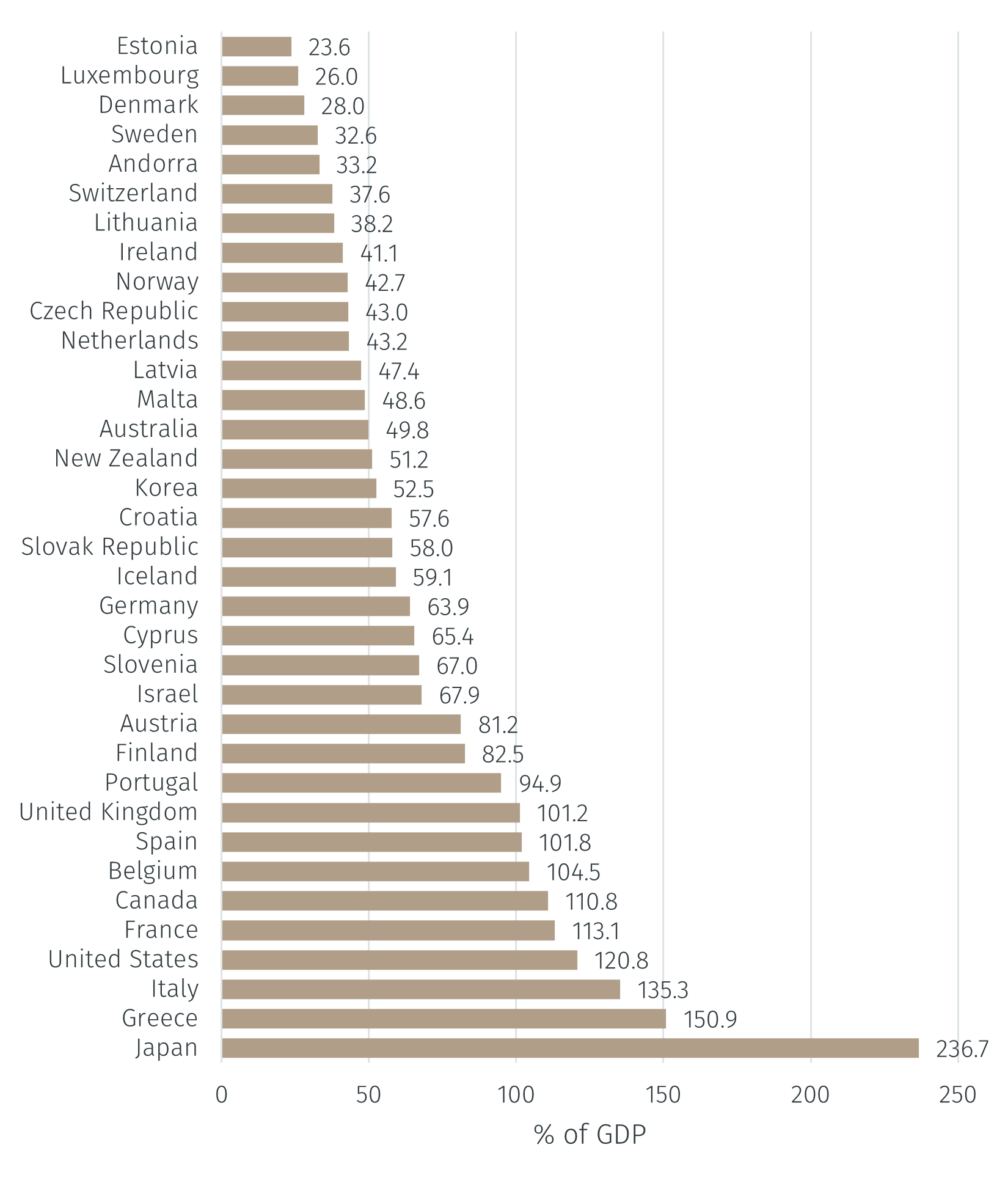
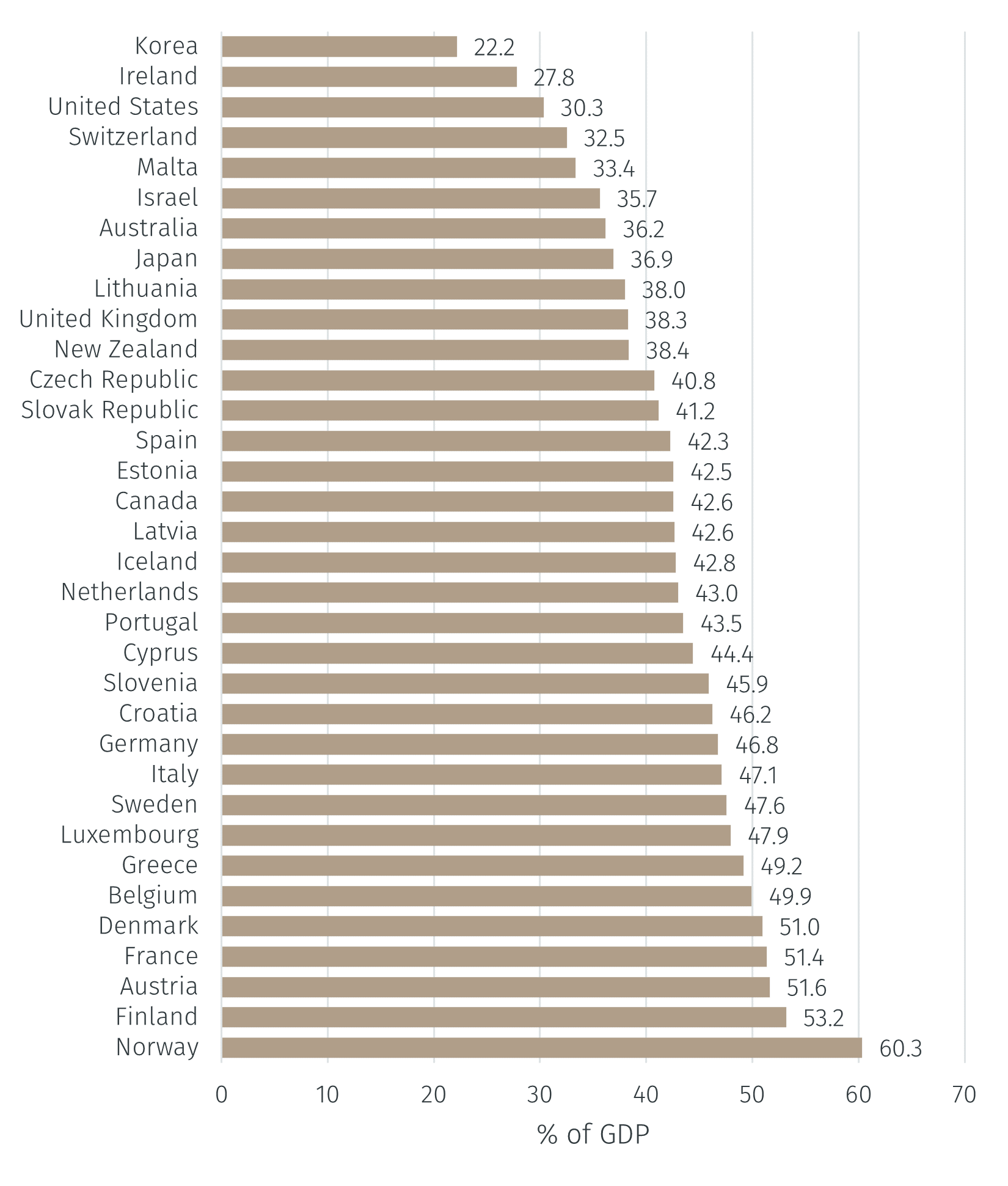
Chart 1. General government gross debt in 2024 (% of GDP)

Debt1.png

Source: IMF. Data as of 30 June 2025.

However, debt-to-GDP ratios alone do not provide a complete picture of fiscal sustainability. It is also essential to consider the revenue-raising capacity of the state - that is, how much of national income the government can mobilise through taxes and other receipts. Two countries with similar debt levels may face very different fiscal constraints if one collects 30% of GDP in revenue and the other collects 50%.

The share of GDP that governments can collect depends on several factors:

  • Political considerations. Taxation is a politically sensitive issue. Governments may choose to limit tax collection to avoid alienating voters and increasing the risk of losing the next election.
  • Economic considerations. Policymakers may resist raising taxes out of concern that higher rates are distortionary. Beyond a certain point, taxation may reduce incentives to work, save, or invest, thereby slowing growth.
  • Institutional capacity. The effectiveness of revenue collection also depends on the quality of public institutions. In countries with weak tax administrations, limited enforcement capacity, or slow judicial processes, tax evasion tends to be widespread. This is particularly true in economies dominated by small firms or reliant on cash transactions, where concealing income is easier.1

The next chart shows general government revenue as a share of GDP across countries. The differences are striking. While the South Korean government collects about 22% of GDP in revenue, Norway, benefiting from substantial oil-related income, raises around 60%. Finland and Austria, despite having no comparable natural resource base, collect 53% and 52% of GDP respectively.

Chart 2. General government revenue in 2024 (% of GDP)

Debt2.png

Source: IMF. Data as of 30 June 2025

What then is the relationship between the size of public debt and a government’s ability or willingness to raise revenue?

There are several plausible hypotheses:

  • The relationship could be positive. Governments with large debt stocks may also collect higher revenues, either to service debt obligations or because they have stronger institutional frameworks that support both borrowing and taxation.
  • It could be negative. Governments that are unwilling or unable to raise sufficient revenue may resort to debt accumulation to finance persistent fiscal deficits.
  • These two effects could be offsetting, leaving no systematic relationship at all. 

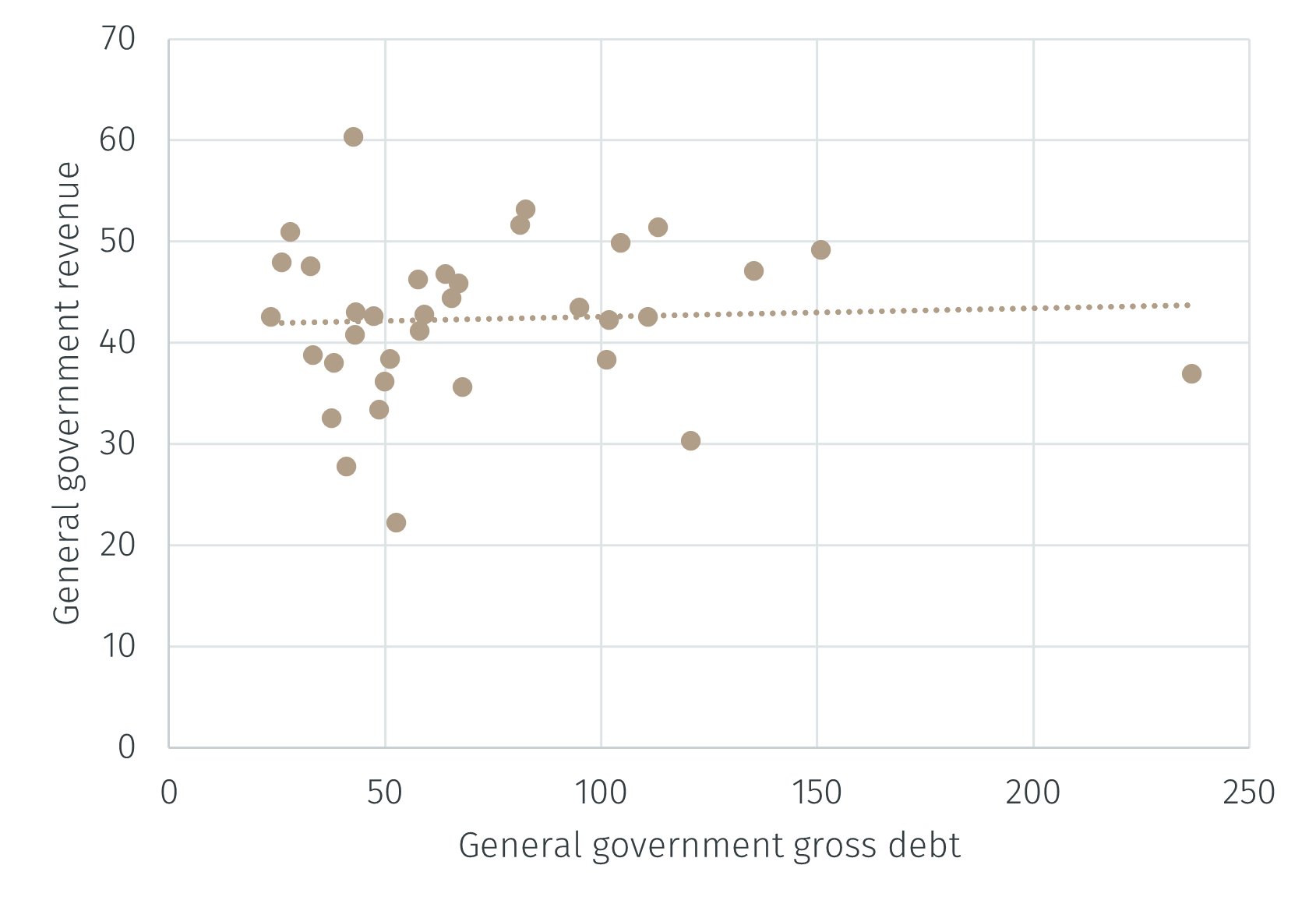
The data provide support for the third view. The correlation between debt-to-GDP ratios and government revenue-to-GDP ratios is close to zero (0.05). If Japan - an outlier with exceptionally high public debt but robust revenue collection - is excluded, the correlation rises only modestly to 0.17. As the final chart shows, there is no clear pattern linking the two variables across countries.

Chart 3. Government debts and revenues in 2024 (% of GDP)

Debt3.png

Source: IMF. Data as of 30 June 2025

The fact that government debt levels and revenues are essentially uncorrelated means that some countries with high debt also collect a large share of GDP in revenue, while others do not. Similarly, some countries with low debt raise substantial revenue relative to GDP, while others collect much less. As a result, the debt-to-GDP ratio alone is not always informative.

For example, Italy has general government debt of 135% of GDP but collects 47% of GDP in revenue. The US has debt of 121% of GDP but collects only 30%, while the UK has debt of 101% and revenue of 38%. Measured relative to revenue, this means the US (398%) is in a more difficult position than Italy (287%), which in turn is slightly more stretched than the UK (264%).

This finding highlights the importance of not only focusing on the size of the public debt relative to GDP but also on the underlying fiscal capacity of a government as captured by its ability to raise revenue. A country with low debt may nonetheless face severe constraints if it cannot raise sufficient revenue, while another with high debt may remain fiscally stable if it has the political and institutional means to collect large and reliable revenues. 

1 For a discussion of how weak institutional capacity leads to persistently low tax revenues, see IMF (2015), Current Challenges in Revenue Mobilization: Improving Tax Compliance. On the role of cash use in facilitating tax evasion, see OECD (2017), Technology Tools to Tackle Tax Evasion and Tax Fraud. The World Bank (2007) report Designing a Tax System for Micro and Small Businesses notes that tax evasion is particularly widespread among small and informal firms.

Obligatorisch

Obligatorisch

Obligatorisch

Obligatorisch

Obligatorisch

Obligatorisch

Obligatorisch

Please note you can manage your subscriptions by visiting the Preferences link in the emails you receive from us.

Obligatorisch