What Pythagoras’ theorem can teach us about the Fed

All Insights

Currently reading

ECB to keep rates unchanged for some time

Investment Insights • Macro

2 min read

ECB to keep rates unchanged for some time

On 11 September, the European Central Bank (ECB) left interest rates unchanged and signalled that it will likely keep them at the current level for some time. In the ECB’s assessment, downside risks to growth and inflation have diminished, reducing the scope for a more accommodative policy. In this Macro Flash Note, Senior Economist GianLuigi Mandruzzato looks at the factors that could lead the ECB to a different conclusion.

As expected, the ECB's Governing Council (GC) left the deposit facility rate (DFR) unchanged at 2%. President Lagarde stated that the GC will evaluate the data "meeting-by-meeting" and does not "pre-commit" to a rate path, which can be characterised as a wait-and-see mode.1 However, the new macroeconomic projections highlight a reduction in downside risks to price stability, limiting the scope for lower interest rates in the coming months.

The new ECB staff projection for inflation sees a less pronounced decline the coming quarters despite low energy prices and a strong euro (see Chart 1). However, these factors are expected to lower inflation in the final part of the projection that now sees it returning to the ECB’s 2% target only in late 2027.
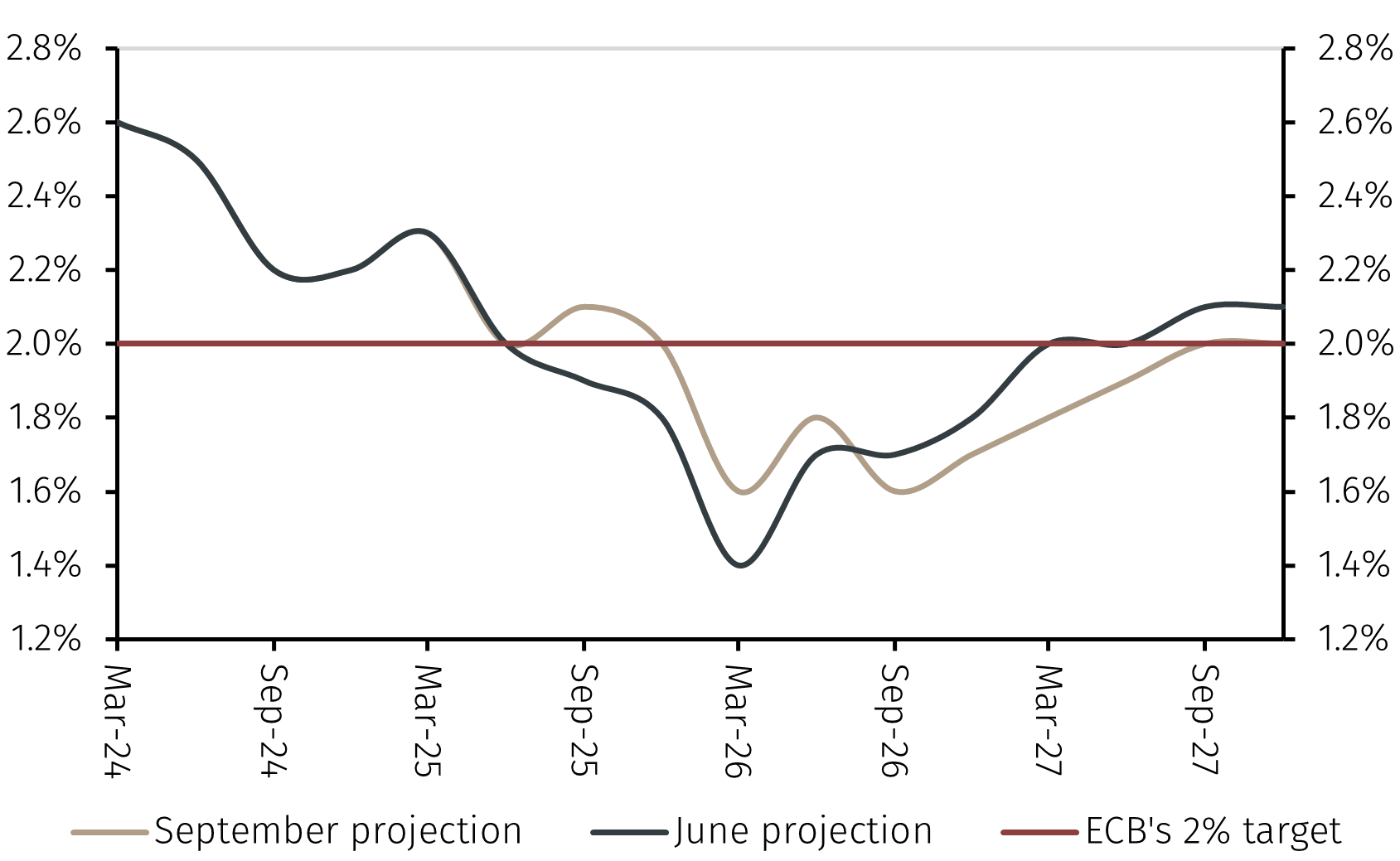
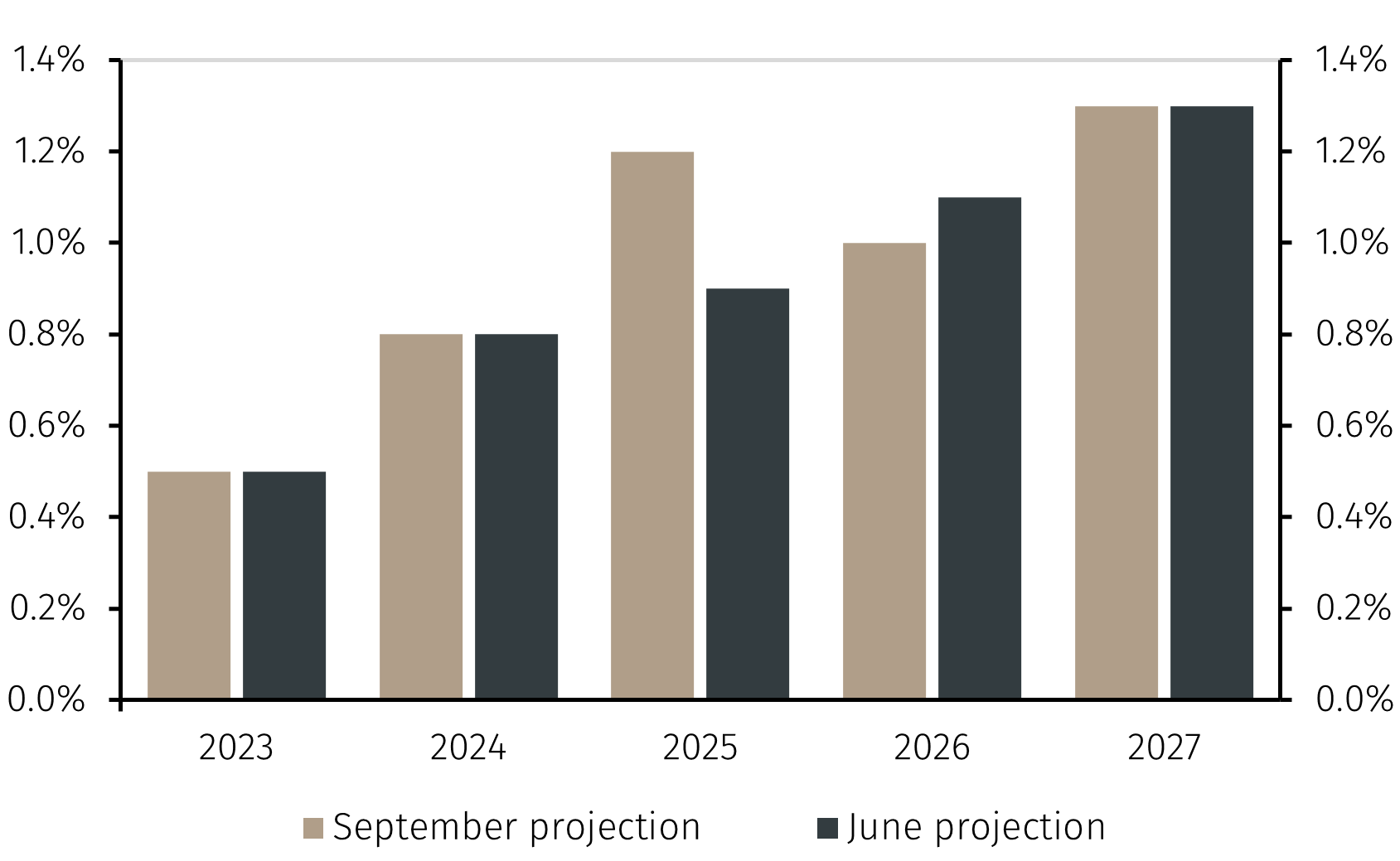
Chart 1. ECB’s inflation projections (year-on-year)

ECB1.png

Source: ECB. Data as of 12 September 2025.

The GDP growth projection for 2025 has been raised from three months ago, reflecting both stronger-than-expected data for the first half of 2025 and reduced uncertainty over the coming quarters after the trade deal signed by the European Union (EU) and the Trump administration. Lagarde emphasised that the EU's lack of retaliation on tariffs reduces the risk of a trade war with the US, the eurozone's main export market, and lowers downside risks to growth. 

Chart 2. ECB’s GDP growth projections (year-on-year)

ECB2.png

Source: ECB and EFGAM calculations. Data as of 12 September 2025.

Looking ahead and absent new shocks, we believe interest rates will likely remain at their current levels for the rest of 2025 and for much of 2026. 

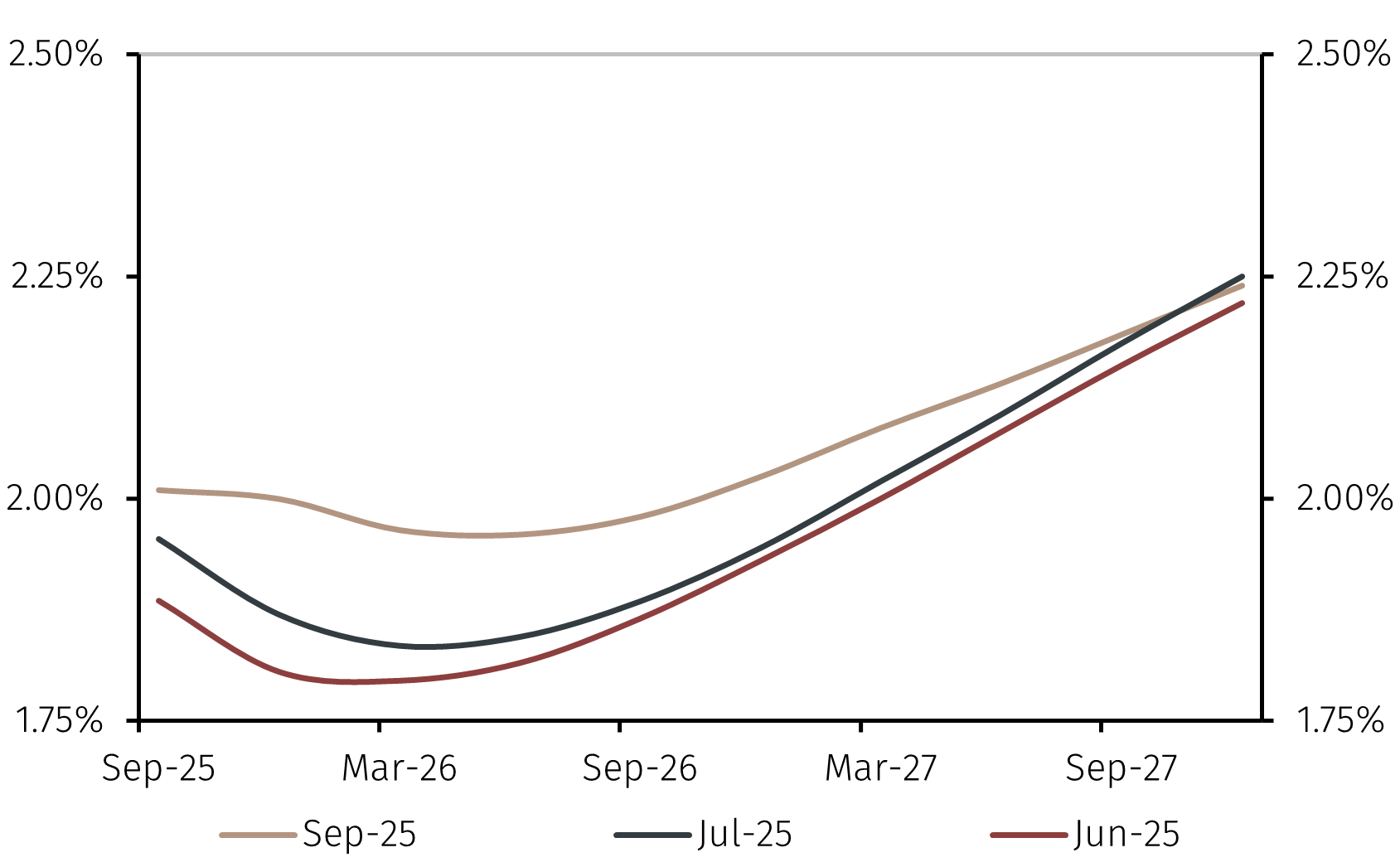
The prices of futures contracts on eurozone short-term interest rates show that the market does not exclude a DFR cut to 1.75% by the first half of 2026, although the probability attached to it is less than 40%. The likelihood of rate cuts would increase if the downside risks to eurozone inflation and growth materialised.   

Chart 3. Eurozone 3-month interbank rate implied in futures contracts

ECB3.png

Source: LSEG Data & Analytics and EFGAM calculations. Data as of 12 September 2025.

These, as Lagarde noted, stem primarily from outside the eurozone. In the US, the latest data show the job market is weaker than previously reported. If US growth were to slow significantly, the consequences would be felt in the eurozone. 

The euro exchange rate could appreciate further. This would put downward pressure on the prices of intermediate and consumer goods imports into Europe, dampening the inflation outlook. A stronger euro would also penalise eurozone exports and GDP growth. 

Furthermore, there is a risk that, in response to the high tariffs imposed by the US on Asian countries, low-cost manufactured goods will be diverted from Asia to other markets, including the eurozone, dampening local inflation. 

Finally, the eurozone's outlook would worsen if the pressure on French government bonds spread to those of other member countries with high public debt. The resulting tightening of financial conditions would slow economic activity and inflation and could justify a monetary policy response.  

1 See also “Eurozone PMI data leaves the ECB in its comfort zone”, EFG Macro Flash Note, 28 August 2025.

Obligatorisch

Obligatorisch

Obligatorisch

Obligatorisch

Obligatorisch

Obligatorisch

Obligatorisch

Please note you can manage your subscriptions by visiting the Preferences link in the emails you receive from us.

Obligatorisch