With the political situation in France evolving rapidly, the country has entered a period of instability marked by short-lived cabinets, fractious coalitions, and a fragmented parliament. Successive governments have fallen to no-confidence votes, and no party now commands a majority in the National Assembly.
The result is a weakened presidency, policy paralysis, and uncertainty over France’s fiscal direction and role in Europe. The summary below outlines the main developments since 2022 and the composition of the parliamentary blocs shaping the current impasse.
Recent governments
- The Borne government, May 2022 to January 2024, ended amid divisions within President Macron’s coalition over a controversial immigration bill. Several ministers rebelled or resigned after its passage in December 2023, and Macron asked Élisabeth Borne to step down.
- The Attal government, January 2024 to September 2024, faced growing instability. After Marine Le Pen’s National Rally won the European elections on 9 June, Macron dissolved the National Assembly. The ensuing snap election produced a hung parliament split between the left-wing New Popular Front, Macron’s Ensemble alliance, and the far-right National Rally. Gabriel Attal led Ensemble to its worst result in modern history, resigned in July, and remained caretaker until 5 September.
- The Barnier government, September 2024 to December 2024, followed two months of caretaker rule. Michel Barnier, a veteran conservative and former EU negotiator, was appointed as a compromise figure but lacked a majority. His use of article 49.3 to push through the 2025 budget triggered no-confidence votes from both left and right, and on 4 December the Assembly ousted his government.1
- The Bayrou government, December 2024 to September 2025, sought to restore fiscal order. François Bayrou, a centrist ally of Macron, imposed austerity and deficit cuts but alienated nearly all parties. On 8 September 2025, the Assembly rejected his confidence motion, and he resigned the next day.
- The Lecornu government, September 2025, was the shortest in French history. Sébastien Lecornu’s near-identical cabinet collapsed after one day under threats of censure from both opposition blocs. By October 2025, France had seen four prime ministers in less than two years, leaving parliament paralysed and Macron’s authority severely weakened.
Parliamentary blocs
The National Rally (Rassemblement National, RN), led by Marine Le Pen, is a far-right nationalist party founded in 1972 by her father as the National Front and renamed in 2018. It stresses sovereignty, immigration control, and protectionism, combining conservatism with welfare for French citizens. Strong among working-class voters, it won the 2024 European elections and is now one of the three dominant blocs in parliament.
The New Popular Front (Nouveau Front Populaire, NFP), created in 2024 after the dissolution of parliament, unites La France Insoumise, the Socialists, the Greens, and the Communists. Formed mainly to counter the far right, it advocates higher spending, wealth taxes, and climate investment but remains divided between moderates and Jean-Luc Mélenchon’s more radical supporters.
Ensemble, President Macron’s centrist alliance of Renaissance, MoDem, and Horizons, promotes a pro-European and economically liberal agenda focused on fiscal restraint and structural reform. Having lost its majority in 2022, it has since governed through fragile alliances and repeated use of constitutional powers.
The Republicans (Les Républicains, LR), a centre-right Gaullist party led in the Senate by Bruno Retailleau, advocates for market liberalism, fiscal discipline, and tighter immigration. Weakened by Macron’s rise and the far right’s advance, they still wield influence by holding the parliamentary balance of power and shaping legislation from opposition.
Parliament
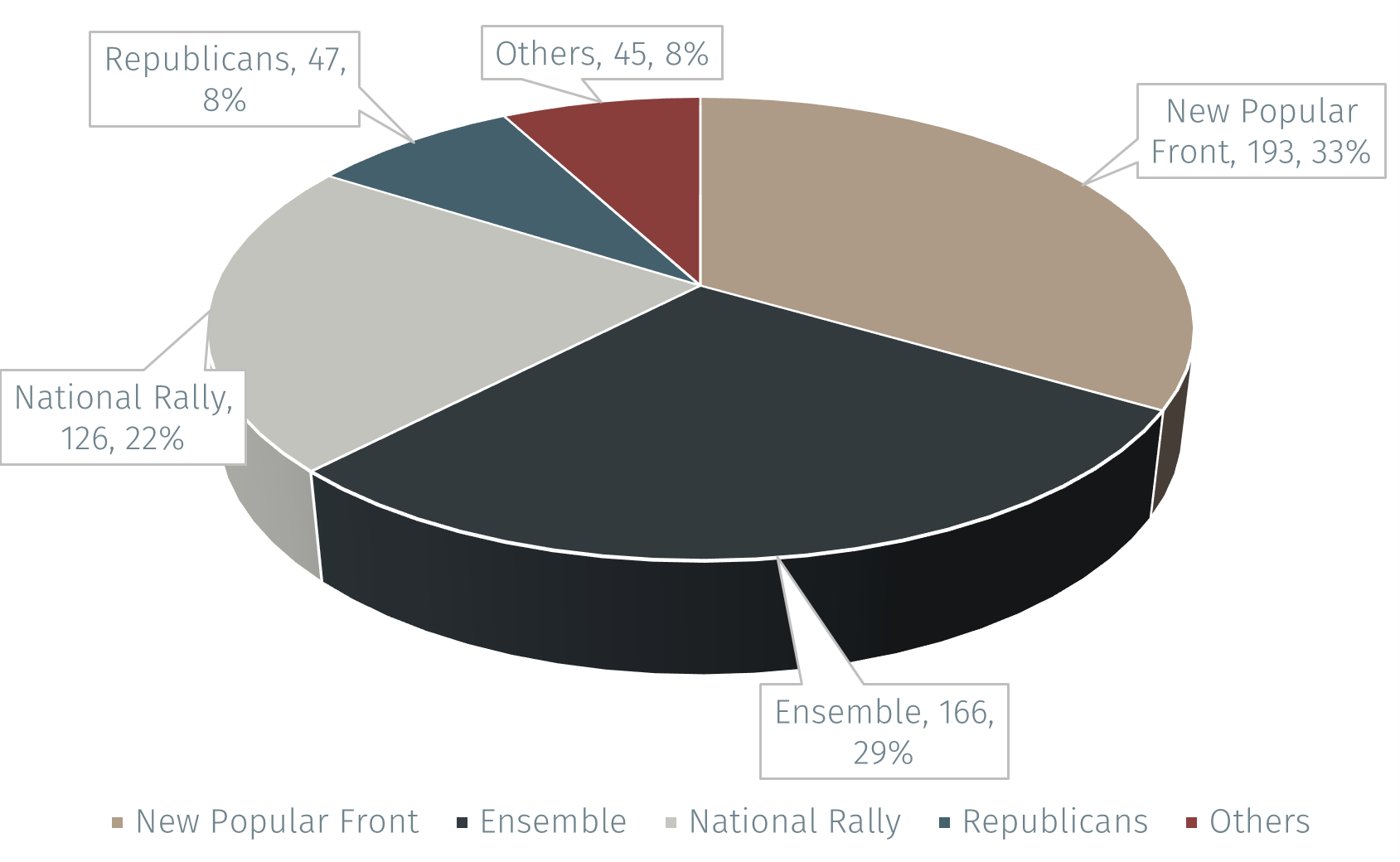
The National Assembly, the lower house of the French parliament, includes around a dozen parties grouped into four main blocs. One authoritative estimate is shown in the accompanying chart. Roughly speaking, Jean-Luc Mélenchon’s New Popular Front and President Macron’s Ensemble each hold about 30 percent of the seats, Marine Le Pen’s National Rally around 20 percent (and rising), and The Republicans roughly 10 percent. This fragmentation makes forming stable majorities difficult and has led to successive governments struggling to govern effectively.