4. Geopolitics: New alliances, state capitalism and a diverging electorate

Currently reading

4. AI’s next phase: The promise and perils of a capex supercycle

Macro and Policy

2 min read

4. AI’s next phase: The promise and perils of a capex supercycle

Key takeaways

  • All eyes will remain on AI in 2027 due to the pace and scale of technological change.
  • The hyperscalers (the largest cloud computing companies) have been increasing their debt issuance, and this is expected to continue.
  • The pace of technological change and the scale of investment bring opportunities but also significant risks.

In the year ahead, the debates surrounding artificial intelligence (AI) will continue to grow. The topic has fast become one of the most significant issues for financial markets, not just due to the scale of technological change and its potential economic impact, but also because of the enormous expenditure associated with the build-out of AI infrastructure, which has raised important questions around debt issuance.

GDP growth from the Age of Artificial Intelligence
Most economists agree that AI is already contributing meaningfully to GDP growth. The Fed estimates that in the first quarter of 2026, contributions from software, data centres and IT equipment accounted for around one third of US GDP growth.4 This phenomenon is not unique to the US. While there are very few estimates that directly quantify the impact of AI on GDP growth in China, the rise in high-tech investment and exports is notable. Perhaps surprisingly, the UK was the fastest- growing G7 economy in the first half of 2026, and the Office for National Statistics highlighted the role of AI-related companies in achieving this.

“ ...many differing views about the extent to which AI will increase GDP growth by lifting productivity... ”

Many more examples show that AI is already affecting GDP growth, but it is important to recognise the channel through which it is doing so. While there may be company-specific cases of AI boosting productivity, there is currently little evidence that it does this for the global economy as a whole.

There are many differing views about the extent to which AI will increase GDP growth by lifting productivity, and how long it will take for this to happen. Right now, AI is clearly still in its infrastructure build-out phase, and so investment is the main channel through which it is affecting GDP growth.

Rise of the hyperscaler
Key to the infrastructure build-out phase are the hyperscalers. 5 These are cloud computing providers that lease computing capacity to AI companies. As demand for their services has increased, the hyperscalers have spent significantly, with most of this investment directed towards the construction of data centres. The scale of capital expenditures (capex) by hyperscalers has become so great that it is often used as a proxy for aggregate AI infrastructure investment.

However, hyperscaler capex is not a perfect proxy for AI infrastructure investment since not all hyperscaler capex is AI-related. Furthermore, many of the hyperscalers use a mix of operating and financing leases for their data centres. In practice there is little difference between the two, but in accounting treatment terms leases are included in capex while operating leases are not. This may result in an understatement of AI-related capex by hyperscalers.

Nonetheless, from January 2024 to September 2026, hyperscalers spent $1.21 trillion on capex (Figure 11). By the end of 2026, that number is expected to sit at $1.45 trillion and by the end of 2027, it is expected to be $2.61 trillion. This means that hyperscalers are expected to spend about $1.2 trillion dollars more on capex in 2027. To put that into context, the International Monetary Fund expects world gross domestic product (GDP) to rise by $7.1 trillion in 2027. That means hyperscaler capex is expected to be equivalent to around 15% of world GDP growth in 2027.

Given the scale of expected hyperscaler capex in 2027, it is crucial to consider how it will be funded. In 2025, hyperscaler capex could be funded out of operating cash flow (the amount of cash generated by day-to-day business activities). In 2026, it is estimated that capex will rise above operating cash flow, and in 2027 that gap is expected to widen (Figure 12). This creates a financing gap and a need for hyperscalers to raise capital.

Hyperscalers – carrying the debt of a major economy
To meet their financing needs, the hyperscalers have been increasing debt issuance. In 2025, hyperscalers issued $109 billion of investment grade debt.

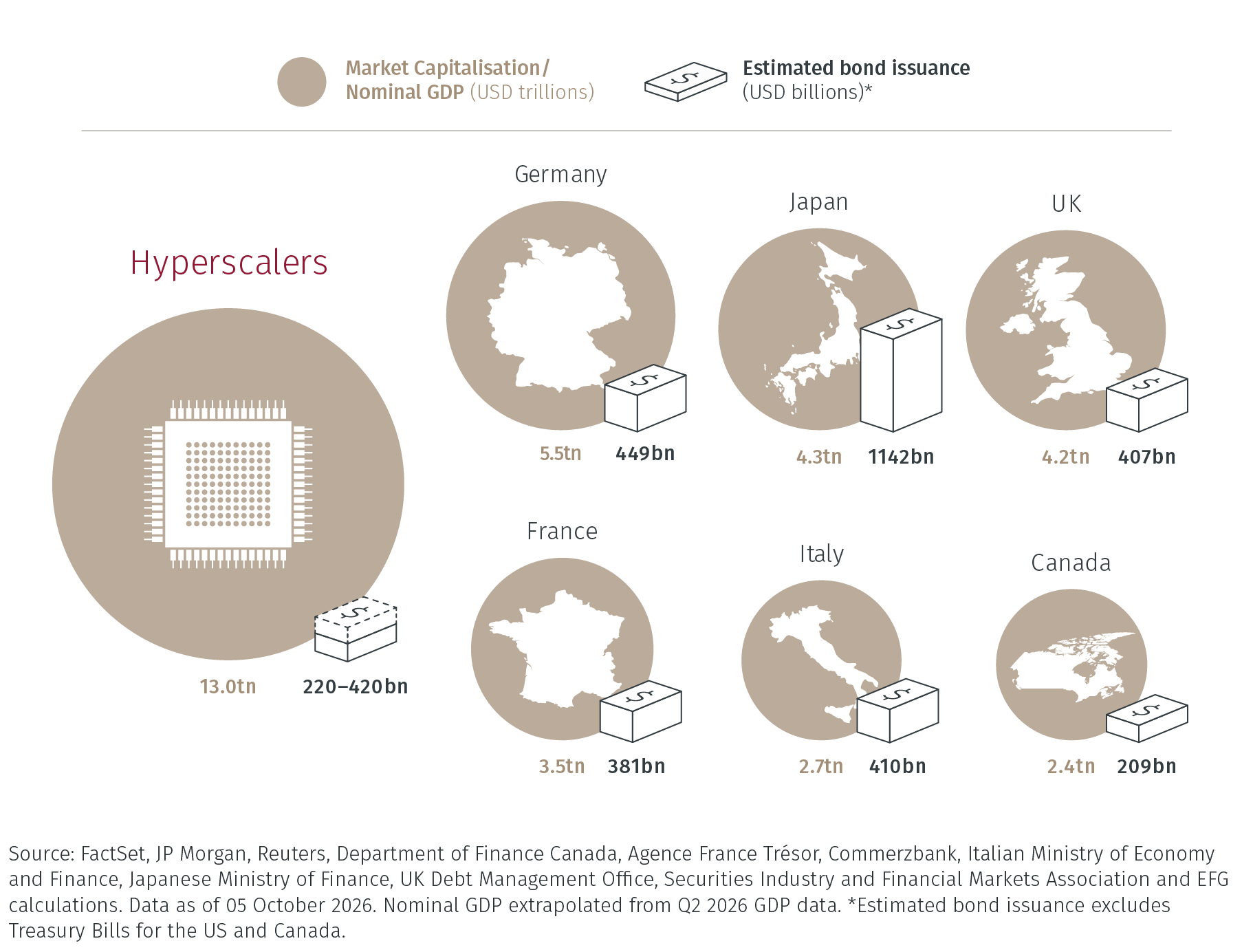
This is expected to rise to just under $280 billion in 2026 and estimates range from $220 billion to $420 billion in 2027.6 To put this into context, the 2026 and 2027 issuance numbers are not dissimilar to the value of bonds the UK government plans to issue in fiscal year 2026-27.7

Figure 13. Market capitalisation and estimated bond issuance

02_EFG_Outlook_2027_EN_Charts_Website__Figure13_Source.png

While the range of expectations is wide, the message is clear: debt issuance by hyperscalers is on an increasing trend and is expected to remain similar to that of a large nation (Figure 13). Perhaps that should not be surprising given that the market capitalisation of the hyperscalers is greater than the GDP of six of the seven G7 economies.

“ By 2030, hyperscalers are expected to issue around $2.5 trillion of investment grade debt. ”

By 2030, hyperscalers are expected to issue around $2.5 trillion of investment grade debt.8 The Bloomberg Global Corporate Aggregate Index (a widely used benchmark for global corporate bonds) has a total market value of $13.6 trillion. Assuming the index grows in line with nominal GDP until 2030, new hyperscaler issuance would represent around 13% of the total market value of the index. This could materially change the composition of the index.

The risk of longer debt maturity profiles
As hyperscalers issue more debt, they will become a larger share of the benchmark index. Furthermore, the average maturity of hyperscaler debt tends to be longer than that of the benchmark investment-grade index. As a result, passive investors will hold greater exposure to a smaller number of issuers, increasing concentration risk, and will see the duration (interest rate sensitivity) of that allocation rise because of the hyperscaler debt.

In 2027, it may be particularly important to manage this risk. In Theme 1, we outlined our central view that the global economy will remain resilient in 2027, with continued strength in the US and a pick-up in Europe. In Theme 2, on monetary policy, we discussed how we think markets are anticipating more interest rate increases than central banks may need to deliver. Against this backdrop, we expect the long end of the yield curve (reflective of growth expectations) to be well supported, but we see potential for the short end (reflective of monetary policy expectations) to decline.

Our view for 2027

For investors, it will be important to focus on active strategies and avoid passively taking on unintended duration risk. AI offers enormous potential, but the pace of technological change and the scale of investment also bring significant risks. Concerns regarding overheating, excessive borrowing and overextended valuations make selectivity essential, particularly as AI-related debt grows.

The lessons of the Global Financial Crisis remain a powerful reminder of the cost of unchecked optimism and leverage. The world may be eager to embrace AI and its opportunities, but not at the price of another systemic financial shock.

For you as an investor, the message from the AI capex theme is to recognise how the AI build‑out is reshaping corporate bond markets and index composition, and to manage concentration and duration risk in hyperscaler debt proactively. The points below translate this into concrete portfolio actions for the year ahead.

Action for investors:

  • Avoid unintended concentration in hyperscaler debt via passive bond funds. Review bond fund holdings; consider active bond strategies that manage issuer concentration and duration, rather than relying solely on broad passive corporate bond indices.
  • Use shorter-duration and diversified credit to manage rate and AI-debt risks. Combine short-duration bond funds, diversified investment-grade credit and some cash to reduce sensitivity to large AI-related issuance and potential shifts in yield curves.
  • For Balanced Investors, it will be critical to analyse the very high representation of hyperscalers and AI leaders in the equity indices and now an increasingly large passive allocation in the bond indices.

Required

Required

Required

Required

Required

Required

Required

Please note you can manage your subscriptions by visiting the Preferences link in the emails you receive from us.

Required