
No need for negative SNB rates

All Insights

Currently reading

A chill in the air: JOLTS add further evidence of US labour market cooling

Investment Insights • Macro

3 min read

A chill in the air: JOLTS add further evidence of US labour market cooling

With the Federal Reserve increasingly focused on the risk of a softening US labour market, the release of the December JOLTS data on 5 February was closely watched by markets. EFG Chief Economist Stefan Gerlach explains what the latest figures tell us about the state of the US labour market and the implications for monetary policy.

The end of exceptional tightness

The December Job Openings and Labor Turnover Survey (JOLTS) report adds to the growing body of evidence that the US labour market is losing momentum. While the monthly data are volatile, the broader message across job openings, hiring, and worker turnover is increasingly consistent. Labour demand is easing, and the exceptional tightness seen in 2021–22 has largely unwound.

The headline surprise was the further decline in job openings. Vacancies fell by 386,000 in December to 6.5 million, well below market expectations. At 3.9%, the job openings rate is now close to pre-pandemic norms and far below the peak of 4.6% reached last autumn.

Subdued hiring and low quits rates

Other components of the report reinforce this picture. Hiring remains subdued at 5.3 million, with the hiring rate stuck at 3.3%, a level last seen during the slow recovery following the global financial crisis. That firms are neither hiring aggressively nor shedding workers points to a labour market that is cooling primarily through weaker labour demand rather than outright job losses.

The quits rate provides further confirmation. Quits, which are best seen as an indicator of worker confidence and bargaining power, were unchanged at 2.0% in December. This is well below the roughly 3% rates seen in early 2022, when workers were rapidly switching jobs amid strong wage growth. Today, there are fewer than one job openings per unemployed worker, compared with around two at the peak. This shift is consistent with easing wage pressures and suggests that nominal wage growth is likely to slow further over the course of the year.  
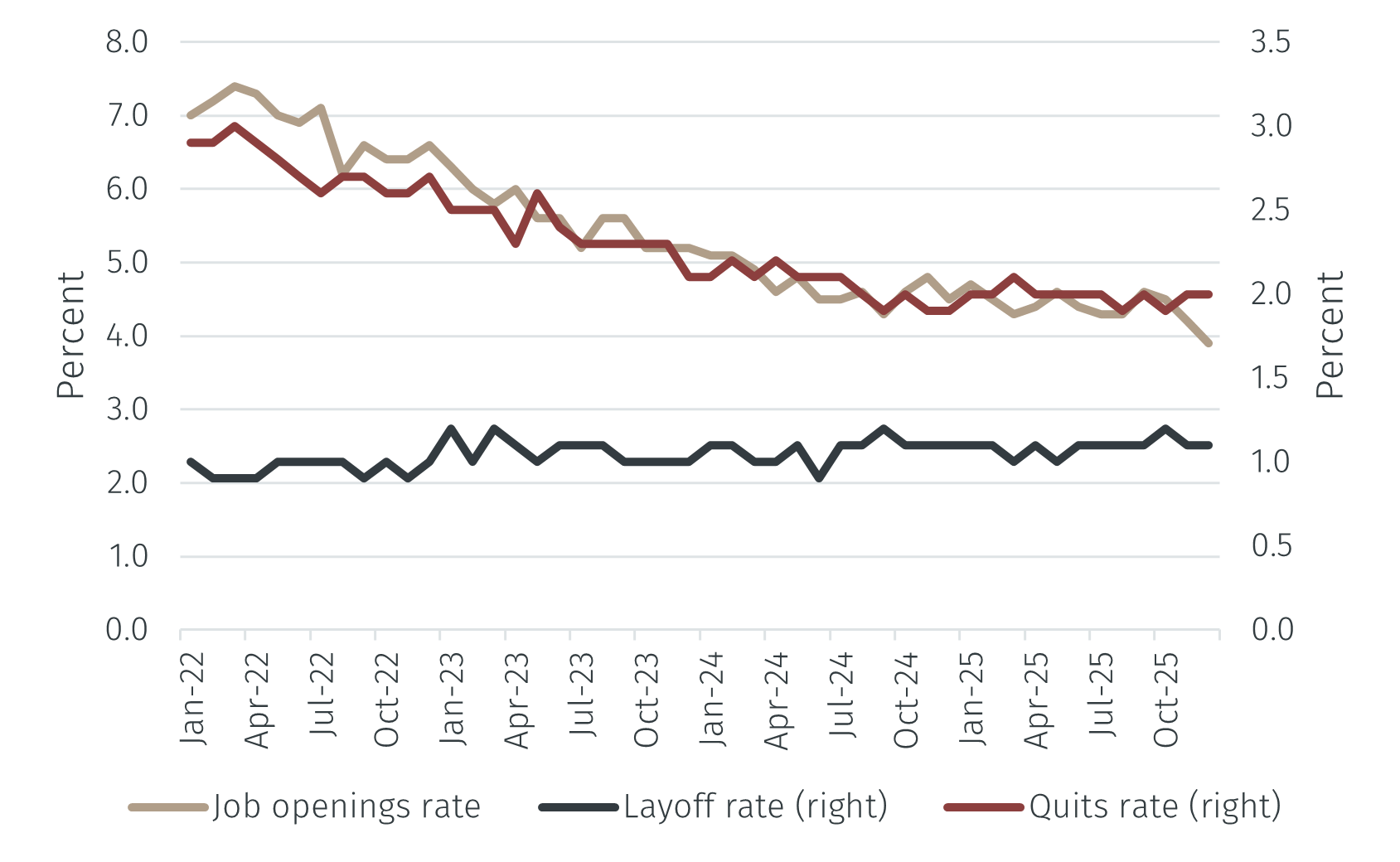
Chart 1. US labour market is cooling

JOLTS1.png

Source: FRED, data as of 6 February 2026.

At the same time, there is little evidence of a sharp deterioration. The layoffs rate was unchanged at a low 1.1%, indicating that firms remain reluctant to shed labour aggressively after the hiring difficulties experienced in the post-pandemic period.

Taken together, the JOLTS data align with other recent indicators pointing to a softer labour market. Initial jobless claims have edged up, layoff announcements have increased, and vacancies continue to trend lower, even if some high-frequency indicators suggest pockets of stabilisation. The evidence points to a labour market that is no longer tight and is gradually cooling rather than re-accelerating.

Implications for the Fed

With the Federal Reserve balancing the risk of inflation remaining too high against the risk of an overly weak labour market, the JOLTS data suggest that the latter risk has increased. Market pricing has reacted accordingly. CME FedWatch probabilities implied around a 10% chance of a rate cut at the March Federal Open Market Committee meeting before the release of the JOLTS data, rising to around 20% afterwards.  

Required

Required

Required

Required

Required

Required

Required

Please note you can manage your subscriptions by visiting the Preferences link in the emails you receive from us.

Required