The deal agreed has five main points.
1) Agricultural exports
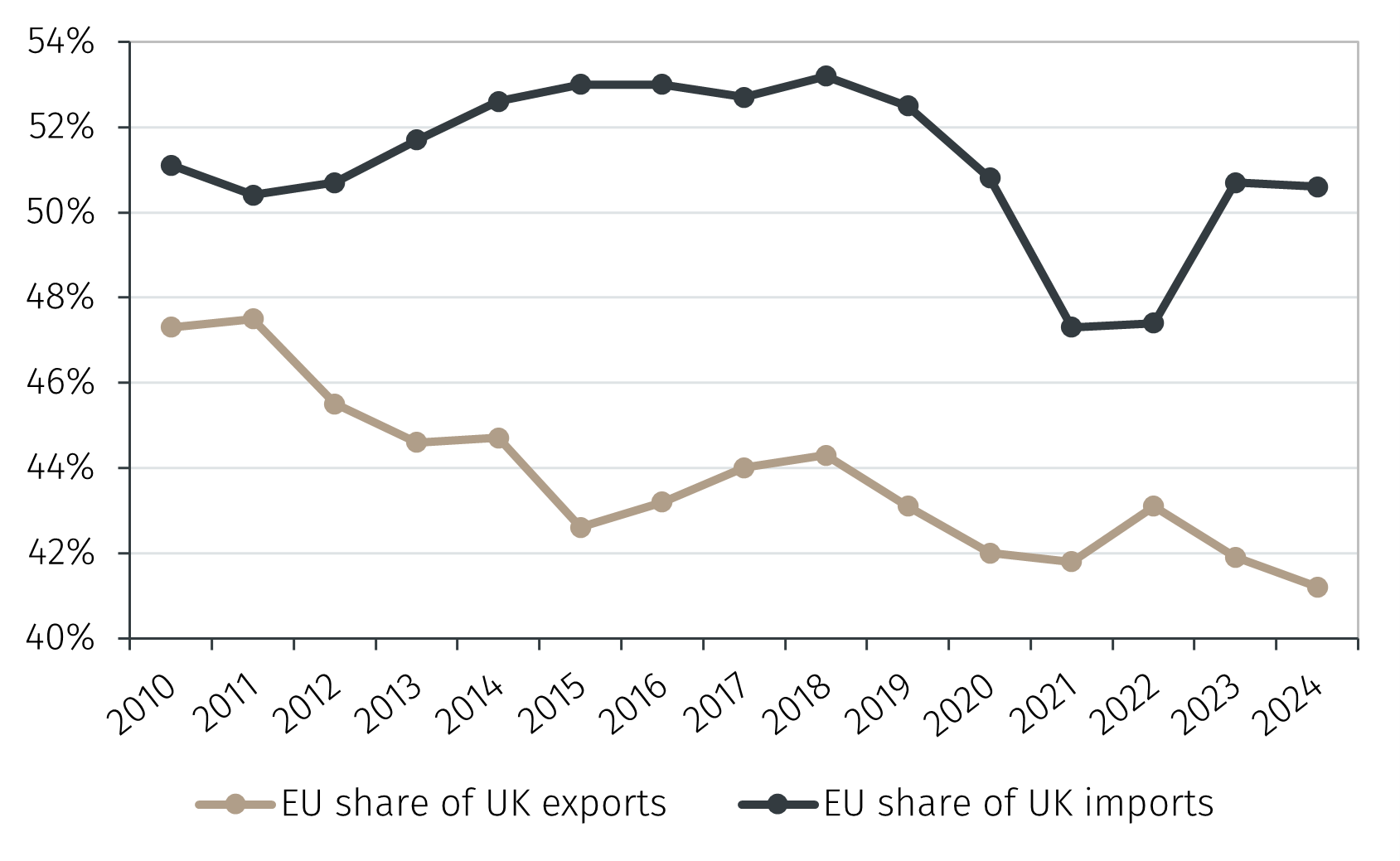
The agreement reduces checks on agricultural products and food exports, with most border checks on animal and plant products to and from the EU being dropped. The UK’s National Farmers Union (NFU) welcomed these developments, highlighting the benefits for domestic farmers. According to NFU, 68% of UK agri-food exports went to the EU in 2024, and over 70% of the UK’s food imports came from the EU.1 Therefore, the prospect of less border checks and fewer delays at customs could help reduce costs, and transport times for perishable products.
2) Fishing rights
In return, the UK extended the EU’s access to UK fishing waters until 2038. This represents an extension of the current deal, negotiated as part of the 2020 Brexit deal. Back then the UK regained 25% of the EU fishing quotas in return for allowing EU fishing vessels access to UK waters. This agreement was expected to end in 2026. The extension of these conditions for 12 more years creates more certainty and security for EU producers. Despite concerns from political opposition, this is a small concession by the Starmer government given the UK fishing industry is very small, representing only 0.04% of GDP in 2024.2
Furthermore, although fishing conditions do not change for UK or EU vessels, the reduced checks for exports under the new deal will make it easier for UK fishermen to export their products into the EU. According to research from the UK House of Commons, in 2023 around 70% of all UK fish exports went to the EU, worth around £1.2bn.3
3) Defence and security
Additionally, a formal UK-EU defence and security pact was established to help coordinate sanctions, share intelligence and develop a common security policy. Apart from speeding up troop and equipment movements, the agreement is the first step to allow UK defence firms to access the Security Action For Europe (SAFE) fund, which provides up to €150bn in loans for defence investment.
4) Carbon and energy
The UK and EU also agreed to link their carbon markets to avoid firms paying taxes on carbon-intensive goods such as steel and cement. This is expected to represent a saving for UK firms of around £800m in tax payments, protecting firms from EU tariffs. In addition, the agreement will allow the UK to begin negotiations on buying and selling directly into the EU shared electricity market.
5) Youth mobility scheme and e-gates
An agreement was reached to cooperate on a scheme to allow young people to work in Europe for a limited time. The UK currently has similar arrangements with Australia, and smaller economies such as New Zealand and Uruguay, where an annual quota of visas allows people between the age of 18 and 35 years old to work in each other’s countries for up to 3 years. However, headlines have focused on the possibility that UK citizens would be able to use electronic gates at EU customs borders. Despite the largely zero economic impact of this measure, it is expected to reduce waiting times and queues at airports for travellers and should come into effect in October.
Conclusion
Overall, the agreement is a step to strengthen the bilateral relations between the UK and the EU, its largest trading partner. The clear statement that the UK has no intention of restarting the discussions around joining the EU’s customs union represents a shift from the previous ambiguity of past Conservative governments.
Although it seems clear that the Brexit process has created difficulties for the UK related to labour shortages, rising food prices and increased administrative burdens, this agreement aims to reduce some of these and strive towards having a better working relation. For the UK, it also sends the message that the country is open to work with every trading partner to find areas of understanding that can be developed for mutual benefit. After symbolic deals with India, US and the EU, could China be next?