Looking through the noise: Thoughts on the current crisis

All Insights

Currently reading

US and Iran agree a fragile ceasefire while negotiations start

Investment Insights • Macro

8 min read

US and Iran agree a fragile ceasefire while negotiations start

On Tuesday 7 April the US and Iran announced an agreement for a two-week ceasefire that would open the Strait of Hormuz (SoH). This has been the first diplomatic breakthrough since the conflict started in late February. The news came just before the deadline set by the US President for Iran to reopen the strait, following threats of strong military actions against Iran’s power plants and bridges.

Iranian authorities have submitted a 10-point plan, which was labelled by Trump as a “workable basis” for negotiations that are due to start on 11 April. Iran has confirmed that it will allow a safe passage through the SoH while negotiations for a more permanent deal are ongoing. As part of this 10-point plan, Iran aims to maintain control over traffic through the SoH and has demanded that economic sanctions be lifted together with complete cessation of attacks in Iran, Iraq, Lebanon and Yemen.

One key component of the plan is Iran’s commitment not to seek possession of any nuclear weapons. However, there was no explicit mention to Uranium enrichment plans.

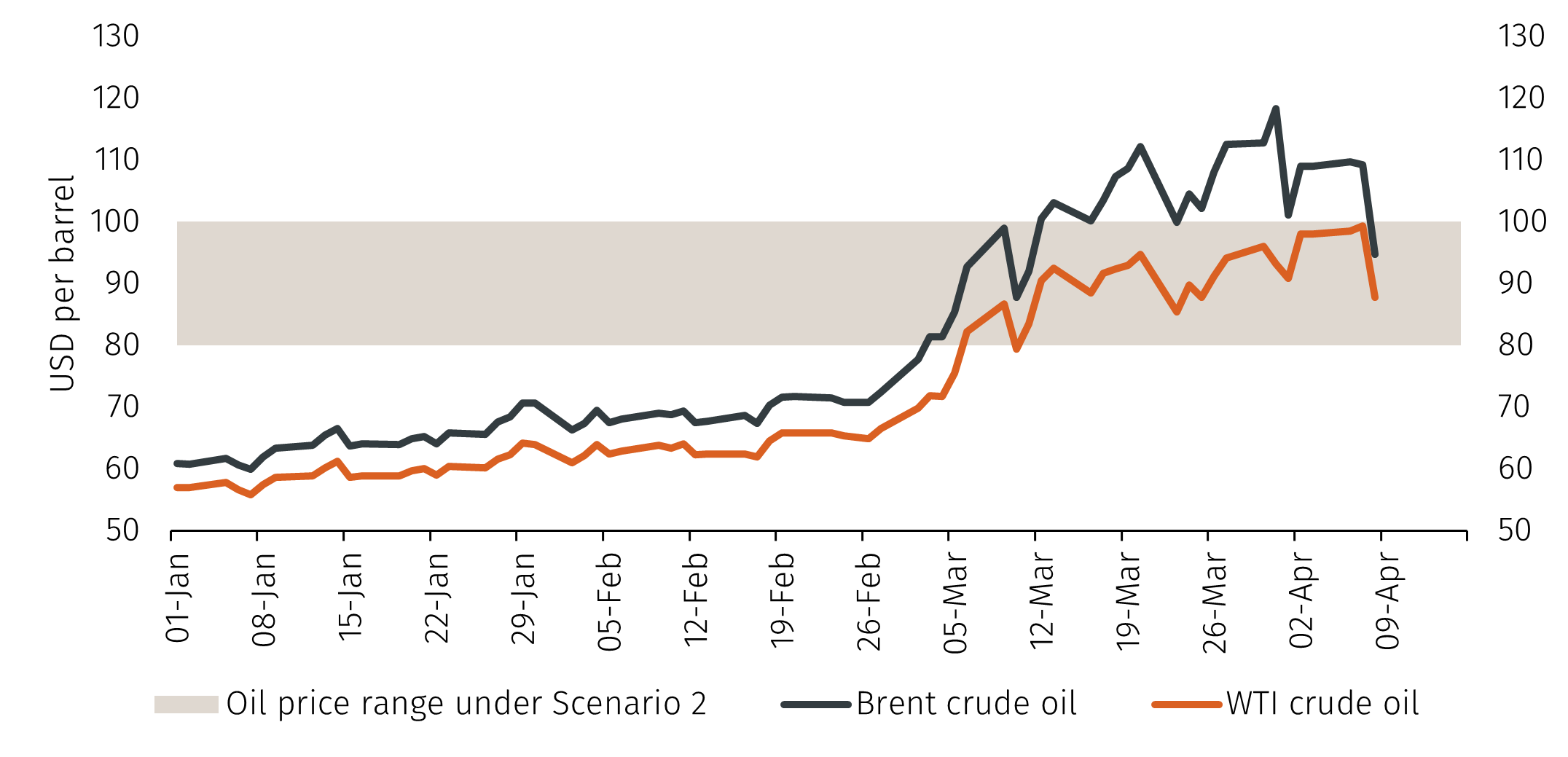
The news was positively received by markets, prompting a decline of over 13% in the oil price. On Wednesday morning, Brent crude oil was trading at $94.7 per barrel, while the equivalent West Texas Intermediate crude oil traded at $87.5 per barrel. Stocks in Europe and Asia were up by over 3% at the market open, while gold price rallied by 2.3% to $4,812 an ounce.

Crude oil price – June 2026 settlement price (USD per barrel)

Ceasefire1.png

Source: LSEG Data & Analytics and EFG. Data as of 9 April 2026. Past performance is not indicative of future results.

However, the situation remains delicate, with news of attacks in Kuwait, UAE and Qatar hours after the ceasefire announcement. Despite Israel welcoming the ceasefire news, authorities stated it does not apply to Lebanon where they continue to carry out military operations. This could jeopardise the ceasefire and delay the reopening of the strait. 

The negotiations are scheduled to start in Islamabad, Pakistan on Saturday 11 April, with the talks being led on the US side by US Vice President JD Vance, Jared Kushner and Steve Witkoff. The rumour is that China has been actively involved and has been supporting the Pakistanis to mediate. This provides further credibility behind the initiatives. 

As a result of this news we are updating our Scenario Analysis, increasing the probability of Scenario 2 to 70%.

Middle East War – Scenario Probability Analysis (as at 09 April 2026)

Scenario 1 (20%) Scenario 2 (70%) Scenario 3 (10%)

Iran

Ceasefire talks fail and the new leadership doubles down with an aggressive approach to attacking US and Israeli assets. Other countries in the region become increasingly and reluctantly dragged into the conflict. The US puts troops on the ground, and the situation escalates. The Iranian regime successfully forces the war to drag on for at least several more months and possibly into year end. The Strait of Hormuz becomes militarised, acting as an ongoing deterrent to seaborne energy transportation, resulting in a prolonged increase in energy prices.

The US and Iran finally agree to a tentative cease-fire and the next two weeks sees a series of meetings, public arguments, rumours, and possibly the odd missile strike via proxies. Tankers and freights do start to move through the SoH with a co-ordinated supervision agreement for ships to transverse through the Strait. Fees to be paid for re-construction of Iran does become a bargaining chip longer term. Trump may not oppose this, but it certainly would become an issue for the other GCC countries. The Iranian leadership maintains the same philosophy as the prior regime but de-emphasises its short term nuclear and military ambitions, focussing instead on stabilising the domestic situation. The threat to US and Israeli assets - including via terrorist actions around the world – subsides but does not disappear. Trump claims victory although the situation remains highly fragile. Iran may rebuild its military capabilities over the longer term.

The new Iranian leadership adopts a much more conciliatory approach resulting in swift and successful ceasefire and disarmament negotiations. Within a few months a new nuclear deal is announced, and an agreement is reached to curtail Iran's ballistic missile program. The Israelis, although un-happy with the deal, step back driven by a large deterioration in popularity for the Israeli administration in the US according to the latest polls.

Political backdrop

Trump does not want an extended war. The longer the war goes on, the more problematic it is for the US given opinion polls and forecast mid-term performance. Trump's popularity even amongst his traditional “MAGA” base is on a downtrend due to Epstein, high and rising costs of living (energy prices), tariffs, and other initiatives driven by the White House. The Trump-Xi summit is now scheduled for 14 May and it is in Trump's interests to reach some sort of ceasefire/deal by then. However, this is not guaranteed.

Trump does not want an extended war. The longer the war goes on, the more problematic it is for the US given opinion polls and forecast mid-term performance. Trump's popularity even amongst his traditional “MAGA” base is on a downtrend due to Epstein, high and rising costs of living (energy prices), tariffs, and other initiatives driven by the White House. The Trump-Xi summit is now scheduled for 14 May and it is in Trump's interests to reach some sort of ceasefire/deal by then. However, this is not guaranteed.

Trump does not want an extended war. The longer the war goes on, the more problematic it is for the US given opinion polls and forecast mid-term performance. Trump's popularity even amongst his traditional “MAGA” base is on a downtrend due to Epstein, high and rising costs of living (energy prices), tariffs, and other initiatives driven by the White House. The Trump-Xi summit is now scheduled for 14 May and it is in Trump's interests to reach some sort of ceasefire/deal by then. However, this is not guaranteed.

Financial markets

The impact of the war is extended, due largely to the persistence of upward pressure on energy prices and the feed through to inflation / inflation expectations. There is a large equity market correction of 10-20% as markets reprice for higher oil and gas prices and the expectation of higher rates and rising bond yields. Risk premia generally move higher. Credit spreads - including emerging markets - widen and remain elevated for the next few months.

The market remains range-bound from the previous peak to down 10%. Investors take time to assess the consequences and what it means for asset prices. Once that assessment has been made and the likely future paths of the global economy, rates and earnings become clearer, calmness and order returns. There is mild credit spread widening from the lows at the end of February, but that’s the extent of it. Other factors, such as earnings, rate expectations, tariffs and the meeting with Trump and Xi will determine whether markets go to new highs.

Markets breathe a sigh of relief and a rally in risk assets continues. Equity markets rebound and reach new 52-week highs led by cyclicals. Credit spreads tighten back to levels seen in Q4 2025.

Oil price

The bulk of the move in the oil price has already taken place but over time the cost of a barrel of Brent continues to move higher, eventually reaching $140pb and staying elevated for some time. Gas prices follow a similar path, something that is more problematic for Europe than for the US.

Energy prices initially remain elevated, with the oil price levelling off in the range $80 - $100 per barrel. As the war concludes and traffic starts to move once again through the SoH oil prices recede but remain a little higher than before the war due to an elevated risk premia.

There is a more immediate and profound decline in the oil price of 25% due to the positive news flow and increased OPEC+ supply, however a small risk premium remains as countries from all around the world build strategic reserves. Renewables become an even greater focus which sows the seeds for an oil price below $50 per barrel.

Precious metals/FX

Gold stays within the range of $5,000/oz to $5,500/oz. The CHF stays stronger against the EUR and GBP but is weaker against the USD. In this scenario the USD remains the strongest currency.

Gold stays in the current range ($4,000 - $5,000/oz), driven by demand disruption vs geopolitical action. We expect the USD to remain rangebound against the majors and on a trade weighted basis.

The gold price trades in the middle end of the range at around $4,500/oz, as lower rates are offset by the diminished geo-political risks. The USD resumes its downtrend; however, the CHF is weaker against the GBP and EUR. 

Iran
  • Scenario 1 (20%)

    Ceasefire talks fail and the new leadership doubles down with an aggressive approach to attacking US and Israeli assets. Other countries in the region become increasingly and reluctantly dragged into the conflict. The US puts troops on the ground, and the situation escalates. The Iranian regime successfully forces the war to drag on for at least several more months and possibly into year end. The Strait of Hormuz becomes militarised, acting as an ongoing deterrent to seaborne energy transportation, resulting in a prolonged increase in energy prices.

  • Scenario 2 (70%)

    The US and Iran finally agree to a tentative cease-fire and the next two weeks sees a series of meetings, public arguments, rumours, and possibly the odd missile strike via proxies. Tankers and freights do start to move through the SoH with a co-ordinated supervision agreement for ships to transverse through the Strait. Fees to be paid for re-construction of Iran does become a bargaining chip longer term. Trump may not oppose this, but it certainly would become an issue for the other GCC countries. The Iranian leadership maintains the same philosophy as the prior regime but de-emphasises its short term nuclear and military ambitions, focussing instead on stabilising the domestic situation. The threat to US and Israeli assets - including via terrorist actions around the world – subsides but does not disappear. Trump claims victory although the situation remains highly fragile. Iran may rebuild its military capabilities over the longer term.

  • Scenario 3 (10%)

    The new Iranian leadership adopts a much more conciliatory approach resulting in swift and successful ceasefire and disarmament negotiations. Within a few months a new nuclear deal is announced, and an agreement is reached to curtail Iran's ballistic missile program. The Israelis, although un-happy with the deal, step back driven by a large deterioration in popularity for the Israeli administration in the US according to the latest polls.

Political backdrop
  • Scenario 1 (20%)

    Trump does not want an extended war. The longer the war goes on, the more problematic it is for the US given opinion polls and forecast mid-term performance. Trump's popularity even amongst his traditional “MAGA” base is on a downtrend due to Epstein, high and rising costs of living (energy prices), tariffs, and other initiatives driven by the White House. The Trump-Xi summit is now scheduled for 14 May and it is in Trump's interests to reach some sort of ceasefire/deal by then. However, this is not guaranteed.

  • Scenario 2 (70%)

    Trump does not want an extended war. The longer the war goes on, the more problematic it is for the US given opinion polls and forecast mid-term performance. Trump's popularity even amongst his traditional “MAGA” base is on a downtrend due to Epstein, high and rising costs of living (energy prices), tariffs, and other initiatives driven by the White House. The Trump-Xi summit is now scheduled for 14 May and it is in Trump's interests to reach some sort of ceasefire/deal by then. However, this is not guaranteed.

  • Scenario 3 (10%)

    Trump does not want an extended war. The longer the war goes on, the more problematic it is for the US given opinion polls and forecast mid-term performance. Trump's popularity even amongst his traditional “MAGA” base is on a downtrend due to Epstein, high and rising costs of living (energy prices), tariffs, and other initiatives driven by the White House. The Trump-Xi summit is now scheduled for 14 May and it is in Trump's interests to reach some sort of ceasefire/deal by then. However, this is not guaranteed.

Financial markets
  • Scenario 1 (20%)

    The impact of the war is extended, due largely to the persistence of upward pressure on energy prices and the feed through to inflation / inflation expectations. There is a large equity market correction of 10-20% as markets reprice for higher oil and gas prices and the expectation of higher rates and rising bond yields. Risk premia generally move higher. Credit spreads - including emerging markets - widen and remain elevated for the next few months.

  • Scenario 2 (70%)

    The market remains range-bound from the previous peak to down 10%. Investors take time to assess the consequences and what it means for asset prices. Once that assessment has been made and the likely future paths of the global economy, rates and earnings become clearer, calmness and order returns. There is mild credit spread widening from the lows at the end of February, but that’s the extent of it. Other factors, such as earnings, rate expectations, tariffs and the meeting with Trump and Xi will determine whether markets go to new highs.

  • Scenario 3 (10%)

    Markets breathe a sigh of relief and a rally in risk assets continues. Equity markets rebound and reach new 52-week highs led by cyclicals. Credit spreads tighten back to levels seen in Q4 2025.

Oil price
  • Scenario 1 (20%)

    The bulk of the move in the oil price has already taken place but over time the cost of a barrel of Brent continues to move higher, eventually reaching $140pb and staying elevated for some time. Gas prices follow a similar path, something that is more problematic for Europe than for the US.

  • Scenario 2 (70%)

    Energy prices initially remain elevated, with the oil price levelling off in the range $80 - $100 per barrel. As the war concludes and traffic starts to move once again through the SoH oil prices recede but remain a little higher than before the war due to an elevated risk premia.

  • Scenario 3 (10%)

    There is a more immediate and profound decline in the oil price of 25% due to the positive news flow and increased OPEC+ supply, however a small risk premium remains as countries from all around the world build strategic reserves. Renewables become an even greater focus which sows the seeds for an oil price below $50 per barrel.

Precious metals/FX
  • Scenario 1 (20%)

    Gold stays within the range of $5,000/oz to $5,500/oz. The CHF stays stronger against the EUR and GBP but is weaker against the USD. In this scenario the USD remains the strongest currency.

  • Scenario 2 (70%)

    Gold stays in the current range ($4,000 - $5,000/oz), driven by demand disruption vs geopolitical action. We expect the USD to remain rangebound against the majors and on a trade weighted basis.

  • Scenario 3 (10%)

    The gold price trades in the middle end of the range at around $4,500/oz, as lower rates are offset by the diminished geo-political risks. The USD resumes its downtrend; however, the CHF is weaker against the GBP and EUR. 

Source: EFG. Based on EFG’s analysis, as at the date of this document. The information contained in the above Scenario Analysis is not intended to predict actual results, which may differ substantially from those reflected in the information, nor is it intended to be a complete analysis of every material fact. Hypothetical performance analysis (including all scenario analyses contained herein) are based on certain assumptions with respect to significant factors that might not reflect what actually might happen. You should understand these assumptions and evaluate whether they are appropriate for their purposes.

必填

必填

必填

必填

必填

必填

必填

Please note you can manage your subscriptions by visiting the Preferences link in the emails you receive from us.

必填