No need for negative SNB rates

All Insights

Currently reading

Takaichi’s gambit

Investment Insights • Macro

2 min read

Takaichi’s gambit

Japan’s second general election in as many years has potentially significant policy and market implications. In this Macro Flash Note, Economist Sam Jochim assesses Prime Minister Sanae Takaichi’s motivations for calling the election and discusses the implications.

Sanae Takaichi’s decision to call a snap election for 8 February, less than four months after she became Japan’s first female Prime Minister, is undoubtedly a large gamble. Yet it also represents a carefully calculated risk and is underpinned by clear motivations. 

Takaichi aims to improve on the Liberal Democratic Party’s (LDP) majority in Japan’s lower house. The LDP currently governs with the support of the Japan Innovation Party (JIP), after its coalition partner, Komeito, exited a thirteen-year long partnership following Takaichi’s election and a subsequent disagreement on the future direction of policy. 

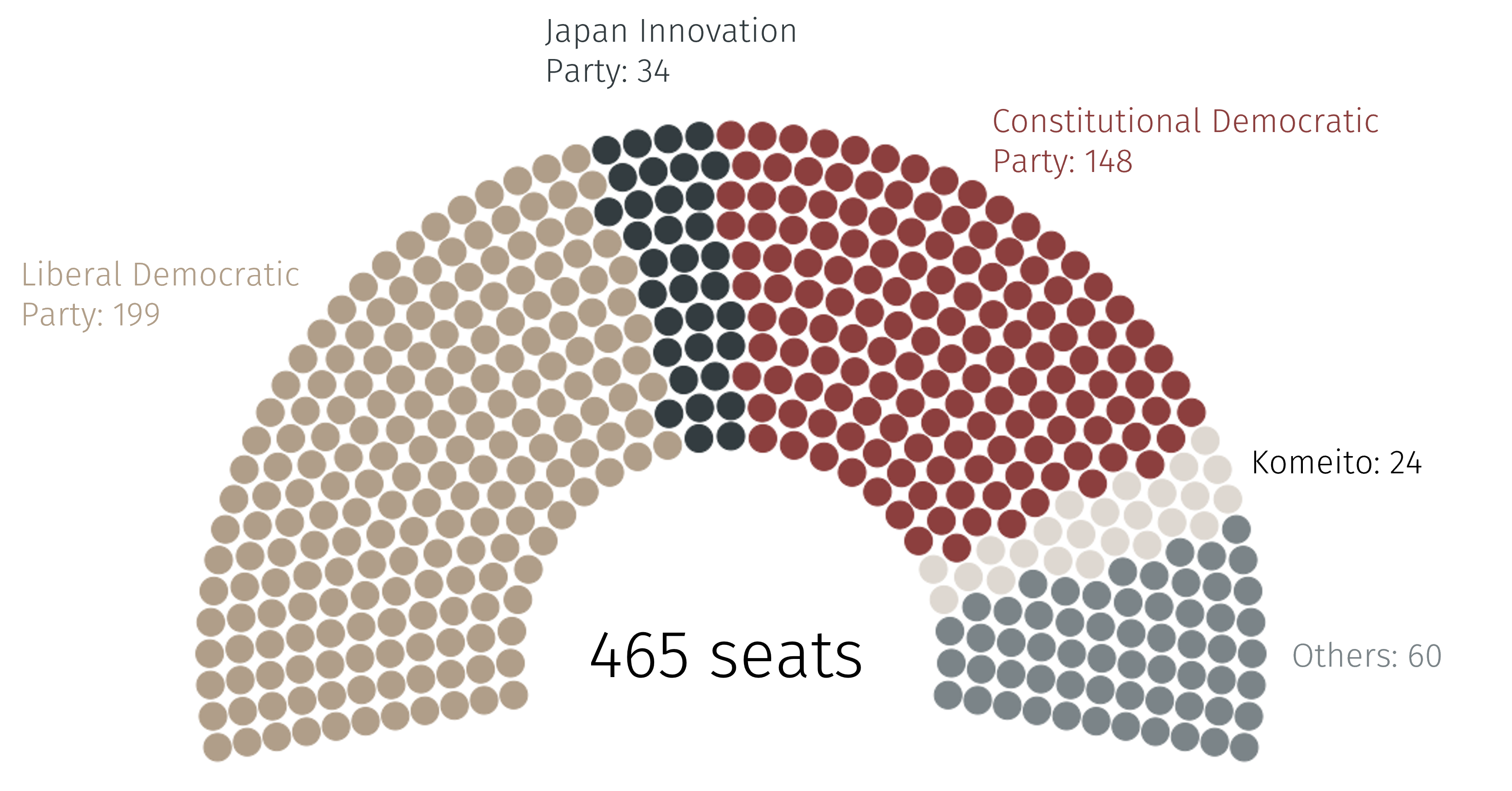
Together, the LDP and JIP have a one-seat majority in the lower house of the National Diet (see Chart 1). Were this position to be improved upon in February’s snap election, it would give Takaichi a clear mandate to govern with a more expansive fiscal policy. That would be quite a remarkable feat when one considers that a record-high draft budget has already been approved for the fiscal year starting in April.1 In some respects, the election can be framed as a referendum on whether Japan’s population wants to return to Abenomics with fiscal expansion at the forefront as the main driver of growth.

Chart 1. Japan’s lower house composition

Japan1.png

Source: Japan House of Representatives and EFG calculations. Data as at 26 January 2026.
 

Timing is everything
There is also an important timing piece to this election. Takaichi made comments in November which implied Japan would be willing to intervene using military force if China decided to invade Taiwan. This irked China, which responded by encouraging its residents not to visit Japan and imposing export restrictions on dual-use goods. 

China was the top source of tourism for Japan in 2025.2 Yet in December, following Takaichi’s comments, the number of tourists from China fell by almost a half from the same month a year earlier.3 Of greater concern to Takaichi will be the imposition of restrictions on exports of dual-use goods. These goods include rare earths, an area in which China dominates the global supply chain.4 

Takaichi is currently experiencing extremely high approval ratings.5 There is no doubt that she is seeking to capitalise on nationalist sentiment before any economic impact from escalating tensions with China is felt by Japan’s electorate.

Land of the rising sun
Takaichi has vowed to make Japan a “land of the rising sun” again. Her rhetoric often adopts elements that could easily find themselves in Trump’s “Make America Great Again” playbook. This is no accident. Fostering the US-Japan relationship is of the utmost importance to Takaichi. Despite having declared a new golden age for the alliance in late 2025, Japan’s Prime minister remains well aware of the need to keep Trump onside and avoid being caught in his crosshairs.

Recent events regarding Greenland make Takaichi’s nomination of Trump for the Nobel Peace Prize look like a masterstroke and the absence of Bank of Japan (BoJ) Governor Kazuo Ueda from the international central bankers’ statement in support of Fed Chair Jerome Powell should not be viewed as purely coincidental. Japan is carefully curating its relationship with the US and image plays a key role in doing so. When Takaichi visits the White House in March, she will be hoping to do so as a leader who carried her party to a large election victory and has a strong mandate to govern.

Election implications
The market implications of a strong LDP election victory could be meaningful. Such a scenario could reignite the “Takaichi trade” given expectations of more expansive fiscal policy, leading to a rally for Japanese equities spurred on by stronger growth expectations and a sell off for Japanese government bonds and the Japanese yen amid fiscal sustainability concerns. 

Sustained yen weakness beyond what fundamentals warrant could pull forward the next BoJ interest rate increase. While the BoJ was on hold at its meeting on 23 January, there were many signals that provided a hawkish tilt. Notably, one Policy Board member dissented and voted in favour of raising rates from 0.75% to 1.00%, and the growth and inflation forecasts for the fiscal year starting in April were raised (see Chart 2).6


Before January’s meeting, markets were pricing in the next rate increase at the June Policy Board meeting, but the April meeting is now viewed as the most likely candidate for the next rate hike. While Takaichi has publicly opposed a tighter monetary policy by Japan’s central bank, she would likely support the move given pressure from the Trump administration, which has advocated for a stronger yen.8

However, a strong LDP election victory is by no means a foregone conclusion. Takaichi has positioned the election as a vote on Japan’s leader. She is conscious of the fact she is an extremely popular Prime Minister and has attempted to take the focus away from her party, which is much less popular.9 What’s more, the LDP faces a united opposition following the surprise partnership between the main opposition party, the Constitutional Democratic Party of Japan, and the LDP’s former coalition partner, Komeito. Whether Takaichi’s gambit pays off hinges on if she can convince Japan’s electorate to vote for the leader, and not the party. 

1 https://www.reuters.com/world/asia-pacific/japans-cabinet-approves-record-785-billion-budget-vows-keep-debt-check-2025-12-26/
2 In 2025, China was the top source of tourists for Japan according to data from the National Tourism Organization: https://statistics.jnto.go.jp/en/graph/#graph--breakdown--by--country
3 The number of visits to Japan by Chinese tourists fell by 45% in December compared to the same month a year earlier: https://www.asahi.com/ajw/articles/16299613
4 According to the US Geological Survey and International Energy Agency, China accounts for almost half of the global reserves of rare earths, two-thirds of global production and over 90% of global refining.
5 The Takaichi Cabinets’ approval rating in December 2025 was 75% according to a Nikkei/TV Tokyo survey. This is the highest approval rating since Abe in 2013.
6 https://www.boj.or.jp/en/mopo/outlook/gor2601a.pdf
7 Real GDP is inflation adjusted gross domestic product. Core CPI is the consumer price index excluding fresh food. Core-core CPI is the consumer price index excluding fresh food and energy.
8 https://www.reuters.com/world/asia-pacific/bessent-urges-sound-boj-policy-address-excess-fx-volatility-2026-01-14/
9 The LDP’s approval rating is below 40% according to the same survey that has The Takaichi Cabinets’ approval rating at 75%.

Obligatoire

Obligatoire

Obligatoire

Obligatoire

Obligatoire

Obligatoire

Obligatoire

Please note you can manage your subscriptions by visiting the Preferences link in the emails you receive from us.

Obligatoire