What Pythagoras’ theorem can teach us about the Fed

All Insights

Currently reading

RBA and RBNZ: Inflation Targeting in Action

Investment Insights • Macro

3 min read

RBA and RBNZ: Inflation Targeting in Action

New Zealand pioneered inflation targeting in 1990 and Australia soon followed. In this Macro Flash Note, EFG Chief Economist Stefan Gerlach reviews the monetary policy frameworks in both countries and the outlook for interest rates.

The Reserve Bank of New Zealand (RBNZ) was the first central bank to adopt inflation targeting in 1990, a framework that soon became the global standard. The Reserve Bank of Australia (RBA) introduced its own version a few years later. Since then, both have been seen as leading examples of how small open economies can manage monetary policy in a world of volatile trade, commodity prices, and capital flows.

This note reviews how the two banks have operated in recent years. Their mandates and institutional settings share many features, but the shocks of the past few years - Covid, surging inflation, and tight labour markets - produced different responses. Understanding those differences sheds light on how central banks balance inflation control with support for growth, and what that means for policy in the months ahead.
Mandates and institutions

Monetary policy reflects a mix of economic conditions, institutional design, and historical experience. The RBA was created in 1960, taking over central banking functions from the Commonwealth Bank, which had been founded in 1911. The RBNZ was established earlier, in 1934, in response to the Great Depression.

Their objectives are broadly similar. The RBA seeks to keep inflation between 2% and 3% over time while supporting full employment. The RBNZ aims for 1% to 3% inflation with a focus on the 2% midpoint, while also considering financial stability and avoiding unnecessary swings in output, employment, interest rates, or the exchange rate.

Decision-making structures combine internal expertise with external perspectives. The RBA’s Monetary Policy Board has nine members: the Governor, Deputy Governor, Secretary to the Treasury, and six external appointees of the Treasurer. The RBNZ’s Monetary Policy Committee has six members, split evenly between internal officials and external experts, all appointed by the Minister of Finance.

Both banks meet regularly - eight times a year in Australia, seven in New Zealand - and operate mainly through short-term interest rates. The RBA sets the overnight cash rate, while the RBNZ sets the Official Cash Rate, which directly influences the interest paid on deposits and loans with the central bank. After each meeting, the RBA publishes a short statement; the RBNZ issues a fuller Monetary Policy Statement four times a year.

Economic developments

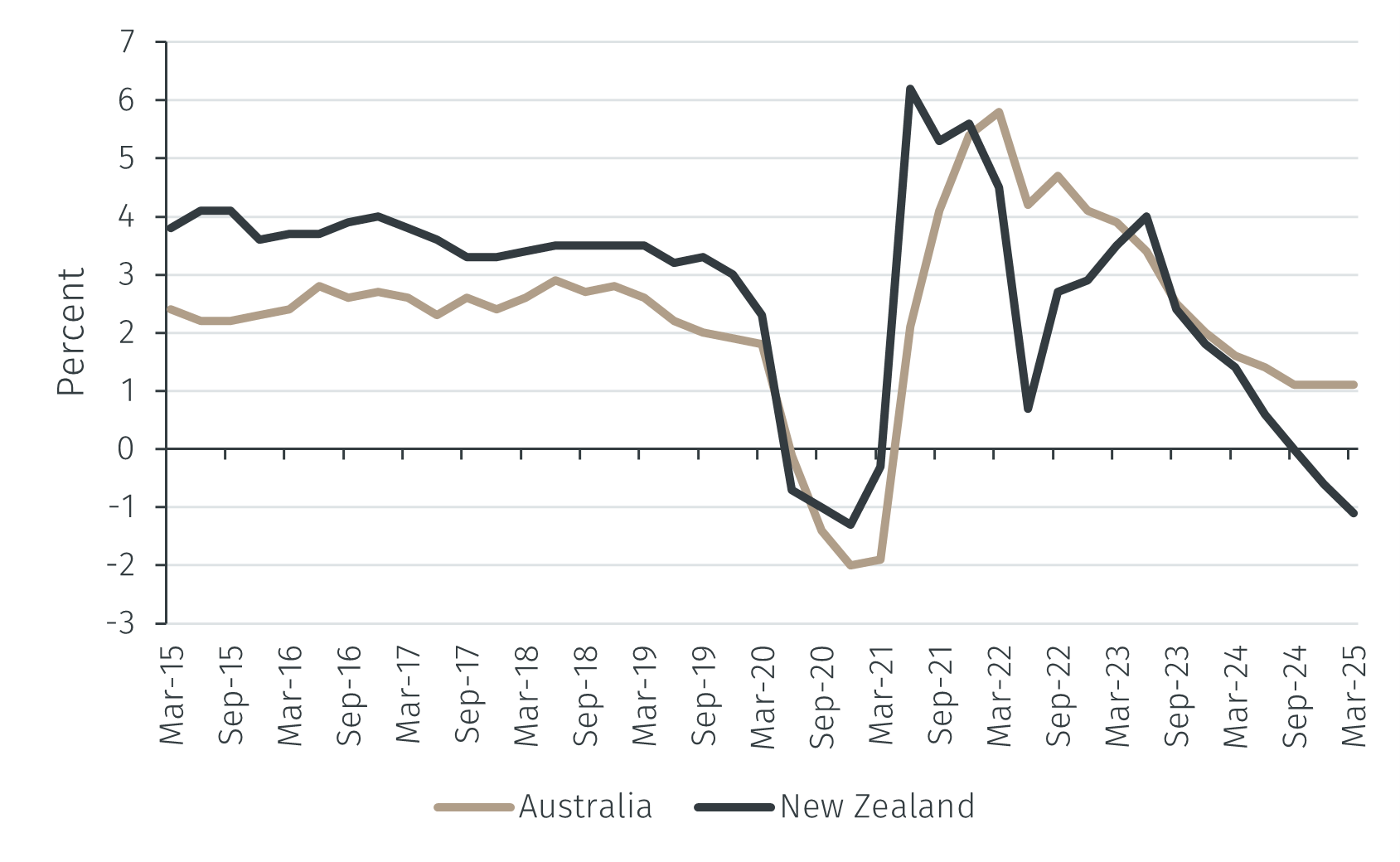
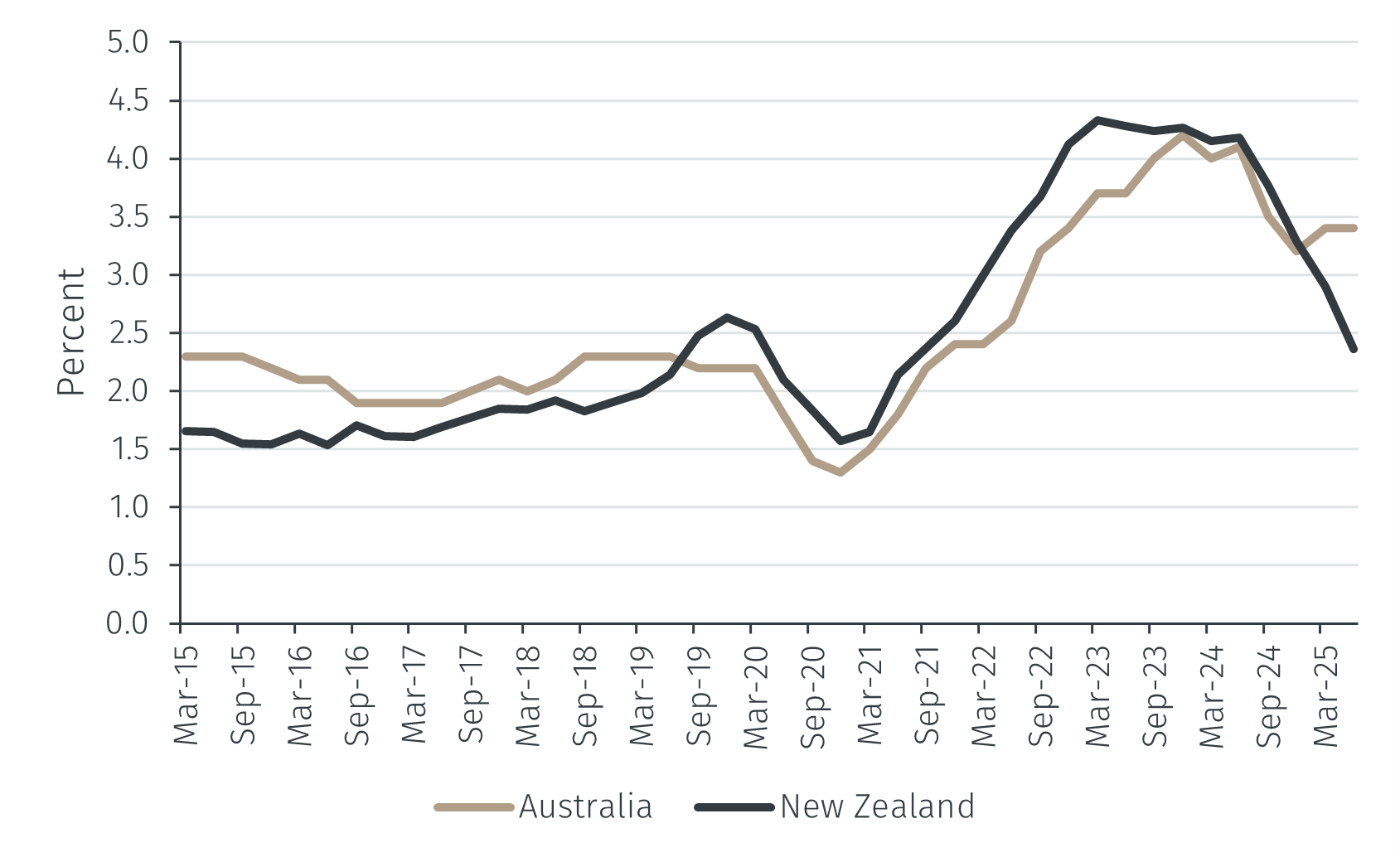
Both central banks eased monetary policy aggressively during the Covid crisis, then tightened it sharply when inflation surged to levels not seen in decades. Inflation peaked earlier in New Zealand, in mid-2022, while in Australia it peaked later that year.

Chart 1. Consumer price index inflation

AuNZ1.png

Source: Australian Bureau of Statistics and StatNZ. Data as of 26 August 2025.

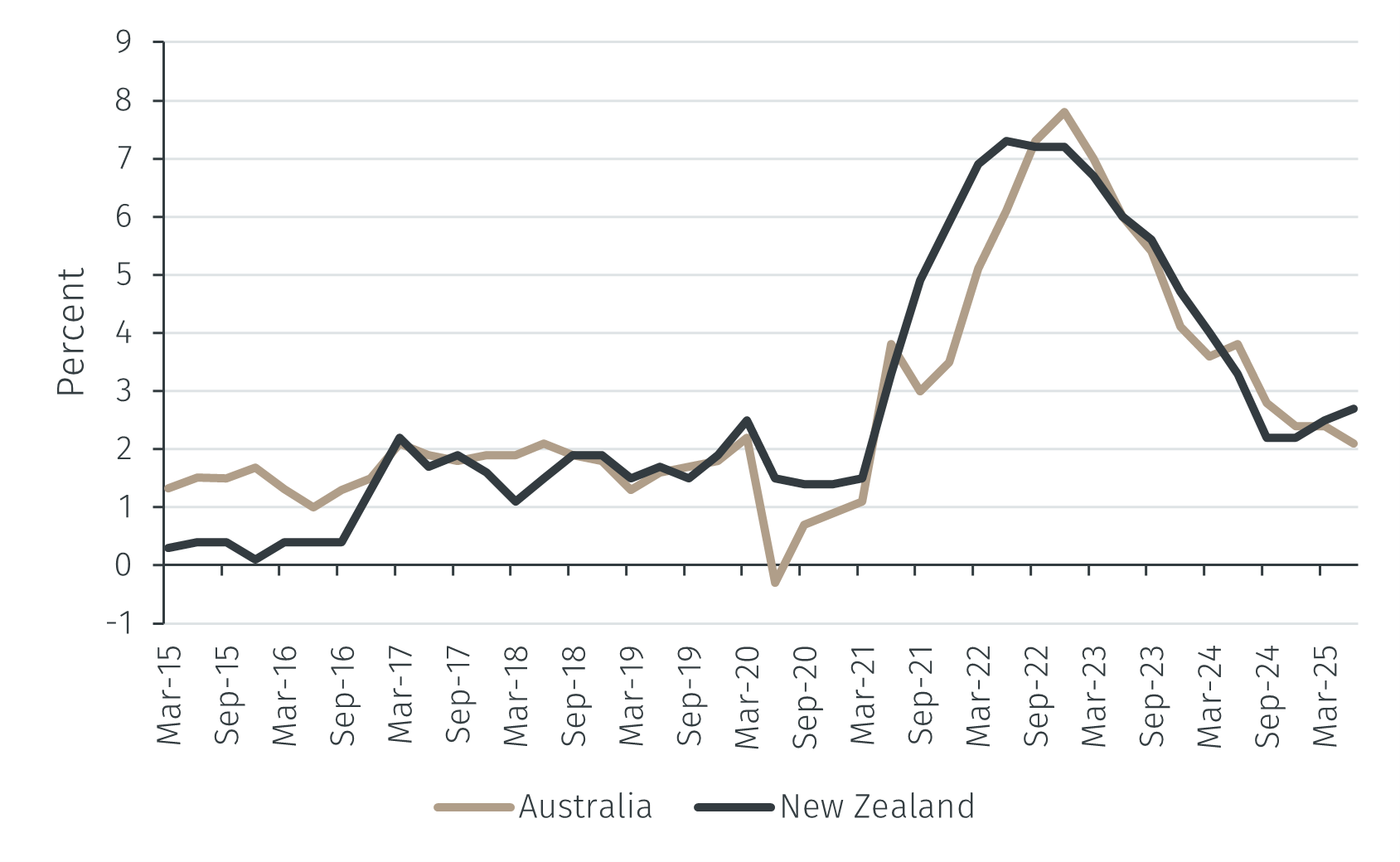
Labour markets also tightened strongly. Unemployment fell to multi-decade lows in both countries, but wages diverged. In New Zealand, wage growth accelerated earlier and more strongly, while inflation expectations deteriorated more quickly. This prompted the RBNZ to raise rates sooner and more forcefully. In Australia, wage growth picked up later and remained more subdued, allowing the RBA to move more gradually.

Chart 2. Wage growth

AuNZ2.png

Source: Australian Bureau of Statistics. Data as of 26 August 2025.

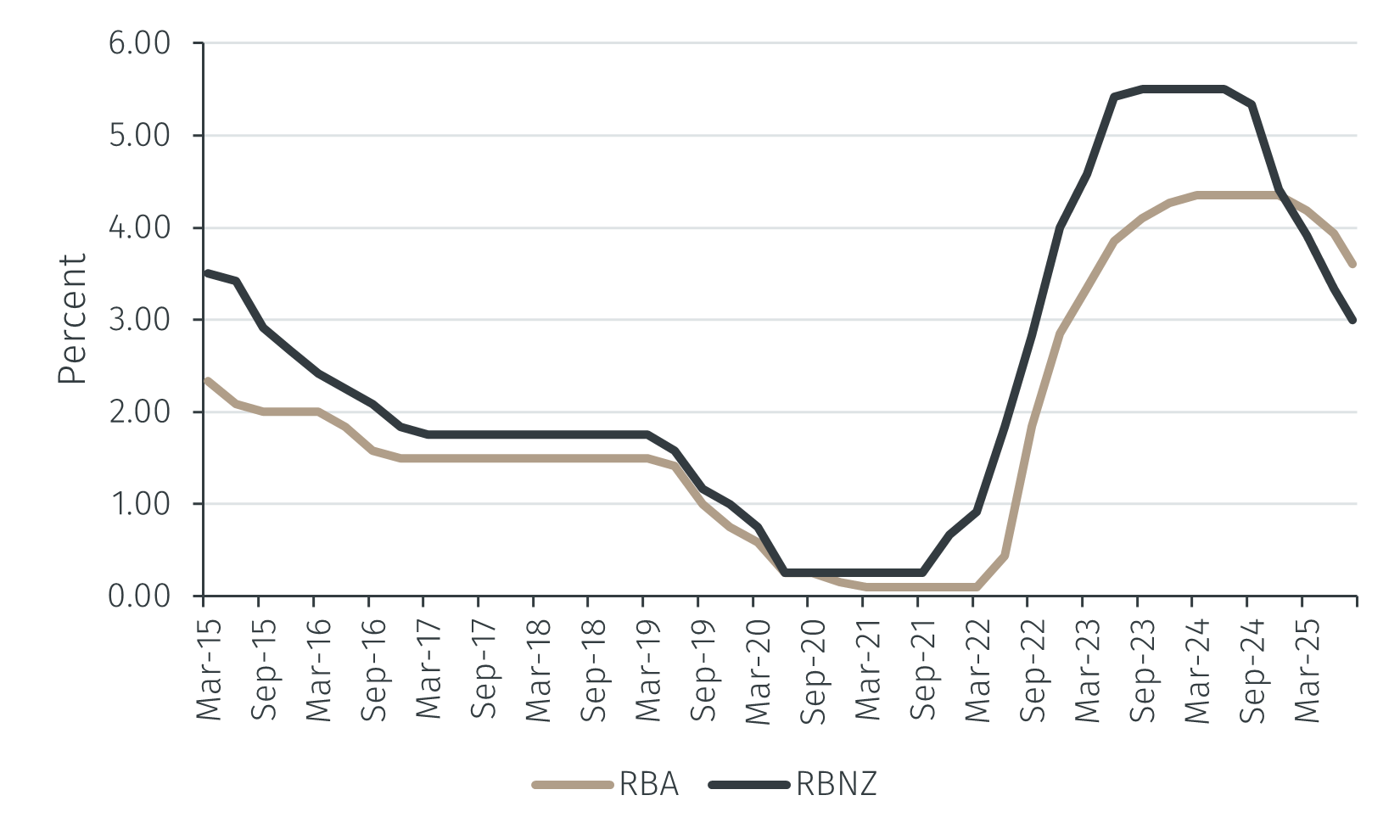
The difference is clear in policy rates. The RBNZ began tightening first and lifted rates to 5.5% by the third quarter of 2023. The RBA increased rates more slowly, with the overnight cash rate peaking just above 4% by the second quarter of 2024. As a result, the New Zealand economy slowed more sharply, with weaker GDP growth and a higher unemployment rate than in Australia.

Chart 3. Policy rates

AuNZ3.png

Note: The last data point is August 2025. Source: BIS. Data as of 26 August 2025.

Chart 4. Real GDP growth

AuNZ4.png

Source: RBNZ. Data as of 26 August 2025.

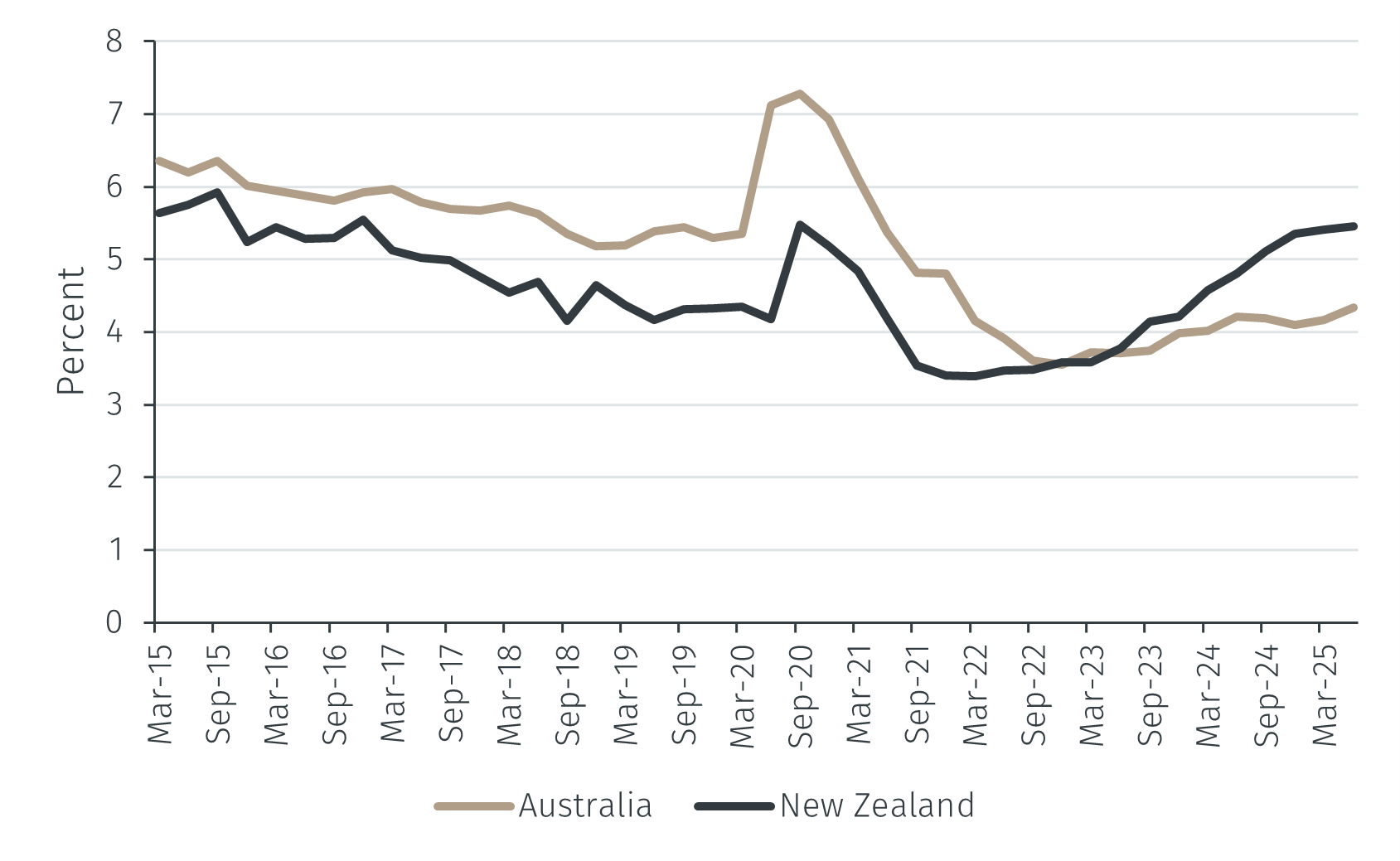
Chart 5. Unemployment rate

AuNZ5.png

Source: FRED. Data as of 26 August 2025.

Conclusions

By mid-2025, inflation in both countries had declined but had not fully reached target. In Australia, inflation was 2.1% in the second quarter, while the July monthly figure rose to 2.8%. The RBA is unlikely to attach much significance to the monthly data and will focus on third quarter outcomes to judge whether price pressures are easing.

In New Zealand, inflation was 2.7% in the second quarter, close to the top of the RBNZ’s 1-3% band, with domestic cost pressures still evident. Both banks therefore face a similar dilemma: policy is already restrictive, growth is slowing, but inflation risks have not fully receded.

Looking ahead, both central banks are likely to cut rates, though for different reasons. In Australia, further reductions depend on clear evidence that inflation pressures are subsiding, with second quarter data pivotal. On 12 August, the RBA lowered the cash rate to 3.6%, and market pricing suggests investors expect one additional cut before year-end.

In New Zealand, policy easing has already begun. On 20 August, the RBNZ reduced the Official Cash Rate to 3% and explained its decision in terms of both the stalling recovery and the expectation that inflation will decline towards target. It added that, if inflation continues to ease as anticipated, monetary policy could be adjusted further.

Obligatoire

Obligatoire

Obligatoire

Obligatoire

Obligatoire

Obligatoire

Obligatoire

Please note you can manage your subscriptions by visiting the Preferences link in the emails you receive from us.

Obligatoire